Roulette Odd / Even Bet
A roulette odd/even bet covers eighteen odd or eighteen even numbers from 1 to 36. Zero is not included in either bet.
Pays 1:1, probabilitymathProbabilityA measure of how likely an event is, from zero to one. Percentages express the same scale from 0% to 100%.Read full definition → 48.65%. Identical odds to red/black.
Placement
The “Even” and “Odd” boxes in the outside row, between the dozensbetDozenA bet on 1–12, 13–24 or 25–36, ordinarily paying 2 to 1.Read full definition → and the color diamonds; pair and impair on a French layoutequipmentLayoutThe marked betting surface, whether printed on a table or displayed on a screen.Read full definition →. Each must meet the table minimum.
Is zero odd or even in roulette?
ZerowheelZeroThe 0 outcome, conventionally shown in green. Ordinary color, parity, high/low, dozen and column bets do not include it.Read full definition → is even in arithmetic (it is divisible by two) and loses for both odd and even bets at the roulette table. The layout settles the question by not listing zero in either box. Beginners sometimes argue the point; dealers have heard it before.
| $10 × 100 spins | odd |
|---|---|
| probability per spin | 48.65% |
| expected wins in 100 spins | 48.6 |
| expected result | −$27.03 |
| standard deviation | $100 |
| p(no win in 100 spins) | 0.000000% |
Odd/even versus red/black
Mathematically identical: 18 numbers, 1 to 1, 48.65%. The two pairs of bets differ only in which eighteen numbers they cover, so a combination like “redbetRedAn even-money wager on the 18 red numbers. French: rouge.Read full definition → and even” covers 28 numbers with a double hit on the eight numbers that are both red and even (12, 14, 16, 18, 30, 32, 34, 36). The Bet Builder computes any such overlap.
Colors of odd and even numbers in roulette
Odd and red are not the same eighteen numbers. Ten of the odd numbers are red and eight are blackbetBlackAn even-money bet on the 18 black numbers. French: noir.Read full definition →: red 1, 3, 5, 7, 9, 19, 21, 23, 25 and 27; black 11, 13, 15, 17, 29, 31, 33 and 35. The even numbers split the other way, eight red and ten black. So red plus odd covers 26 numbers, ten of them twice, where red plus even covers 28.
Roulette odd/even payout and expectation
Fair odds against 18 in 37 are 1.056 to 1; the table pays 1. Over 37 spins at $10, a bet on even has expected counts of 18 wins (+$180), 18 odd-number losses (−$180) and one zero loss (−$10): −$10 on $370 staked, 2.70%. On a double-zero wheel there are two zeros to lose to, and the cost is $20 on $380, 5.26%.
On the wheel
Odd and even pocketsequipmentPocketA compartment on the rotor in which the ball can settle. The number of pockets depends on the wheel.Read full definition → are spread around the wheel; particular arcs can contain unequal counts of each. The odd/even bet is defined by number parity, not by a contiguous wheel sectorwheelSectorA continuous arc of neighboring pockets around the wheel, rather than a group defined by the betting layout.Read full definition →.
French rules
With la partageruleLa partageA rule returning half of a qualifying even-money stake when zero lands. On a fair single-zero wheel it gives an edge of 1/74, about 1.35%.Read full definition →, half of an odd or even bet comes back when zero is spun, and the cost falls to 1.35%. With en prisonruleEn prisonA zero rule that holds an even-money stake for possible recovery on a later spin. The details vary by game.Read full definition → the stake is held: a winning resolution returns the stake without profit, while a losing resolution forfeits it. Repeated-zero and withdrawal rules affect the exact edge and duration. Whether zero counts as even never comes up, because the rule treats pair and impair alike.
A worked evening
$5 on odd for 100 spins is $500 staked, and the expected lossmathExpected lossThe probability-weighted average net loss under a stated model. With a constant edge, it equals edge times expected total stakes.Read full definition → is $500 ÷ 37 = $13.51. The usual swing around that figure is about $50, since under independent standard single-zero spins, the standard deviationmathStandard deviationThe square root of variance: a measure of dispersion in the same units as the result.Read full definition → is 5 × √(100 × (1 − 1/37²)), about $50. About two evenings in three end between $64 down and $36 up.
Questions
Odd/even is eligible when the table explicitly offers la partage on these bets. Check the rules rather than relying on the table name.
No mathematical reason. Some players use both to diversify streak exposure, which changes the distribution of results. Under standard rules, expected loss still depends on the combined amount wagered.
Fun with Math
Try these yourself first. Each solution is folded; open it when you are ready.
Consider a hypothetical “low and even” bet on an independent uniform single-zerowheelZeroThe 0 outcome, conventionally shown in green. Ordinary color, parity, high/low, dozen and column bets do not include it.Read full definition → wheel. It pays 1:1 on low even numbers, loses on high odd numbers or zero, and stays in place on all other results. What is its expected lossmathExpected lossThe probability-weighted average net loss under a stated model. With a constant edge, it equals edge times expected total stakes.Read full definition → per occupied spin and per bet eventually settled?
Show the solution
Answer 2.70% per spin, but 5.26% of each bet that was actually settled.
Count the pocketsequipmentPocketA compartment on the rotor in which the ball can settle. The number of pockets depends on the wheel.Read full definition →. Low and even: 2, 4 … 18, nine numbers, win. High and odd: 19, 21 … 35, nine numbers, plus the zero, ten in all, lose. The other eighteen, low and odd or high and even, leave the bet where it is.
Per spin the bet wins 9 times in 37 and loses 10: −1/37, the usual 2.70%. But on 18 spins in 37 nothing happens. Counting only the spins that settle it, the bet loses 1 unitmoneyUnitA base amount used to express stakes or results.Read full definition → in 19, 5.26%, the American price.
On an American wheel, with 00 among the losers, it costs 5.26% per spin and 10% per settled bet. These are different denominators: a spin can leave the bet unresolved.
Comic relief
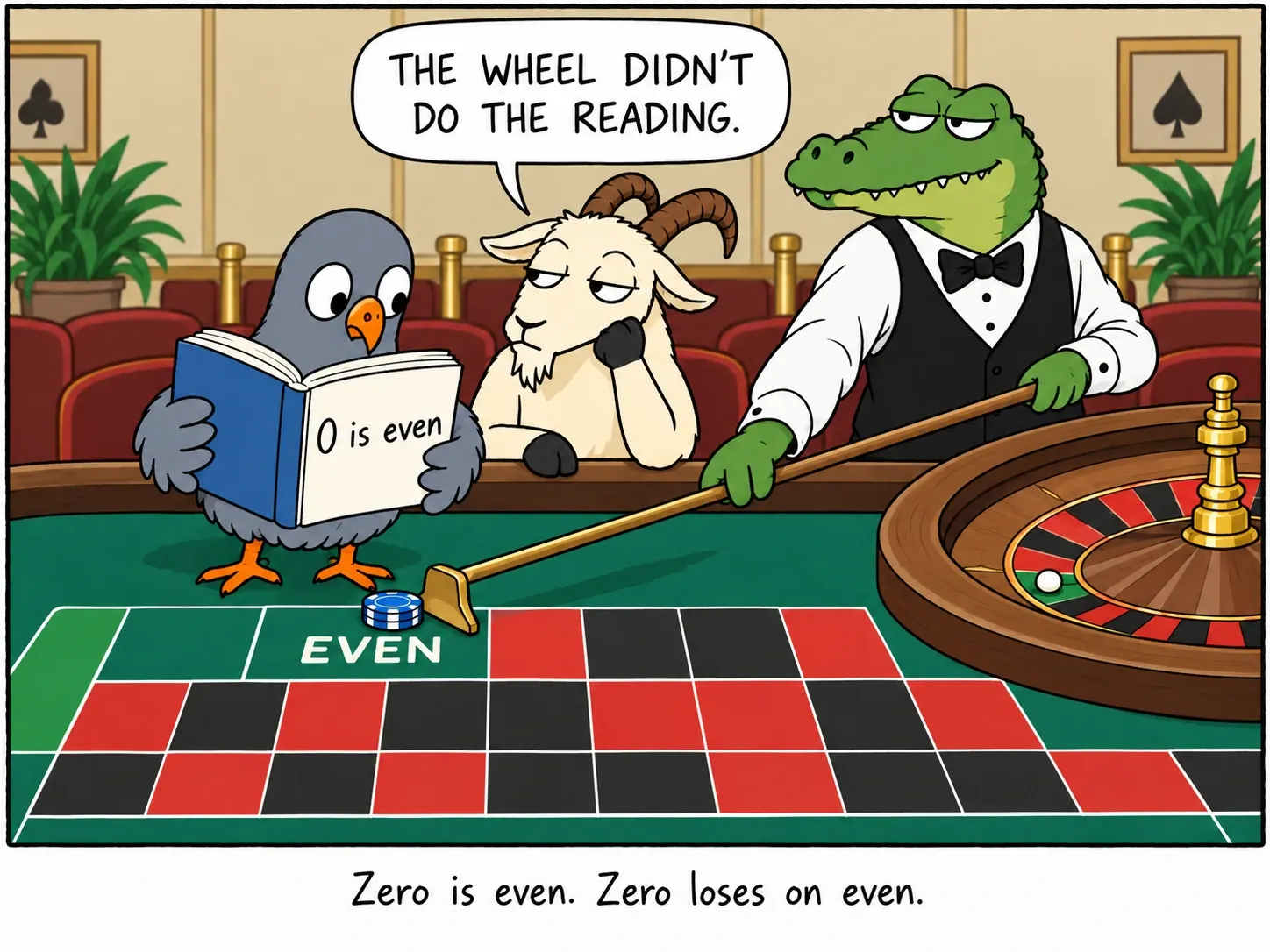
Zero is even. Zero loses on even.
Sources
- Ethier, S. N. The Doctrine of Chances: Probabilistic Aspects of Gambling.