Roulette Tournaments
Roulette as a competition: fixed chips, fixed spins, and a prize for the biggest stack. The one format where strategy exists.
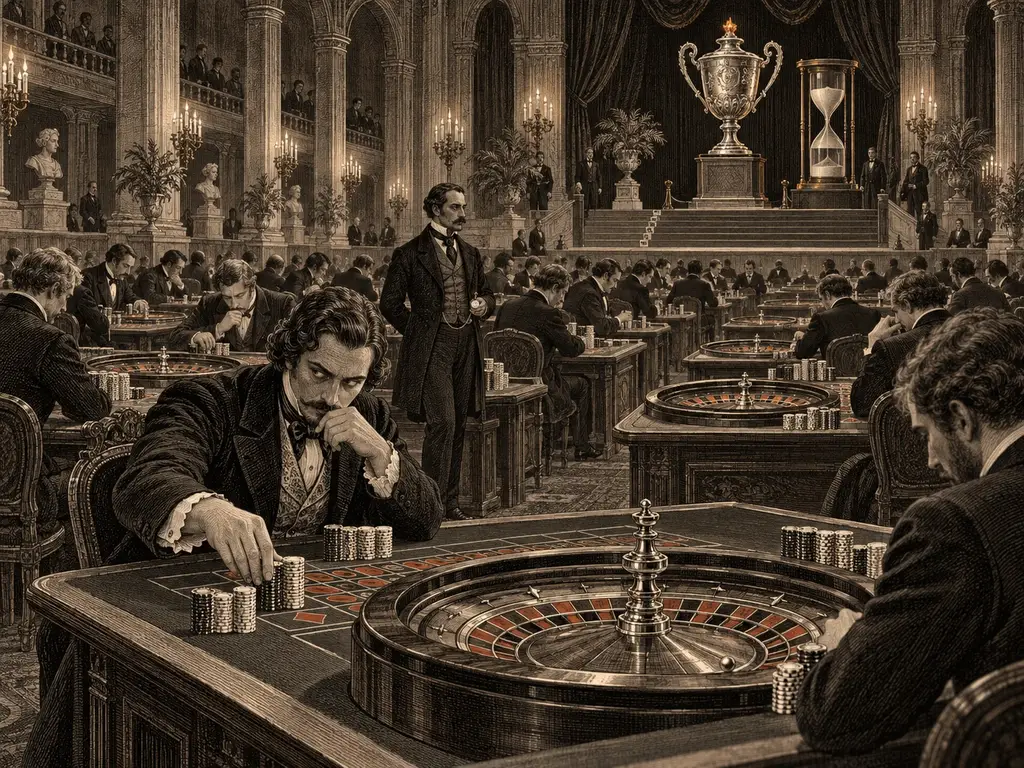
In a tournament every player gets the same play-money chips and the same spins; the prize goes to the largest final stack. The house edgemathHouse edgeThe share of each stake the casino keeps on average: 2.70% in European roulette.Read full → still applies to every bet, but the goal is to beat other players, not the wheel, and that changes which bets are right.
The format
Entry fee, equal stacks of tournament chipsmoneyChipA token representing a fixed amount, placed on the layout to make a bet. Also: check.Read full →, a fixed number of spins (often 20 to 50) or a time limit, and a prize pool paid to the top finishers. Tournament chips have no cash value; the prize is the only money. Online tournaments run on RNG or live tables with a leaderboard; casino-floor versions are occasional events.
Why strategy exists here
In ordinary roulette the goal is money and every bet has the same negative expectation, so the only strategy is stake and pace. In a tournament the goal is rank. Finishing second with a large loss is worth the same as finishing second with a small one: nothing. What matters is the probabilitymathProbabilityChance of an outcome, from 0 to 1 or 0% to 100%. One number: 1/37 = 2.70%.Read full → of ending above the other players, and that depends on variancemathVarianceA measure of how widely results spread around the expected value. High for straight up, low for even-money bets.Read full →, not expectation. A player who is behind should bet high-variance (straight upsbetStraight upA single number, pays 35:1.Read full →) to have a chance of catching up; a player who is ahead should bet low-variance or not at all to protect the lead.
The arithmetic of catching up
Suppose you trail the leader by 300 chips with three spins left and 200 chips in hand. Even-money betsbetEven-money betRed/black, odd/even, high/low. 18 numbers, pays 1:1.Read full → need two wins in a row, all in: 200 to 400 to 800, about 24%. A straight up for 10 chips pays 350 and does the job with probability 1/37 per spin; three attempts give about 8%. A splitbetSplitTwo adjacent numbers, pays 17:1.Read full → for 20 chips pays 340 with probability 2/37 per spin; three attempts give about 15%. The choice is between a small chance of winning and a large chance of finishing second regardless. In the tournament, second is zero, so the high-variance play is right.
What does not change
Every bet still has EV −1/37 of its stake in tournament chips. Over all players the chips flow to the house at 2.70% of turnovermoneyTurnoverThe total amount wagered over a session or period, counting re-bet winnings. Also: handle, action.Read full →; the prize pool comes from entry fees. The tournament has not made roulette beatable; it has made the opponents other players, against whom variance is a tool. This is the one roulette setting where “strategy” means something, and it is strategy about rank, not about the wheel.
The honest summary
If you enjoy roulette and want the game to have decisions in it, a tournament supplies them. The entry fee is the price; the house takes its share of the pool; the rest is a contest of variance management among people who all face the same wheel.
Questions
No. Tournament chips have no cash value.
Low variance when ahead, high when behind, and watch the other stacks. The wheel is the same for everyone.
From the entry fees and from the players who then sit at real tables.
Comic relief
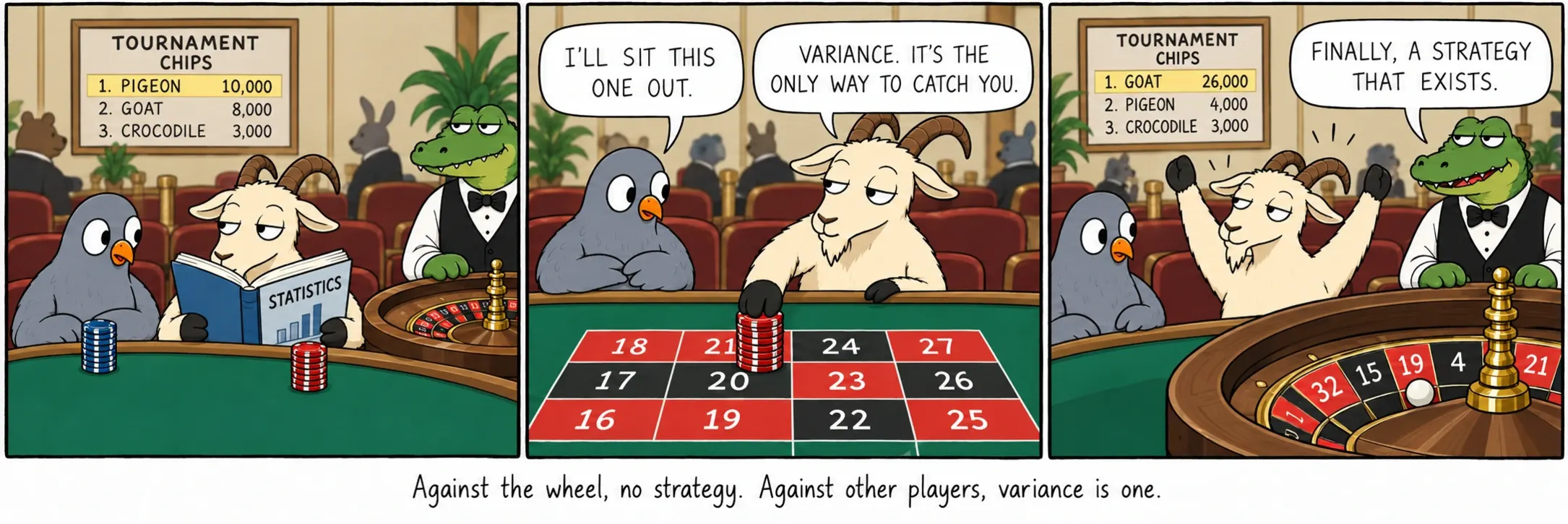
Against the wheel, no strategy. Against other players, variance is one.
Sources
- Ethier, S. N. The Doctrine of Chances: Probabilistic Aspects of Gambling.
- Epstein, R. A. The Theory of Gambling and Statistical Logic, 2nd ed.