Dostoevsky’s Roulettenburg
The Gambler (1866): the best book about roulette, written by a man losing at it, in twenty-six days.
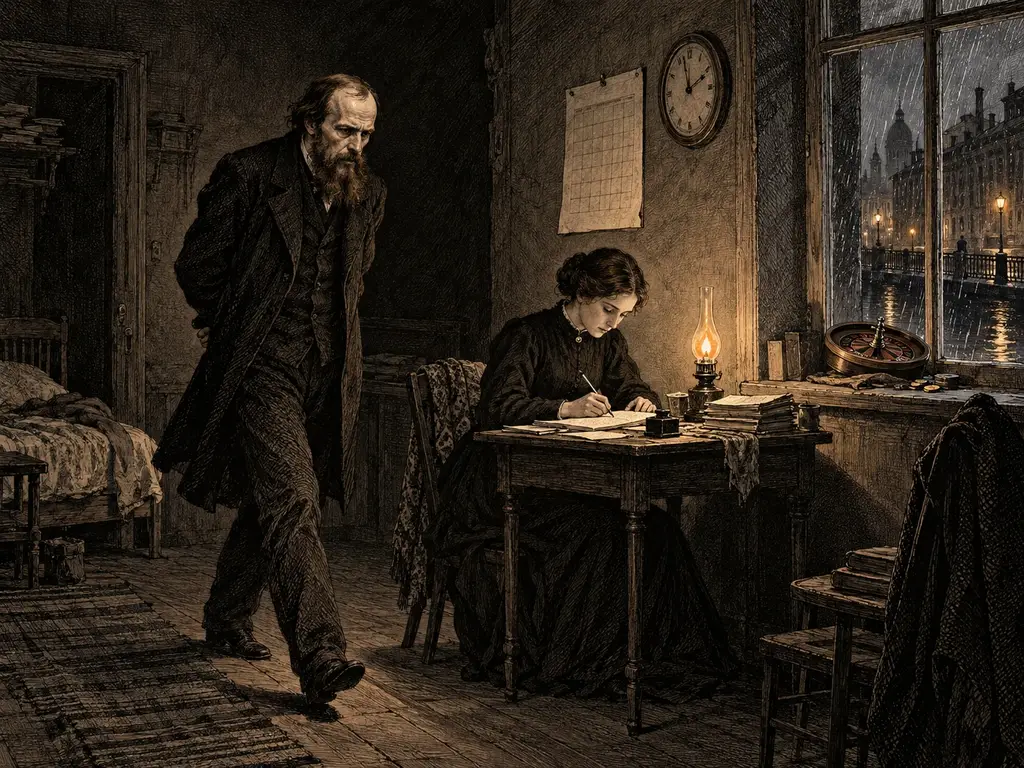
Dostoevsky dictated The Gambler to pay debts run up at the Wiesbaden and Homburg tables. Its narrator Alexei describes the spa casino, the systems, the certainty that a run must end and the feeling of a win as insight, with an accuracy no mathematician has improved on.
The circumstances
In 1866 Dostoevsky owed a publisher a novel by 1 November or forfeit the rights to his works for nine years. He had lost heavily at roulette in the German spas in 1863 and 1865, pawning his belongings and his wife’s jewelry. He hired a stenographer, Anna Snitkina, and dictated The Gambler between 4 and 29 October, finishing with days to spare. He married Anna the following year. He kept gambling until 1871, then stopped completely.
Roulettenburg
The town is Wiesbaden, Homburg and Baden-Baden combined: the Kurhaus, the promenade, the Russian family living on credit while waiting for a grandmother to die. The casino scenes are precise. Alexei describes the croupierspeopleCroupierThe dealer at a roulette table.Read full →’ calls, the layoutequipmentLayoutThe printed betting grid on the table. Also: table, felt, cloth.Read full →, the stakes, the crowd at the table, the “systems” players pursue with notebooks, and the way players talk about numbers as if they had intentions. Every detail matches the roulette pages on this site; the book is a primary source.
The grandmother
The novel’s great set piece: Antonida Vasilievna, the rich grandmother whose death the family awaits, arrives in Roulettenburg in a sedan chair, is wheeled to the tables, bets on zerowheelZeroThe single green pocket that no even-money, dozen or column bet covers; the source of the house edge. Also: single zero, 0.Read full → because she has been told it pays 35 to 1, and hits it. She bets zero again. And again. Within two days she has lost most of her fortune, insisting on zero, certain it must come, as her relatives watch their inheritance go across the table one straight upbetStraight upA single number, pays 35:1.Read full → at a time. It is the best fictional account of what a 1/37 bet does to a person who has seen it hit once.
Alexei’s win
Late in the book Alexei wins two hundred thousand francs in a single night, mostly on redbetRedEven-money bet on the 18 red numbers. French: rouge.Read full → and on straight ups, in a sequence of bets described spin by spin. He feels, in the moment, that he has understood something: that he can control the wheel by will. The win is spent and gone within pages. The book understands that the win was the worst thing that could have happened to him, which is the clinical view a century before there was a clinic.
First trip to the spas; wins, then loses heavily at Wiesbaden.
Wiesbaden again; loses everything; writes begging letters; Crime and Punishment is partly written in this state.
Dictates The Gambler in 26 days to meet a contract.
Marries Anna Snitkina; they go abroad; he gambles at Homburg, Baden-Baden and Saxon-les-Bains, losing repeatedly.
Last recorded gambling, at Wiesbaden. He writes to Anna that it is over. It is.
The German casinos close. The Gambler outlives the tables it describes.
Why it is the best book on roulette
Because it does not explain anything and gets everything right. The mathematics pages on this site say that spins are independent, that systems reshape sessions and not expectations, that a win is variancemathVarianceA measure of how widely results spread around the expected value. High for straight up, low for even-money bets.Read full → and feels like skill. Dostoevsky shows a man believing the opposite of each of those, in order, from the inside, and makes the reader feel the belief. The arithmetic tells you what is true; the novel tells you why that is not enough.
Questions
He believed in composure: that a calm player could not lose. It is the illusion of control, and he described it better than anyone while holding it.
A composite. Wiesbaden is the main model.
Short: a long evening. Read it before your next session, not after.
Comic relief
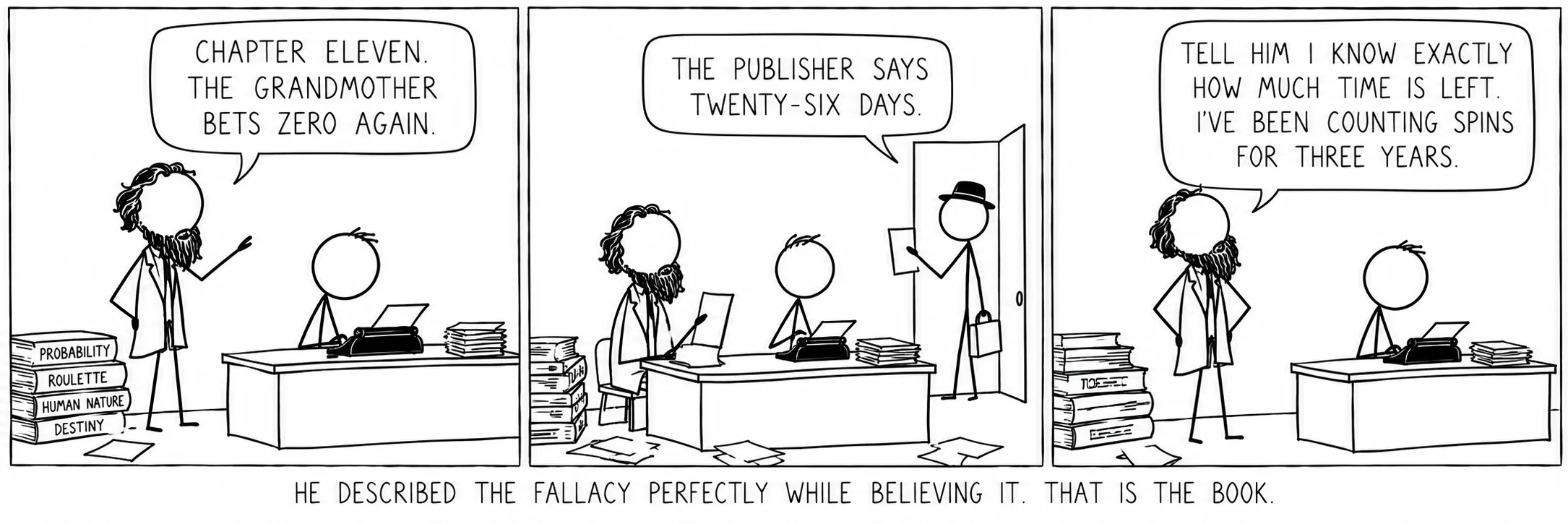
He described the fallacy perfectly while believing it. That is the book.
Sources
- Dostoevsky, F. The Gambler.
- Frank, J. Dostoevsky: The Miraculous Years, 1865–1871.
- Kavanagh, T. M. Dice, Cards, Wheels: A Different History of French Culture.