Probability of Streaks in Roulette
Long runs can occur by chance. On a fair wheel with independent spins, they do not change the next result’s probabilities.
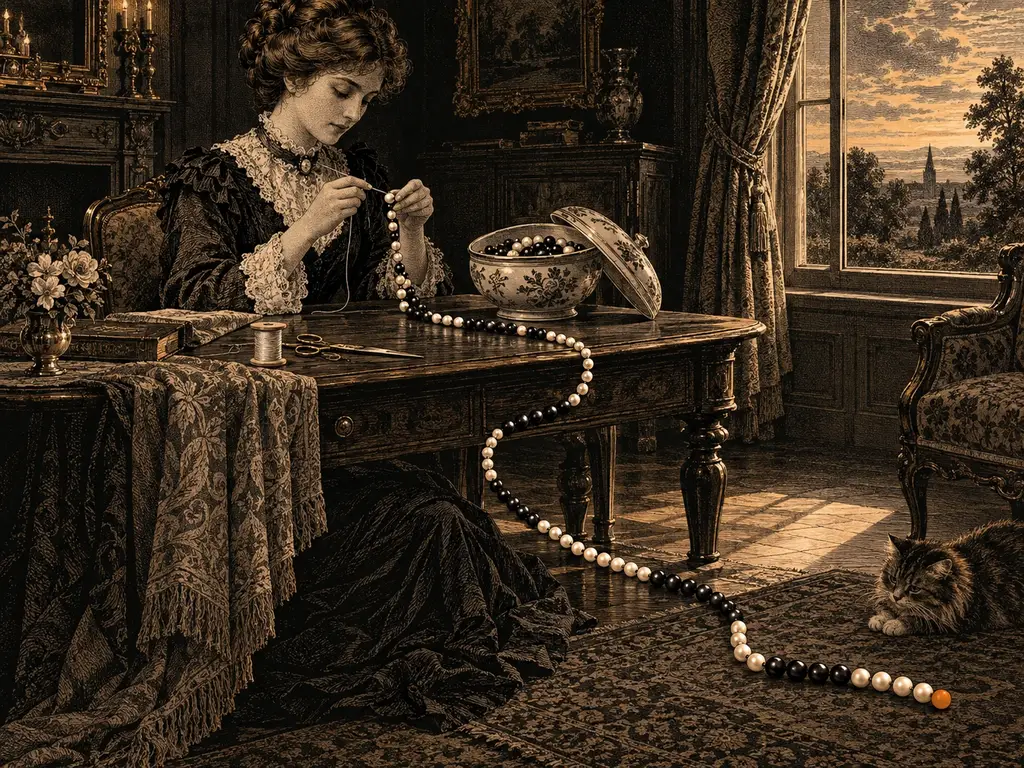
Five reds in a row: 2.7%. Ten: 0.074%. Over a 200-spin session a run of six of one color appears more often than not.
Losing-streak probabilities
On a fair single-zero wheel without special zero rules, an even-money bet loses with probability 19/37 per spin. Each row is the chance that a given run of spins all lose, and what a Martingale player, who doubles after every loss, has lost by then.
| losses in a row | chance | about 1 in | lost so far | next bet |
|---|---|---|---|---|
| 1 | 51.4% | 2 | $1 | $2 |
| 2 | 26.4% | 4 | $3 | $4 |
| 3 | 13.5% | 7 | $7 | $8 |
| 4 | 7.0% | 14 | $15 | $16 |
| 5 | 3.6% | 28 | $31 | $32 |
| 6 | 1.8% | 55 | $63 | $64 |
| 7 | 0.94% | 106 | $127 | $128 |
| 8 | 0.48% | 207 | $255 | $256 |
| 9 | 0.25% | 403 | $511 | $512 |
| 10 | 0.13% | 784 | $1,023 | $1,024 |
| 11 | 0.065% | 1527 | $2,047 | $2,048 |
| 12 | 0.034% | 2974 | $4,095 | $4,096 |
| 13 | 0.017% | 5792 | $8,191 | $8,192 |
| 14 | 0.0089% | 11279 | $16,383 | $16,384 |
| 15 | 0.0046% | 21965 | $32,767 | $32,768 |
The chance is 19/37 multiplied by itself once per loss, counted from one given spin. A longer session offers more possible starting positions, so its chance of containing a run can be higher. Overlapping windows are not independent. The stakes assume enough bankroll and no table limit.
Single run
The probabilitymathProbabilityA measure of how likely an event is, from zero to one. Percentages express the same scale from 0% to 100%.Read full definition → that the next k spins are all redbetRedAn even-money wager on the 18 red numbers. French: rouge.Read full definition → is (18/37)ᵏ. Two: 23.7%. Five: 2.7%. Ten: 0.074%, about 1 in 1,350. Twenty: 1 in 1.8 million. Twenty-six: about 1 in 137 million. Each figure is for one color specified in advance and one specified starting spin. The chance of finding a run anywhere in a long session is different.
In a session
The question people mean is “will a run of k appear somewhere in my session?”, and the answer is far larger than (18/37)ᵏ because a 200-spin session offers nearly 200 places for a run to start. A run of six or more of the same color, red or blackbetBlackAn even-money bet on the 18 black numbers. French: noir.Read full definition →, turns up in a 200-spin session about 94% of the time; eight or more about 47%; ten or more about 14%. Name the color in advance and the chances fall, to about 75%, 27% and 7%. These are probabilities for a fixed 200-spin session, not a guarantee for any evening. The table is calculated by tracking the current run after each spin; simply adding overlapping starting positions would overcount.
| run of at least k, red or black | in 100 spins | in 200 spins | in 500 spins |
|---|---|---|---|
| 5 | 95.6% | 99.8% | > 99.9% |
| 6 | 75.7% | 94.4% | 99.9% |
| 7 | 48.2% | 74.1% | 96.8% |
| 8 | 26.7% | 47.3% | 80.4% |
| 10 | 6.8% | 13.7% | 31.5% |
| 12 | 1.6% | 3.4% | 8.5% |
Why Martingale cares
Starting a MartingalestrategyMartingaleA progression that doubles after each loss and usually returns to the base stake after a win.Read full definition → cycle at $10, six successive losses stake $10, $20, $40, $80, $160 and $320: $630 lost in total. The next required bet is $640, above a $500 limit. The chance of those six losses from a specified start is (19/37)⁶, about 1.8%. Across exactly 200 independent spinsmathIndependent spinsSpins for which learning an earlier outcome does not change the probabilities assigned to a later one.Read full definition → betting the same even-money outcome, the chance of at least one run of six losses is about 84.4%. That is a streak probability, not a universal ruin rate: bankrollmoneyBankrollThe amount set aside for play. Bankroll management concerns stakes and limits within that amount.Read full definition →, stopping rules and the response to a limit all matter.
Hot and cold numbers
The same arithmetic applies to straight upsbetStraight upA wager on one number, ordinarily paying a profit of 35 to 1.Read full definition →. In 300 spins the expected count per number is 8.1; the standard deviationmathStandard deviationThe square root of variance: a measure of dispersion in the same units as the result.Read full definition → is about 2.8. The counts vary, so some numbers will usually be more frequent than others. Neither a count of 15 nor a count of 2 is guaranteed. On a fair wheel, each specified number has a binomial count distribution; selecting the hottest number after seeing all 37 counts adds a multiple-comparison problem. Bias testing needs a stated hypothesis and enough observations to detect the effect being tested.
Independence is the whole point
A run of ten reds does not make black more likely, and it does not make red more likely either. Both are 18/37. Both long runs and unusually few runs can occur by chance. A 200-spin sequence with no color run longer than four has probability about 0.17% under this model. It may justify further investigation if that test was chosen in advance, but it does not by itself establish tampering.
Formula
Questions
There is no verified all-time record established here. A 1938 TIME article recounts 26 consecutive blacks at Monte Carlo in 1913. Claims of 32 reds at an unnamed American casino in 1943 also circulate, but we have not verified the underlying record. Neither story changes the probability of the next independent spin.
On a fair single-zerowheelZeroThe 0 outcome, conventionally shown in green. Ordinary color, parity, high/low, dozen and column bets do not include it.Read full definition → wheel, the next spin is red with probability 18/37 and black with probability 18/37. The streak gives neither bet an advantage; you can also choose not to bet.
A streak alone does not establish bias. A bias toward red could affect red streaks, but streaks also occur on fair wheels. Use an appropriate statistical test, account for how the pattern was selected, and seek independent confirmation.
Fun with Math
Try these yourself first. Each solution is folded; open it when you are ready.
How many spins of a European wheel does it take, on average, before every one of the 37 numbers has come up at least once?
Show the solution
Answer About 155 spins on average; the median is 147.
Count the wait one new number at a time. The first spin always shows a new number. Once you have seen 1 number, 36 pocketsequipmentPocketA compartment on the rotor in which the ball can settle. The number of pockets depends on the wheel.Read full definition → in 37 are new, so the next new number takes 37/36 spins on average. Once you have seen k numbers, it takes 37/(37 − k).
Add the waits: 37/37 + 37/36 + 37/35 + … + 37/1 = 37 × (1 + 1/2 + 1/3 + … + 1/37) ≈ 37 × 4.20 = 155.5 spins.
Most of that is the end. The last number alone takes 37 spins on average, and the last five about 85. On an American wheel the same sum gives about 161. This is the coupon collector’s problem; the same mean follows from the standard calculation.
In 37 spins of a European wheel, one spin for each pocket, how many different numbers should you expect to see?
Show the solution
Answer About 23.6. Roughly a third of the numbers, about 13, do not come up at all.
Take one number, say 17. On each spin it fails to come up with chance 36/37, so it misses all 37 spins with chance (36/37)³⁷ ≈ 0.363.
Every number has the same chance, so on average 37 × 0.363 ≈ 13.4 numbers are missing and 37 − 13.4 ≈ 23.6 come up, many of them twice or more.
Roulette players call this the law of thirds. It is no law, only the arithmetic of repeats: in a run as long as the wheel, about a third of the numbers sit out, on a fair wheel; a biased wheellabBiased wheelA wheel whose outcomes do not have equal probabilities. The cause and strength of any bias require investigation.Read full definition → can give a different expected count. On 38 pockets the share is (37/38)³⁸ ≈ 0.363 too; for a large wheel it settles near 1/e ≈ 0.368.
A friend shows you two lists of 50 colors, redbetRedAn even-money wager on the 18 red numbers. French: rouge.Read full definition → or blackbetBlackAn even-money bet on the 18 black numbers. French: noir.Read full definition →, each said to come from a wheel with the zeroswheelZeroThe 0 outcome, conventionally shown in green. Ordinary color, parity, high/low, dozen and column bets do not include it.Read full definition → left out. One switches color 25 times and its longest run is six. The other switches 35 times and never runs past three. Which list is more unusual under the independent fair-color model?
Show the solution
Answer The second is more unusual by these measures, but either could occur by chance. The expected switch count is 24.5. At least 35 switches occur in about 0.19% of such lists, and no run longer than three occurs in about 1.88%.
Each new color either repeats the last one or switches, half and half, so 49 chances to switch give 24.5 switches on average, give or take about 3.5. Thirty-five is three standard deviationsmathStandard deviationThe square root of variance: a measure of dispersion in the same units as the result.Read full definition → above the mean. The exact probabilitymathProbabilityA measure of how likely an event is, from zero to one. Percentages express the same scale from 0% to 100%.Read full definition → of 35 or more switches is about 0.19%, roughly 1 in 526.
The runs tell the same story. A list of 50 independent fair colors has a run of four or more about 98% of the time, and its longest run is most often five or six.
These are separate checks of the switch count and longest run, not a combined probability or proof that a list was invented. Choosing a test after inspecting a list also affects how its result should be interpreted.
Assume independent uniform single-zero spins. How rare are five consecutive hits on a number named in advance, compared with five consecutive hits on any one number? Estimate the annual count of all-equal five-spin windows at 20 tables, each spinning 40 times an hour around the clock.
Show the solution
Answer A named number: 1 in 69 million five-spin windows. Any number: 1 in 1.87 million. Under the stated schedule, the expected annual count is about 3.7 all-equal windows.
A named number comes up with chance 1/37 each spin, so five in a row has chance (1/37)⁵ = 1 in 69,343,957. But nobody names the number in advance. Whatever comes up first, the next four spins must repeat it: (1/37)⁴ = 1 in 1,874,161.
20 tables × 40 spins × 24 hours × 365 days = 7,008,000 spins a year. Each spin can start a run, so there are approximately 7,008,000 candidate five-spin windows, giving about 3.7 all-equal windows per year in expectation. A run longer than five contributes more than one overlapping window.
This is an expected count under the stated continuous-operation model, not a promise of three or four runs in a particular year. Overlapping windows and year boundaries need care when counting distinct streaks. For independent double-zero spins, the corresponding probabilities are 1 in 79,235,168 and 1 in 2,085,136.
Comic relief
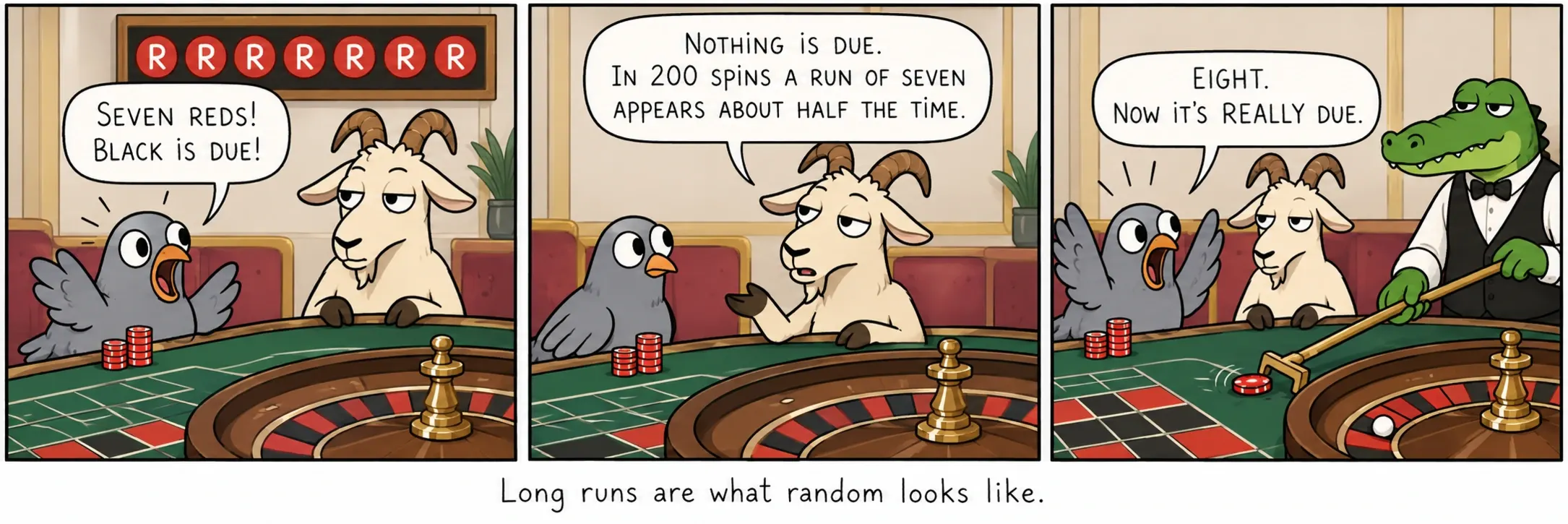
On a fair single-zero wheel with independent spins, black stays 18/37 after a red streak.
Sources
- Feller, W. An Introduction to Probability Theory and Its Applications, Vol. 1.
- Ethier, S. N. The Doctrine of Chances: Probabilistic Aspects of Gambling.
- Taylor, D. G. Games, Gambling, and Probability: An Introduction to Mathematics, 2nd ed.