D'Alembert Roulette Strategy
The D’Alembert roulette strategy adds one unit after a loss and removes one after a win.

It does not beat the wheel. Linear stake increases can still lead to large stakes and drawdownsmoneyDrawdownA fall from a bankroll peak to a later value. Maximum drawdown is the largest such fall in the record.Read full definition →. The expected loss per unit wagered is unchanged.
Walk the system
A loss adds one base unit. A win removes one, with a minimum stake of one unit.
Stakes and results are in units of the base bet.
The D’Alembert roulette system, step by step
Bet one unitmoneyUnitA base amount used to express stakes or results.Read full definition →. Lose, and the next bet is one unit bigger. Win, and it is one unit smaller, never below one. That is all. Picture a seesaw: every loss tips the stake up a notch and every win tips it back. A loss followed by a win at the next higher stake nets one unit: lose 3, win 4, net +1. This does not mean wins and losses must balance. A win followed by a loss at the one-unit floor nets zerowheelZeroThe 0 outcome, conventionally shown in green. Ordinary color, parity, high/low, dozen and column bets do not include it.Read full definition →, not one.
What does a session look like?
Stakes increase by one unit after losses and decrease after wins, with a one-unit floor. Consecutive losses therefore produce stakes 1, 2, 3 and so on. The growth is slower than doubling but losses accumulate: ten consecutive losses cost 55 units. A finite bankrollmoneyBankrollThe amount set aside for play. Bankroll management concerns stakes and limits within that amount.Read full definition → or table limittableTable limitA permitted minimum or maximum stake, applied per bet, bet category or total wager according to the table.Read full definition → can interrupt the sequence.
- p10 −$500
- p25 −$500
- median −$500
- p75 −$500
- p90 −$500
Does the D’Alembert system work?
It does not remove the house edgemathHouse edgeThe casino’s expected net gain expressed as a fraction of the stake, under specified probabilities and payouts.Read full definition →. Equal counts of wins and losses do not always produce the same result because the one-unit floor makes order matter: W L nets zero, while L W nets one unit. For a bounded session of independent standard single-zero bets, expected lossmathExpected lossThe probability-weighted average net loss under a stated model. With a constant edge, it equals edge times expected total stakes.Read full definition → is 1/37 of expected turnovermoneyTurnoverThe sum of amounts wagered over a session or period, including money wagered again after a return. Also called handle or action.Read full definition →.
| sequence | stakes | result |
|---|---|---|
| W L | 1, 1 | 0 |
| L W | 1, 2 | +1 |
| L L W W | 1, 2, 3, 2 | +2 |
| L L L W | 1, 2, 3, 4 | −2 |
| L L L L W W W | 1, 2, 3, 4, 5, 4, 3 | +2 |
| L × 10 | 1 … 10 | −55 |
Why do short sessions usually win?
A high chance of a small gain can coexist with a negative mean because losing outcomes can be larger. If no win occurs at the one-unit floor, the net result after N spins is (N − D²)/2 − D, where D is losses minus wins. Floor wins require a correction, so the formula cannot be applied to every path. The simulation below includes the floor and shows how results change with the horizon.
| spins | sessions ahead | median result | 5th percentile | mean result |
|---|---|---|---|---|
| 37 | 62.3% | 8 | -65 | -4.0 |
| 100 | 58.6% | 13 | -209 | -18.1 |
| 370 | 50.0% | -1 | -917 | -135.6 |
| 1000 | 37.3% | -290 | -3195 | -679.7 |
| 3700 | 14.8% | -4873 | -20193 | -6543.4 |
What if you turn it around?
The reverse version adds one unit after a win and subtracts one after a loss, with a one-unit floor. If no loss occurs at that floor, its net result after N spins is (D² − N)/2 + D, where D is wins minus losses. Floor events require corrections. The simulation below shows this explicit model; it does not assume a finite casino bankroll.
| spins | sessions ahead | median result | 95th percentile | mean result |
|---|---|---|---|---|
| 37 | 27.2% | -13 | 51 | -3.3 |
| 100 | 23.8% | -37 | 109 | -13.8 |
| 370 | 17.9% | -154 | 275 | -83.9 |
| 1000 | 11.4% | -455 | 368 | -317.3 |
Who was d’Alembert?
Jean le Rond d’Alembert was a mathematician and co-editor of the Encyclopédie. His 1754 “Croix ou pile” article questioned the standard calculation for obtaining at least one head in two coin tosses. Treating the three stopping outcomes as equally likely gives the wrong answer; for independent fair tosses, the probabilitymathProbabilityA measure of how likely an event is, from zero to one. Percentages express the same scale from 0% to 100%.Read full definition → is 3/4. This historical probability debate does not establish that he invented or endorsed the staking system named after him.

Are there other versions?
Contra-D’Alembert, above, behaves like a gentle ParolistrategyParoliA positive progression that raises stakes after wins. A common version uses 1, 2 and 4 units, resetting after a loss or three wins.Read full definition →. Some players add two units after a loss and subtract one after a win, which steepens the ladder toward MartingalestrategyMartingaleA progression that doubles after each loss and usually returns to the base stake after a win.Read full definition → territory. All versions share the same expected loss per unit wagered.
Simulator · D'Alembert
2,000 sessions of even-money bets from a $1,000 bankroll.
Base bet $10 · table limit $500 · up to 100 spins per session
Losing-streak probabilities
On a fair single-zero wheel without special zero rules, an even-money bet loses with probability 19/37 per spin. Each row is the chance that a given run of spins all lose, and what a D’Alembert player, who adds one base bet after every loss, has lost by then.
| losses in a row | chance | about 1 in | lost so far | next bet |
|---|---|---|---|---|
| 1 | 51.4% | 2 | $1 | $2 |
| 2 | 26.4% | 4 | $3 | $3 |
| 3 | 13.5% | 7 | $6 | $4 |
| 4 | 7.0% | 14 | $10 | $5 |
| 5 | 3.6% | 28 | $15 | $6 |
| 6 | 1.8% | 55 | $21 | $7 |
| 7 | 0.94% | 106 | $28 | $8 |
| 8 | 0.48% | 207 | $36 | $9 |
| 9 | 0.25% | 403 | $45 | $10 |
| 10 | 0.13% | 784 | $55 | $11 |
| 11 | 0.065% | 1527 | $66 | $12 |
| 12 | 0.034% | 2974 | $78 | $13 |
| 13 | 0.017% | 5792 | $91 | $14 |
| 14 | 0.0089% | 11279 | $105 | $15 |
| 15 | 0.0046% | 21965 | $120 | $16 |
The chance is 19/37 multiplied by itself once per loss, counted from one given spin. A longer session offers more possible starting positions, so its chance of containing a run can be higher. Overlapping windows are not independent. The stakes assume enough bankroll and no table limit.
Questions
Linear increases do not make it safe: repeated losses can exhaust the bankroll or reach the table limit. Expected cost depends on expected turnover, which can be much higher than with the same fixed base stake.
Wins reduce the stake toward its floor. Long losing stretches increase it; bankroll and table limits can prevent the next scheduled bet.
Fun with Math
Try these yourself first. Each solution is folded; open it when you are ready.
You play the D’Alembert on redbetRedAn even-money wager on the 18 red numbers. French: rouge.Read full definition → for 50 spins, starting at one unitmoneyUnitA base amount used to express stakes or results.Read full definition →, and never win a bet of one unit (after such a win the stake would have nowhere lower to go). You finish with 27 losses and 23 wins. How many units are you up or down? And with 29 losses and 21 wins?
Show the solution
Answer +13 units with 27 losses, −15 units with 29. Two spins out of fifty going the other way cost 28 units.
Call D the losses minus the wins. The result is (N − D²)/2 − D for N spins. With 27 losses and 23 wins, D = 4: (50 − 16)/2 − 4 = 17 − 4 = +13. With 29 and 21, D = 8: (50 − 64)/2 − 8 = −7 − 8 = −15.
Why the rule holds: the stake is always one unit plus the losses so far minus the wins so far. Each loss that a later win cancels makes a pair, lose s and then win s + 1, which nets +1 unit, as the table above shows. Out of N spins, (N − D)/2 such pairs form, worth +(N − D)/2. The D losses left over were placed at stakes 1, 2 … D on the way up and never cancelled; they cost 1 + 2 + … + D = D(D + 1)/2. Together: (N − D)/2 − D(D + 1)/2 = (N − D²)/2 − D.
The formula depends on the question’s restriction: no winning bet at the one-unit floor. If the floor is reached and the stake cannot fall after a win, the simple formula needs a correction. It is not an expectation or a guarantee for arbitrary sessions.
You play the reverse D’Alembert on red for 100 spins, starting at one unit, and no bet of one unit ever loses. You finish with 52 wins and 48 losses. Where do you stand? And with 60 wins and 40 losses?
Show the solution
Answer −38 units with 52 wins, +170 with 60. A small lead in wins still loses; only a large one pays.
Call D the wins minus the losses. The result is (D² − N)/2 + D for N spins.
52 wins and 48 losses: D = 4, so (16 − 100)/2 + 4 = −42 + 4 = −38.
60 wins and 40 losses: D = 20, so (400 − 100)/2 + 20 = 150 + 20 = +170.
Why: each win that a later loss cancels makes a pair, win at s and then lose at s + 1, which nets −1. The D wins left over were placed at stakes 1, 2 … D on the way up and are never cancelled; they bring in D(D + 1)/2. Out of N spins, (N − D)/2 pairs form, so the total is D(D + 1)/2 − (N − D)/2 = (D² − N)/2 + D.
This identity assumes no loss at the one-unit floor, as the question states. Under that restriction it is the sign-reversed counterpart of the preceding calculation, not a formula for every reverse-D’Alembert session.
Comic relief
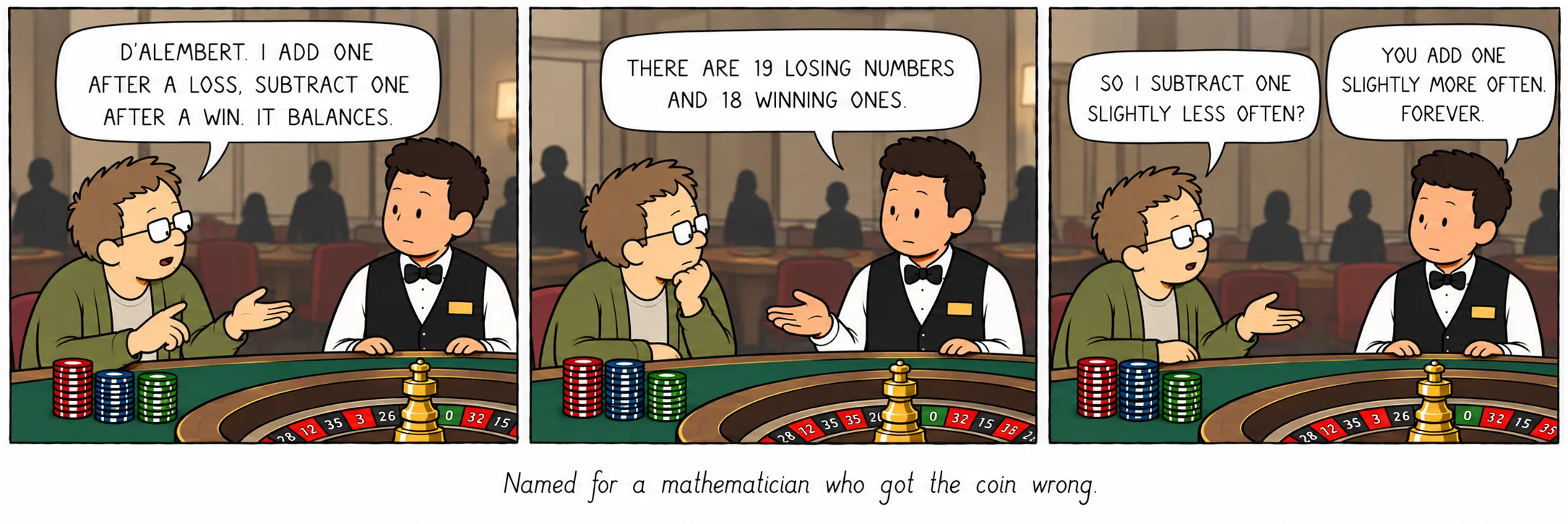
Changing the stake does not change an independent spin’s odds.
Sources
- RouletteDoc. Strategy description and examples.
- Roulette77. Strategy description and examples.
- d’Alembert, J. “Croix ou pile.”
- Ethier, S. N. The Doctrine of Chances: Probabilistic Aspects of Gambling.
- Epstein, R. A. The Theory of Gambling and Statistical Logic, 2nd ed.