Dice and Draw Side Bets
Side bets that add a second random device to the wheel: dice, cards, drawn numbers, an inner ring, extra balls. The device adds prizes; the price is still a count of results against payouts.
These side bets combine roulette with dice, drawn numbers, an extra ring or displayed symbols. Their cost depends on the exact rules and pay table. The examples below show how to calculate the return and why a larger prize does not necessarily mean better value.
Dice and cards on the side
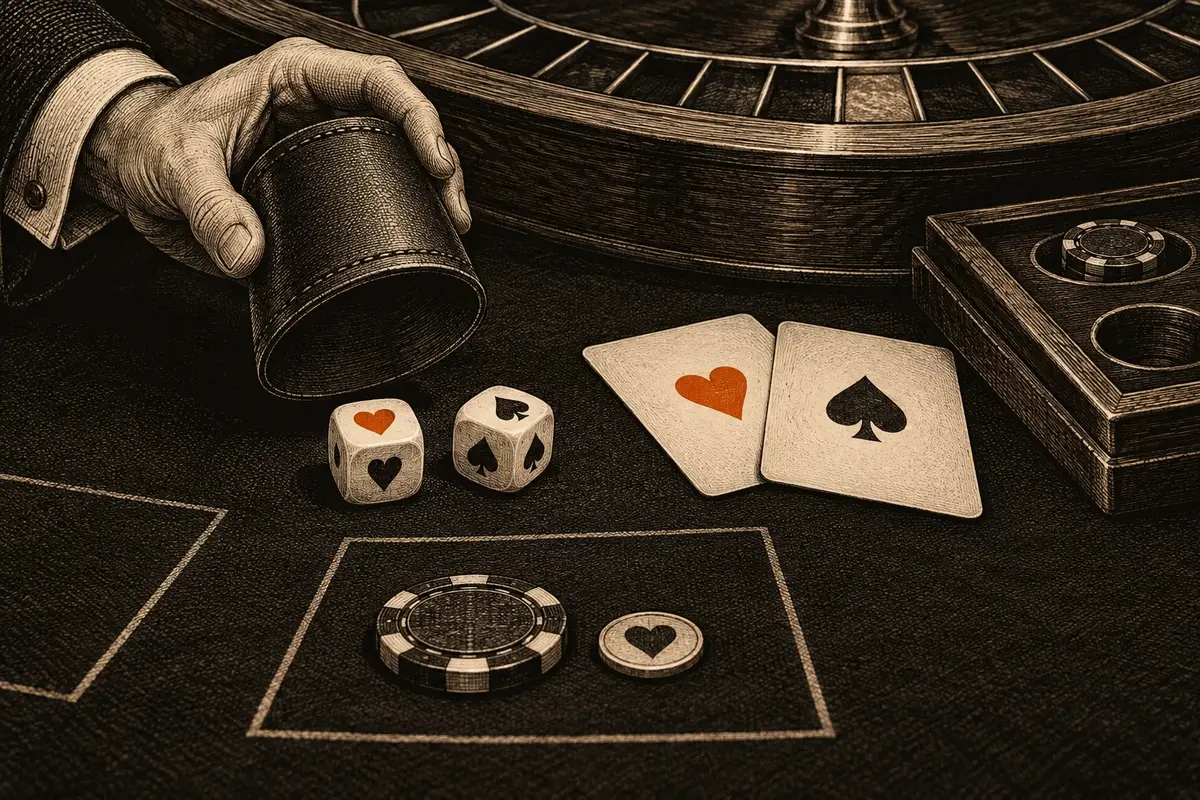
These bets combine a roulette outcome with another draw. Flush Roulette uses two independent suit draws: zero, one or two matches pay 17, 50 or 100 to 1 on a winning number. That gives a 3.89% edge; raising the latter payoutsmoneyPayoutThe amount paid on a winning wager. Check whether the quoted figure is net profit or total return including the stake.Read full definition → to 51 and 101 to 1 would restore the ordinary 2.70%.
Roul 8: three dice and a lucky number
Roul 8, at the Grand Casino in Brussels, adds three dice, each blank except for one face showing an 8 (an ∞, an 8 on its side, in some accounts). The bet pays “for 1” on the ballequipmentBallThe small ball that settles in a numbered pocket to determine a physical roulette result.Read full definition → landing on 8, on the dice showing 8s, or both. The 888 for 1 top prize needs the ball on 8 and all three dice on 8: a chance of 1 in 7,992, worth 11 cents of every dollar staked. Nine times in ten the bet returns nothing. The edge is 5.46% on a single-zerowheelZeroThe 0 outcome, conventionally shown in green. Ordinary color, parity, high/low, dozen and column bets do not include it.Read full definition → wheel and 6.51% on a double-zero wheel, low for a side betbetSide betAn additional wager tied to a game, such as a streak, card hand, bonus event or jackpot. It may be optional or required by the product.Read full definition →.
Lucky Colour Chips: dice in your color
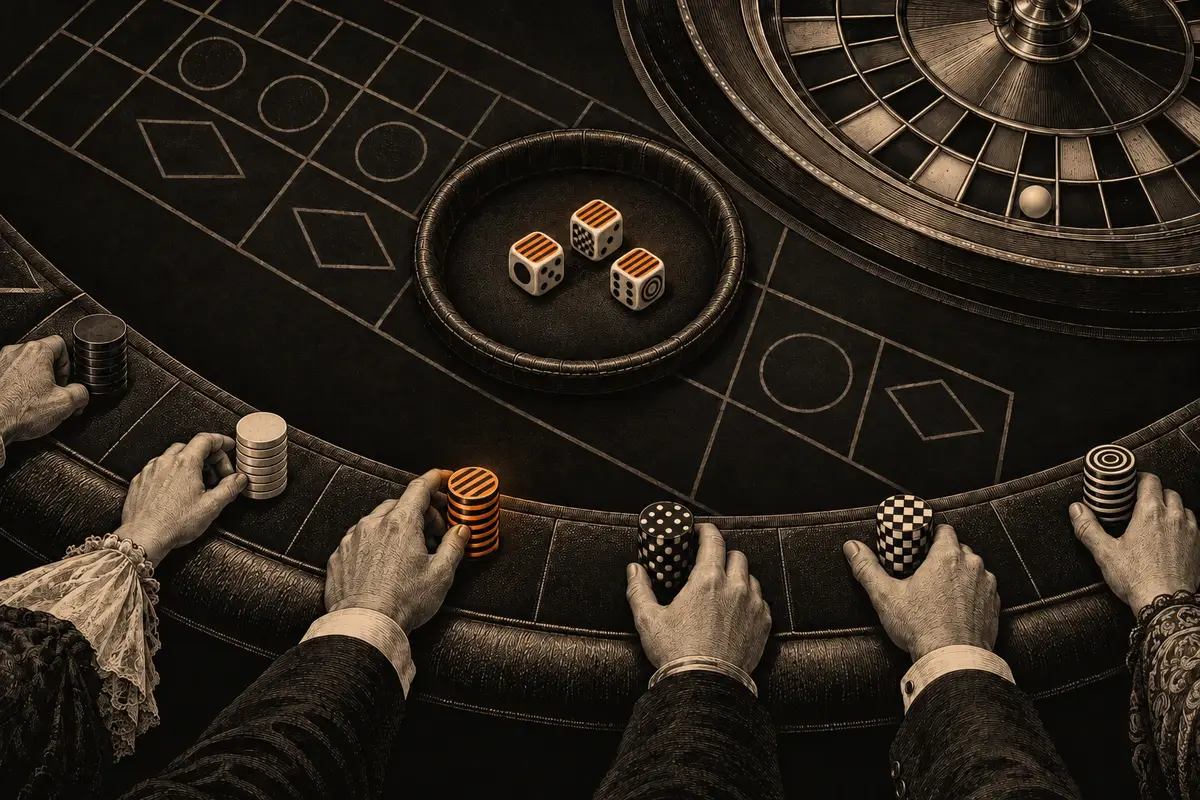
Lucky Colour ChipsmoneyChipA token used to place a wager, with a printed or assigned value. Also called a check in some casino terminology.Read full definition →, at the Macau Casino Complex in Cork, Ireland, in 2022, is a straight-up side bet for up to six players, each with their own chip color. When your number wins, three dice are rolled, each with the six chip colors on its faces. All three in your color pay 300 to 1; all three in one other color, or two in yours, 70 to 1; two alike in another color 40 to 1; three different colors 22 to 1. Every win pays at least 22 to 1, and still the bet costs 5.46% on a single-zero wheel, twice a plain straight upbetStraight upA wager on one number, ordinarily paying a profit of 35 to 1.Read full definition →.
Lucky Ball: four drawn numbers
Lucky Ball is an electronic single-zero game. After bets close, four numbers are drawn at random, one each for redbetRedAn even-money wager on the 18 red numbers. French: rouge.Read full definition →, green, blue and yellow, and one of the four colors is picked for a bonus. A bet on a color wins when the spin lands on that color’s number, 1 time in 37, and pays the bonus rate if that color was the one picked. For a color paying A to 1, or B to 1 with the bonus, the edge is (144 − 3A − B)/148; the exercises below show where that comes from. The most modest pay tablemoneyPay tableThe list of payouts for specified bets or outcomes. Probabilities and charges are also needed to calculate the house edge.Read full definition →, red, is the cheapest.
A newer Lucky Ball
Interblock’s rules for Washington state, filed in 2024, describe a different bet under the same name. You pick a lucky number. At random, on average once in 5 to 30 spins depending on the pay table, the ball in play becomes the lucky ball. The bet pays a small prize, from 2 to 1 up to 11 to 1, whenever the lucky ball comes, and a large one, from 40 to 1 up to 575 to 1, if it lands on your number; only the larger prize is paid. For the single-zero version, the fifteen listed pay tables return from 80.00% to 91.35% of what is staked: an edge of 8.65% to 20.00%, two to five times the old red line.
Blazing 7s: three sevens drawn
Blazing 7s, from Scientific Games, wins when the ball lands on 7, 17 or 27. Then three numbers are drawn from the 38 on the wheel, with no repeats, and the prize depends on how many of the three are 7, 17 or 27: 1,000 to 1 for all three, 100 to 1 for two, 17 to 1 for one, 7 to 1 for none. The bet costs 10.07%. Had repeats been allowed in the draw, the same prizes would cost only 4.48%: a seven that has been drawn cannot be drawn again, which makes the big prizes rarer.
Richer Spin: a wheel inside the wheel
Michael Shackleford reports seeing TCSJOHNHUXLEY’s Richer Spin at the 2021 Global Gaming Expo and at the El Cortez in 2023. His El Cortez example uses a double-zero wheel and an independently rotating inner ring with 38 stops: 1 gold, 9 silver, 4 blue, 4 purple and 20 blank. A winning number bet pays 299 to 1 on gold, 99 to 1 on silver and 7 to 1 on blue or purple; a blank loses. Separate blue and purple bets pay 7 to 1 regardless of the number. These are the observed rules: the manufacturer’s guide instead lists silver at 100 to 1, so its return would differ.
Four balls, one number: Lightning Launch
Lightning Launch Roulette (Scientific Games, 2018) is a video game with four seats and four virtual balls on a double-zero wheel, one ball per player. The $1 Bonus bet goes on one number and is settled on all four balls: 5 for 1 if one ball lands there, 75 for 1 for two, 1,000 for 1 for three and 10,000 for 1 for four. About one Bonus bet in ten wins something, nearly always the 5 for 1, which is 4 to 1 in ordinary terms, against 35 to 1 for the same number on a single ball. The edge is 14.29%.
Spread-Bet: two rings added up
Cammegh’s 2025 brochure describes two displayed number rings that rotate in opposite directions and stop when betting closes. The physical winning number selects the aligned pair whose sum settles the side bet. On a single-zero model with independent, equally likely numbers from 0 to 36, there are 1,369 ordered pairs: 37 total 36, while only one totals 0 and one totals 72. The displayed pay table determines the return. For example, the table below has edges from 8.69% to 12.27%; other pay tables can differ.
Lucky Symbols: a reel on the display
Lucky Symbols pays according to the symbol selected on an electronic display. Shackleford’s report describes a seven-symbol pay table seen at the Casino at the Empire in February 2014 and also reported at Montecasino. It ranges from even money on Prosperity to 80 to 1 on Dragon or Tiger. He attributes the probabilities and the ball-and-wheel-speed selection method to game literature. The quoted house edgesmathHouse edgeThe casino’s expected net gain expressed as a fraction of the stake, under specified probabilities and payouts.Read full definition → range from 10.16% to 13.72%, compared with 5.26% for a standard double-zero bet. These figures describe that reported configuration, not every version of Lucky Symbols.
What these bets show
One way of pricing all of them: list the results, multiply each payout by its chance, add.
- Extra random devices do not imply better value. Calculate each outcome’s probabilitymathProbabilityA measure of how likely an event is, from zero to one. Percentages express the same scale from 0% to 100%.Read full definition → and payout.
- The same bet can carry several pay tables at different prices. On Lucky Ball, red is the cheapest line.
- Drawing without repeats changes the odds: Blazing 7s costs twice what it would with repeats allowed.
Questions
Flush Roulette, at 3.89%, then Lucky Ball on red, at 4.05%. Both still cost more than a plain bet on the same wheel.
The sources document particular products and past placements. They do not establish which tables are operating now; availability and pay tables require a current casino check.
Rules and pay tables come from the cited book, reports, manufacturer material and regulatory documents. We calculate edges where the probabilities are specified. Lucky Symbols uses the published analysis because its displayed probabilities are rounded.
Fun with Math
Try these yourself first. Each solution is folded; open it when you are ready.
In a hypothetical bonus model, a selected number wins with probabilitymathProbabilityA measure of how likely an event is, from zero to one. Percentages express the same scale from 0% to 100%.Read full definition → 1/37. Independently, a bonus flag is set with probability 1/4. A hit pays A:1 without the flag or B:1 with it; a miss loses. Derive the edge and evaluate A=6, B=120.
Show the solution
Answer The bet costs 6/148, about 4.05%.
The color’s number is spun once in 37 spins. When it is, three times in four the bet pays A and once in four it pays B, an average of (3A + B)/4. The other 36 spins out of 37 lose the stake.
So the expected valuemathExpected valueThe sum of each possible net result multiplied by its probability. It can be positive, zero or negative.Read full definition → is (1/37) × (3A + B)/4 − 36/37 = (3A + B − 144)/148.
RedbetRedAn even-money wager on the 18 red numbers. French: rouge.Read full definition →: 3 × 6 + 120 = 138, so −6/148 = 4.05%. Green, 12 and 100: 136, 5.41%. Blue, 20 and 75, and yellow, 25 and 60: both 135, 6.08%. The bet would break even only when 3A + B reached 144.
Comic relief
Dice, cards or a second ball: the price is still arithmetic.
Sources
- Bollman, M. Mathematics of the Big Four Casino Table Games: Blackjack, Baccarat, Craps, & Roulette.
- Wizard of Odds, Richer Spin — observed El Cortez rules
- Wizard of Odds, Lucky Symbols — probabilities from game literature
- Interblock. “Roulette Game & Special Bets: Description”, version 1.2.1.
- Wizard of Odds. “Neighborhoods”, “Richer Spin”, “Back2Back”, “Blazing 7s”, “Straights and 8’s” and “Lucky Colour Chips”.
- TCS John Huxley. “Richer Spin Roulette.”
- Wizard of Odds. “Spread-Bet Roulette” and “Lucky Symbols Roulette”.
- New Jersey Division of Gaming Enforcement. Archived temporary rules for Spread-Bet Roulette, N.J.A.C. 13:69F-5.1 to 5.4.
- Cammegh. “Spread-Bet Roulette” and “Lucky Symbols”.
- Cammegh. 2025 product brochure, Spread-Bet Roulette, p. 60.