Problem: Two Dozens and a Chip
Two dozens cover 24 numbers. Add a chip on zero and you cover 25. Does the insurance pay?
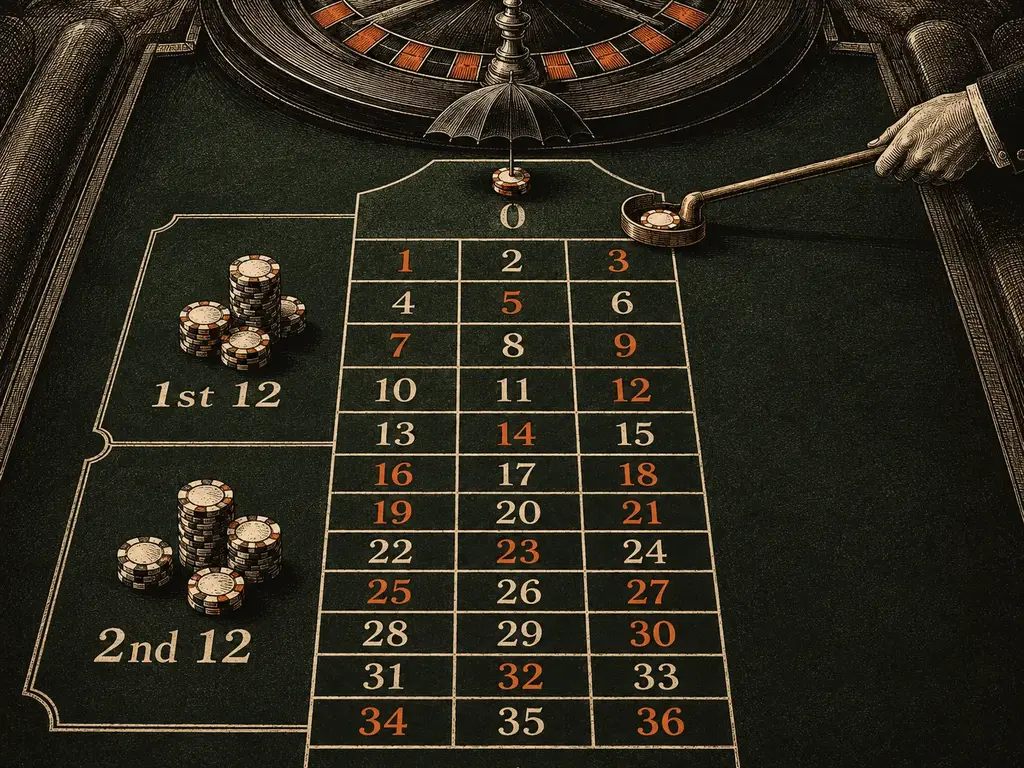
No. Each component is −2.70% of its stake, so the combination is −2.70% of the total. The problem works through why, computes the exact distribution, and shows what changes (the shape) and what does not (the price).
The problem
You stake $10 on the first dozenbetDozen1–12, 13–24 or 25–36, pays 2:1.Read full →, $10 on the second dozen and $1 on zerowheelZeroThe single green pocket that no even-money, dozen or column bet covers; the source of the house edge. Also: single zero, 0.Read full →. (a) What are the possible outcomes and their probabilities? (b) What is the expected valuemathExpected valueThe average result per bet over the long run. −1/37 of the stake for every standard European bet.Read full →? (c) Does the zero chipmoneyChipA token representing a fixed amount, placed on the layout to make a bet. Also: check.Read full → improve the bet?
Solution (a) and (b)
Outcomes: ballequipmentBallThe small ball launched along the track against the rotor. Modern balls are ivorine or Teflon, 18–21 mm.Read full → in 1–24 (24 pocketsequipmentPocketOne of the 37 numbered compartments on the rotor. Also: slot, cup.Read full →): one dozen pays $20, the other loses $10, zero loses $1: net +$9. Ball in 25–36 (12 pockets): both dozens lose, zero loses: −$21. Ball on zero (1 pocket): dozens lose $20, zero pays $35: +$15. EV = (24 × 9 + 1 × 15 − 12 × 21)/37 = (216 + 15 − 252)/37 = −21/37 ≈ −$0.57 per spin on $21 staked: 2.70%.
Solution (c)
Without the zero chip: (24 × 10 − 13 × 20)/37 = (240 − 260)/37 = −20/37 ≈ −$0.54 on $20 staked, also 2.70%. The zero chip has turned the −$20 zero outcome into +$15 (an improvement of $35 one time in 37, worth $0.95 per spin) and cost $1 on the other 36 spins (worth $0.97 per spin). Net change: −$0.03 per spin, which is 2.70% of the extra dollar. The insurance is priced exactly like everything else.
Why this generalizes
Expected values add. Any set of simultaneous bets has EV equal to the sum of the components’ EVs, each of which is −1/37 of its stake. So any combination is −1/37 of the total stake. There is no arrangement of chips on the layoutequipmentLayoutThe printed betting grid on the table. Also: table, felt, cloth.Read full →, however many, that escapes this; the Bet Builder tool will confirm it for any set you can place. What combinations change is the distribution: how often you win, how much, and how bad the worst case is.
A harder follow-up
Find a combination of standard bets that covers all 37 numbers. Three dozens ($10 each) plus $1 on zero: any of 1–36 nets −$1 (one dozen pays $20, the other two lose $20, zero loses $1), and zero nets +$35 − $30 = +$5. EV = (36 × (−1) + 5)/37 = −31/37 on $31 staked: 2.70%. You can guarantee that you are never surprised, and you still pay the same price for the privilege.
Formula
Questions
No, on a European table. On a French table, even-money betsbetEven-money betRed/black, odd/even, high/low. 18 numbers, pays 1:1.Read full → alone are 1.35%; adding anything else raises the blended edge.
Loses $1 per $1 on zero only, wins nothing otherwise. EV −2.70% with no upside: the one combination that is strictly pointless.
To choose a shape of session you enjoy. That is a legitimate reason and the only one.
Comic relief
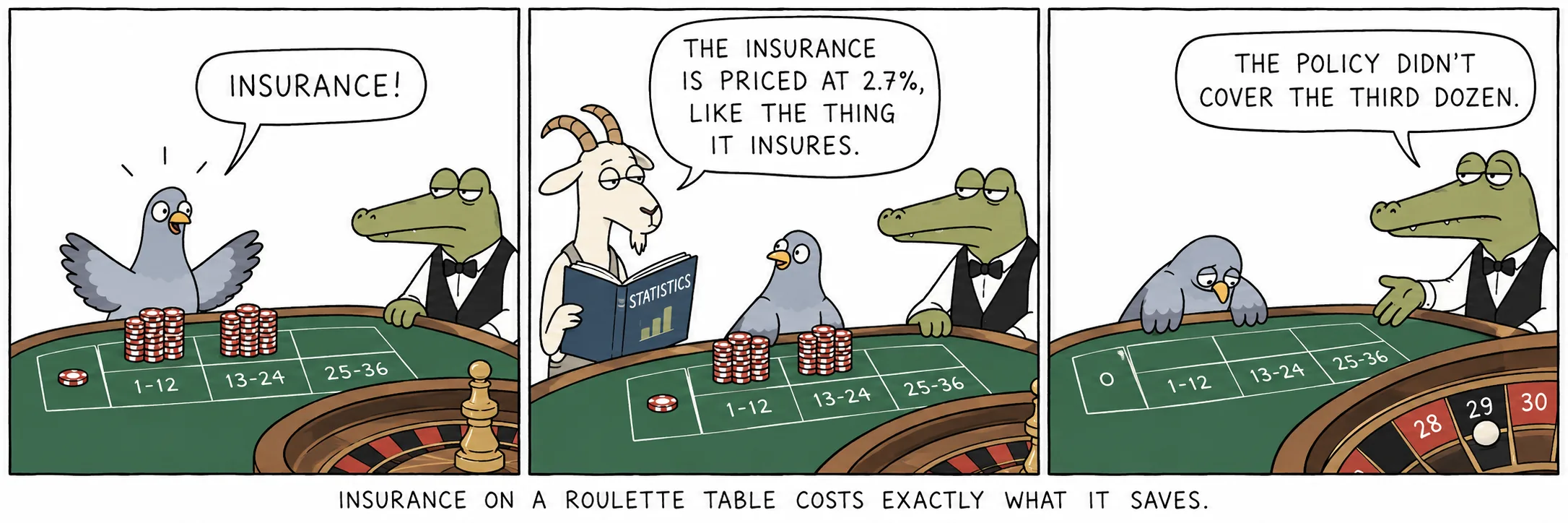
Insurance on a roulette table costs exactly what it saves.
Sources
- Ethier, S. N. The Doctrine of Chances: Probabilistic Aspects of Gambling.