Roulette Computers
How a computer times the ball, who built the first ones, and how accurate it has to be.
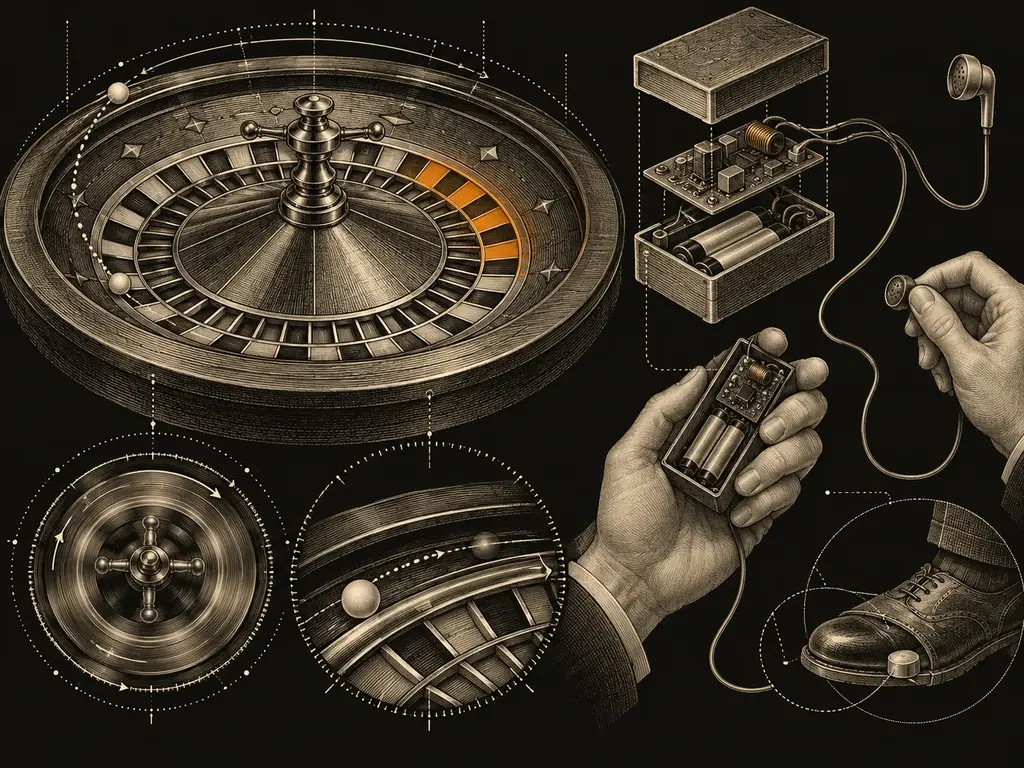
A roulette computer times the ball and the rotor in the first seconds of a spin and names the part of the wheel where the ball should land. Edward Thorp and Claude Shannon built the first in 1961, and the Eudaemons built digital ones from 1976. The method needs bets taken after the launch: live studios now close betting at the launch, and Nevada has banned such devices since 1985.
How the first roulette computer was built
The idea came to Edward Thorp in the spring of 1955, while he was a physics graduate student at UCLA: a wheel too well made to be biased should send the ballequipmentBallThe small ball launched along the track against the rotor. Modern balls are ivorine or Teflon, 18–21 mm.Read full → round as predictably as a planet. He filmed a cheap half-size wheel with a stopwatch in the frame and found it too irregular to predict, and a trip to Nevada in December 1958 showed him that casino wheels ran smoothly. Blackjack then took over. In November 1960, at MIT, he asked Claude Shannon to send his card-counting paper to the National Academy of Sciences; at the end of the meeting Shannon asked what else he was working on, and the roulette project moved into Shannon’s basement. They bought a regulation wheel from Reno for $1,500, set it on an old slate billiard table, and timed the ball against a strobe light and a clock read to a hundredth of a second. With practice their timing errors fell from about 0.03 to 0.01 seconds. By June 1961 the computer had twelve transistors and was the size of a cigarette pack: a switch in the shoe, worked with the big toe, timed the rotorequipmentRotorThe spinning part of the wheel that carries the pockets.Read full → and the ball, and a tone in one ear named one of the eight sectorswheelSectorA contiguous arc of pockets on the wheel, as distinct from a group on the layout.Read full → of the wheel. In Las Vegas that summer Shannon timed at the wheel and wrote down numbers like any system player, while Thorp bet dimes at the far end of the table. The predictions held up, but the hair-thin wires to the earpiece kept breaking, and once a woman beside Thorp stared in horror at the speaker poking out of his ear. They never bet seriously. Thorp announced the system in 1966 and published the details in 1979 and 1984.
The first digital computers
Thorp and Shannon’s machine was analog: its circuit was its program, and changing the method meant rewiring it. The microprocessor removed that limit. Alan Lewis, a student at Caltech, took a home-built digital computer in a camera case to Circus Circus in Las Vegas in 1972, timed wheels from a balcony above the tables and radioed predictions to a partner below. It ran, and made no money; he learned later that he had left out the tilt of the wheel. From 1976 a group of physics students at Santa Cruz, the Eudaemons, did the job thoroughly. They bought a casino wheel, measured the ball, the rotor, the tilt and the bounce, and wrote equations with five settings that the player adjusted for each wheel by clicking toe switches for about twenty minutes before betting. Their computer named one of eight sectors a few seconds into the spin. At a real table in January 1978 it gave an edge they put at 25%; the hardware, strapped to the body and later built into shoes, failed far more often than the physics (see The Eudaemons).
Why late bets mattered
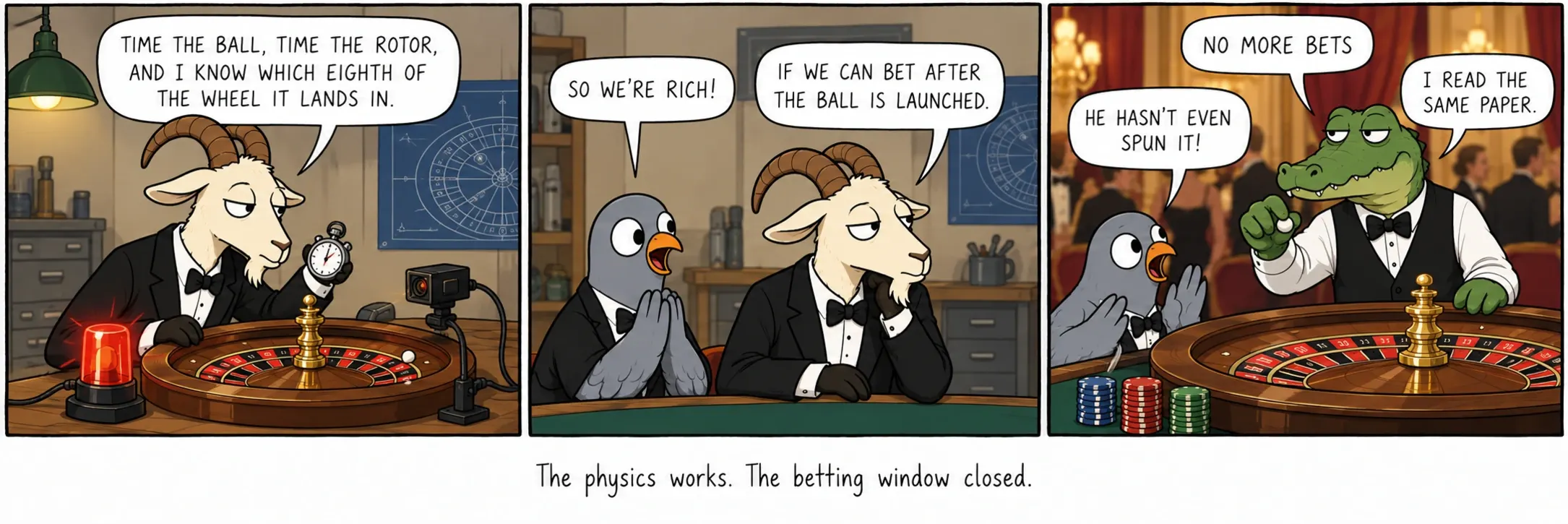
A casino can stop prediction completely by refusing bets once the ball is launched. Thorp found that almost none did: in Reno, Las Vegas, London, Monte Carlo, Nice, Venice and Puerto Rico the usual practice was to call “no more betsprocedureNo more betsThe dealer’s call (or the on-screen prompt) that closes betting. Chips may no longer be placed, moved or removed.Read full →” a revolution or two before the ball dropped. That window is what every prediction scheme since has needed, from the Eudaemons to the Ritz team’s late calls on the racetracktableRacetrackThe oval strip on live and electronic layouts showing the numbers in wheel order, used to place neighbors and sector bets in one tap.Read full →. Nevada outlawed prediction devices in May 1985, and live studios now close betting at the launch.
How casinos fought back
In the years when bets were still taken after the launch, casinos fought suspected players through the dealer. Accounts of Norman Leigh’s system players at Nice in 1966 and of later prediction teams describe a new croupierpeopleCroupierThe dealer at a roulette table.Read full → every spin, a changed ball, spins made short or fast, a table crowded with the casino’s own people, and finally a closed table. These stories come from the players’ side and are hard to check (Goldman, 2007). The tactics make sense all the same: a short or fast spin cannot aim the ball at a pocketequipmentPocketOne of the 37 numbered compartments on the rotor. Also: slot, cup.Read full →, but it does upset the timing a predictor measures.
How good the prediction must be
Thorp (1984) worked out what a prediction is worth when its error follows a bell curve: in a typical spin the predicted pocket is off by σ pockets one way or the other. Bet the predicted number alone, or it and two neighborsbetNeighborsA number and the two pockets on either side of it on the wheel, five straight-up chips.Read full → on each side, and the edge depends on σ alone. A perfect prediction would win every straight upbetStraight upA single number, pays 35:1.Read full →. At σ = 10 pockets, the accuracy Thorp and Shannon reached, a straight up returns about +44%, the figure Thorp gives for their device; his 1998 account puts it on the most favored eighth of the wheel. The edge falls fast as the error grows and is gone at about 17 pockets on a European wheel and 16 on an American one, when the prediction misses by almost half the wheel. Thorp’s own error budget shows why that limit is close: separate errors of 1.4 and 5.5 pockets from timing the rotor and the ball, 7 from the ball’s fall across the deflectorsequipmentDeflectorOne of the metal obstacles on the apron that scatter the falling ball. Also: canoe, diamond, pin.Read full → and 6 from the bounce in the pockets combine to about 10.8.
Questions
No. There is no ball. The number is drawn by software before the animation.
They would be vulnerable to timing, which is why none are run that way.
Fun with Math
Try these yourself first. Each solution is folded; open it when you are ready.
A neighborsbetNeighborsA number and the two pockets on either side of it on the wheel, five straight-up chips.Read full → call puts one chipmoneyChipA token representing a fixed amount, placed on the layout to make a bet. Also: check.Read full → on a number and on the two pocketsequipmentPocketOne of the 37 numbered compartments on the rotor. Also: slot, cup.Read full → either side of it on the wheel: five chips. How often must a prediction land in those five pockets to break even, and what does it earn if it is right one time in five?
Show the solution
Answer It breaks even at 5 in 36, 13.9%, against 13.5% by chance alone. Right one time in five, it returns 44% more than it stakes.
If the call hits, one chip wins 35 to 1 and comes back with its winnings, 36 chips, and the other four are lost. So a hit returns 36 for 5 staked, and the call breaks even if it hits 5 times in 36, 13.9%. By chance it hits 5 times in 37, 13.5%. That small gap, less than half a percentage point, is where the whole 2.70% comes from.
At one hit in five, 0.2 × 36 = 7.2 chips come back for every 5 staked, +44%. At one in four, +80%.
That is why a small gain in accuracy is worth so much, and why casinos close call betstableCall betA bet announced to the dealer rather than placed by hand, usually a wheel-sector bet such as voisins or tiers. Also “announced bet”.Read full → early at high stakes: that small gap is the house’s whole margin. The Ritz players of 2004 are reported to have bet this way.
Thorp listed four independent errors in his prediction, in pockets: 1.4 from timing the rotorequipmentRotorThe spinning part of the wheel that carries the pockets.Read full →, 5.5 from timing the ballequipmentBallThe small ball launched along the track against the rotor. Modern balls are ivorine or Teflon, 18–21 mm.Read full →, 7 from the ball’s fall across the deflectorsequipmentDeflectorOne of the metal obstacles on the apron that scatter the falling ball. Also: canoe, diamond, pin.Read full → and 6 from the bounce in the pockets. How large is the total, and how much do the two timing errors add?
Show the solution
Answer About 10.8 pockets in all. Without the timing errors it would be 9.2, so the two timings add only 1.6.
Independent errors do not add up directly; their squares do. The typical size of the total is the square root of the sum of the squares: 1.4² + 5.5² + 7² + 6² = 1.96 + 30.25 + 49 + 36 = 117.2, and √117.2 ≈ 10.8.
Without the two timing errors: √(49 + 36) = √85 ≈ 9.2.
A total of 10.8 pockets is inside the 17-pocket limit in the table on this page and is worth about +34% on a single number. The lesson Thorp drew: once the fall across the deflectors is the largest error, better timing buys little.
Comic relief
The physics works. The betting window closed.
Sources
- Thorp, E. O. “Optimal gambling systems for favorable games.”
- Thorp, E. O. The Mathematics of Gambling.
- Thorp, E. O. “The invention of the first wearable computer.”
- Bass, T. A. The Eudaemonic Pie.
- Small, M. & Tse, C. K. “Predicting the outcome of roulette.”
- Goldman, N. Great Gambling Scams.
- Nevada Revised Statutes, chapter 465.