Reading Published Spin Histories
Many live operators publish full spin histories. Here is how to read them, clean them, and what they can and cannot tell you.

A spin history is a list of results with timestamps, often per table. It is the raw material for bias analysis if, and only if, it identifies a single wheel headequipmentWheel headSynonym for rotor: the spinning part carrying the numbers.Read full → over a period without maintenance. Most do not, and most are too short.
What a history contains
Timestamp, table name, result (0–36), sometimes dealer name and round ID. It is a log of what the game server recorded, so it is accurate. What it rarely contains is the identity of the physical rotorequipmentRotorThe spinning part of the wheel that carries the pockets.Read full → head on that table at that time, which is the thing a bias analysis needs, because heads are rotated between bowlsequipmentBowlThe fixed outer part of the wheel: the wooden or composite rim that holds the ball track and apron, inside which the rotor spins.Read full →.
Cleaning the data
Check for gaps (maintenance, closures), for duplicate round IDs, for results outside 0–36 (00 on an American table, test spins), and for changes in dealer rotation that might mark a head swap. Split the data into segments at any gap longer than a few hours; treat segments as potentially different wheels. If the table name is the only identifier, assume the head changed at least monthly.
Running the tests
Per segment: chi-square over 37 pocketsequipmentPocketOne of the 37 numbered compartments on the rotor. Also: slot, cup.Read full → (df 36), sectorwheelSectorA contiguous arc of pockets on the wheel, as distinct from a group on the layout.Read full → z-scores in wheel order, and a binomial test for any pocket you suspected before looking. Then shuffle the results within the segment and rerun: the shuffled statistics are what fairness looks like with this exact sample size, and if your real statistics are not clearly outside the shuffled range, you have found nothing. The Wheel Bias Analyzer does this in the browser.
What you will find
Noise. Hot numbersmythHot numberA number that has appeared more often than expected recently. On a fair wheel it predicts nothing.Read full → at 13–15 hits per 300 spins, sectors at ±1.5 sigma, a chi-square around 36 ± 8. Occasionally a segment at p < 0.05, which is what one segment in twenty does. Treat it as a reason to look at the next segment from the same table, and expect it to vanish. Over a dozen histories you will have learned what randomness looks like at sample sizes of a few thousand, which is the most useful thing the Lab can teach.
What the histories are good for
Checking the dealer’s announcement against the log. Measuring pace (spins per hour) for the expected-loss calculation. Learning the birthday problemmathBirthday problemHow many people it takes before two probably share a birthday, or how many spins before a number probably repeats. On a 37-pocket wheel, 8 spins are enough for a better-than-even chance.Read full →, streak lengths and the hot-number distribution on real data. Building the intuition that saves money: a pattern in 500 spins is not a pattern. And, in principle, as the first page of a bias notebook that modern maintenance will make obsolete before it fills.
Questions
Rarely. Floors display 20 numbers and keep the rest internal.
Transparency, and because players ask. It costs them nothing on a maintained wheel.
Chi-square for the whole segment. If it is unremarkable, stop.
Comic relief
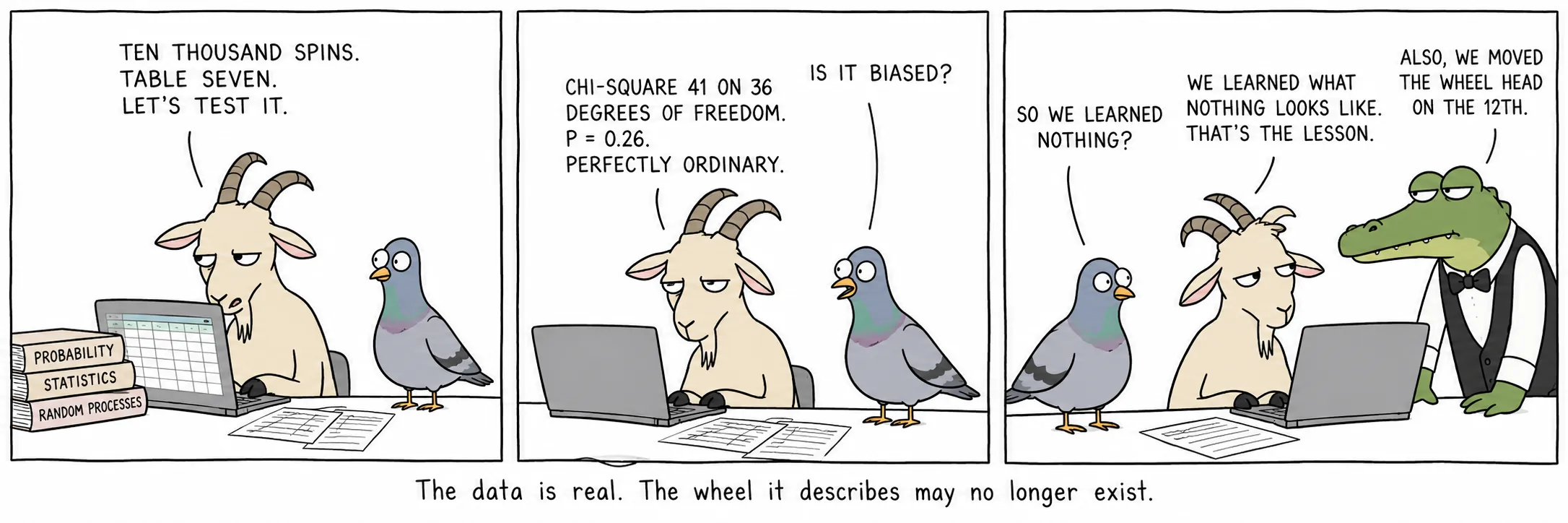
The data is real. The wheel it describes may no longer exist.
Sources
- Pearson, K. “On the criterion that a given system of deviations from the probable…”
- Barnhart, R. T. Beating the Wheel.