Joseph Jagger: The Roulette Strategy at Monte Carlo
A Yorkshire textile businessman, a reported roulette fortune, and the evidence behind the story.
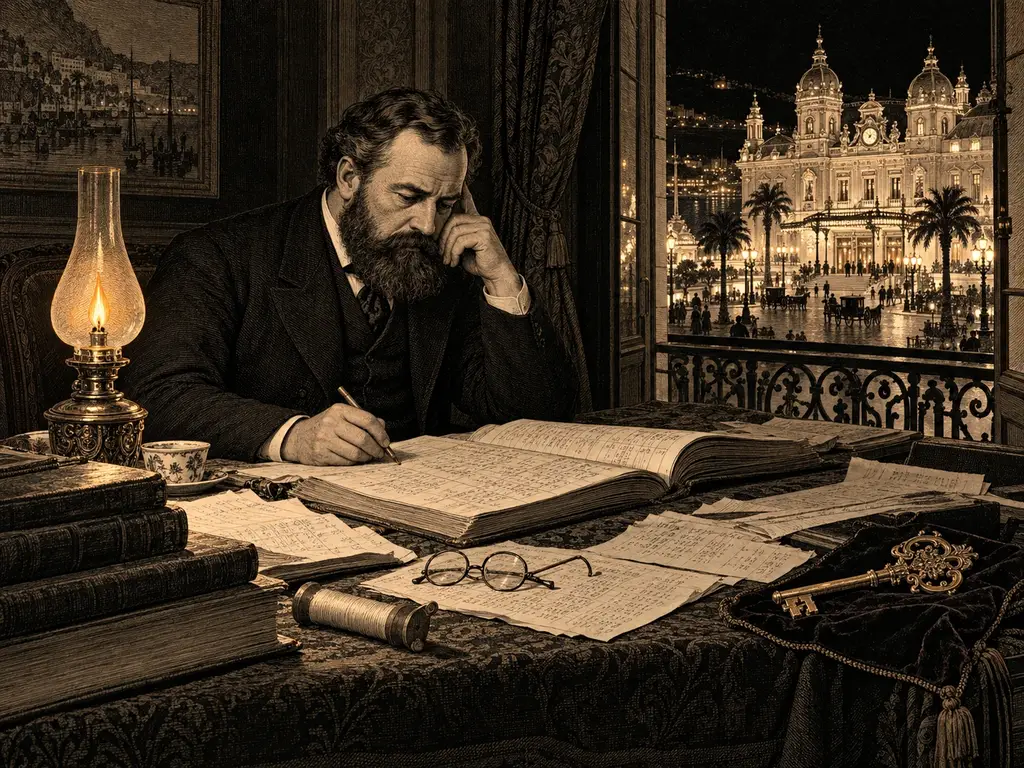
Joseph Hobson Jagger (1830–1892) is remembered for a reported roulette win at Monte Carlo. Victor Bethell’s later account describes recording wheels and betting favored numbers. Biographer Anne Fletcher revisited the story through family archives. The precise winnings, dates and playing method remain harder to establish.
A textile worker behind the legend
Joseph Hobson Jagger worked in Yorkshire’s textile trade. His biographer and relative Anne Fletcher describes a man whose experience with machinery helped shape his interest in roulette. Her research draws on family archives and official records. It offers a reconstruction of his life, rather than a contemporary betting log.
Bethell’s account
Victor Bethell’s Monte Carlo Anecdotes and Systems of Play appeared in 1901. The chapter “Jaggers’s System”, read here in the 1910 printing, describes a Yorkshire mechanic who hired six clerks to record different wheels. After a month, Bethell says, he selected numbers that had appeared unusually often.
The account reports £120,000 in winnings. When the casino moved its wheels between tables, Jaggers lost £40,000, then recognized the wheels by small marks and regained that money. Bethell says new wheels with movable pocketequipmentPocketA compartment on the rotor in which the ball can settle. The number of pockets depends on the wheel.Read full definition → partitions eventually stopped the method and that Jaggers left about £80,000 ahead. The chapter does not explain every change in that balance.
These are Bethell’s reported figures, not an audited record. He gives no exact year, saying the events were more than twenty years earlier. Fletcher’s 2021 article describes the difficulty of finding independent contemporary coverage; that is a limit on the available evidence, not proof that no report can exist.
Two kinds of evidence
Bethell tells a retrospective casino story. Fletcher asks what family and official records can establish about the man behind it. Reading them together is useful, but their different purposes matter.
| source | what it describes | limit |
|---|---|---|
| Bethell’s account | clerks, wheel observations and about £80,000 kept | a later narrative, not an audited balance |
| Fletcher’s research | Jagger’s life and surviving family evidence | a biographical reconstruction |
When he was there
Bethell gives no exact year for the play he describes. Fletcher’s 2018 newspaper extract opens with a scene set in 1881. That scene is a later reconstruction, so it should not be treated as a contemporary record of a particular visit. The sources discussed here do not establish a complete itinerary or the duration of his play.
Who went with him
Bethell describes six hired clerks. Fletcher’s newspaper extract instead names Jagger’s son Alfred and nephew Oates as companions. These accounts should not be merged into a single verified team list.
What the casino did
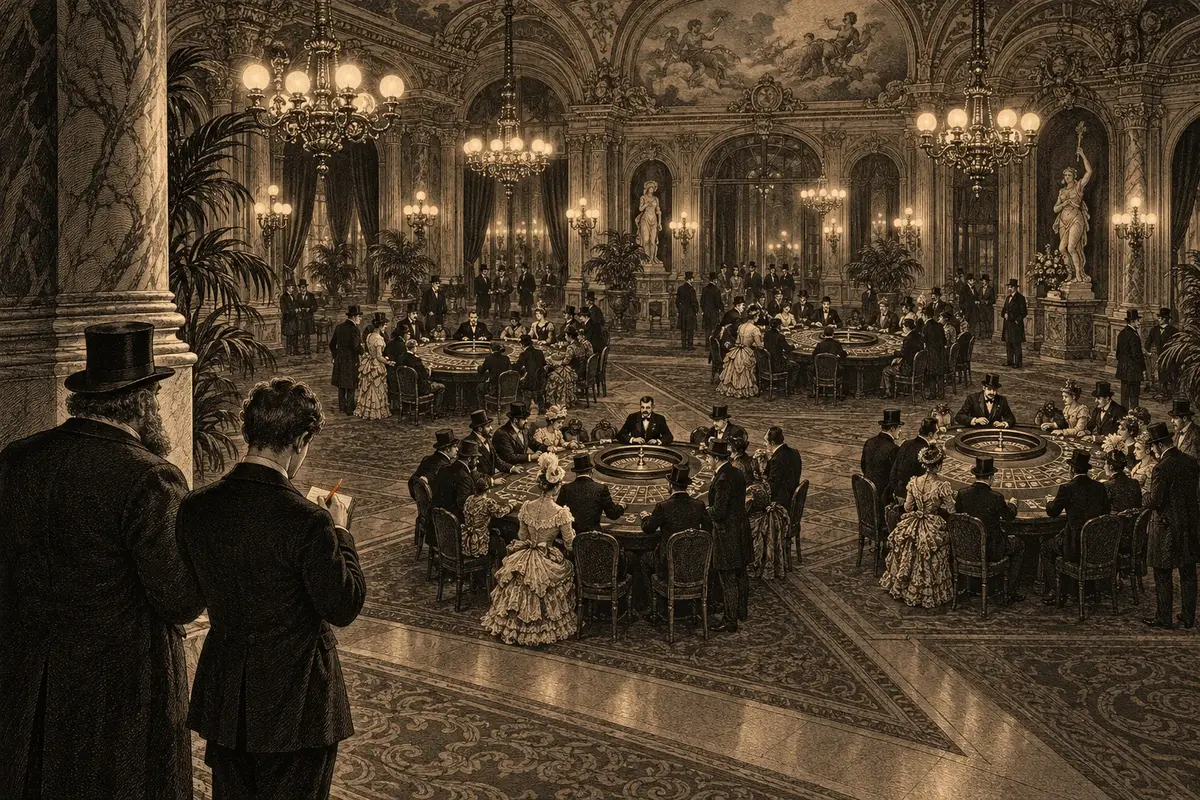
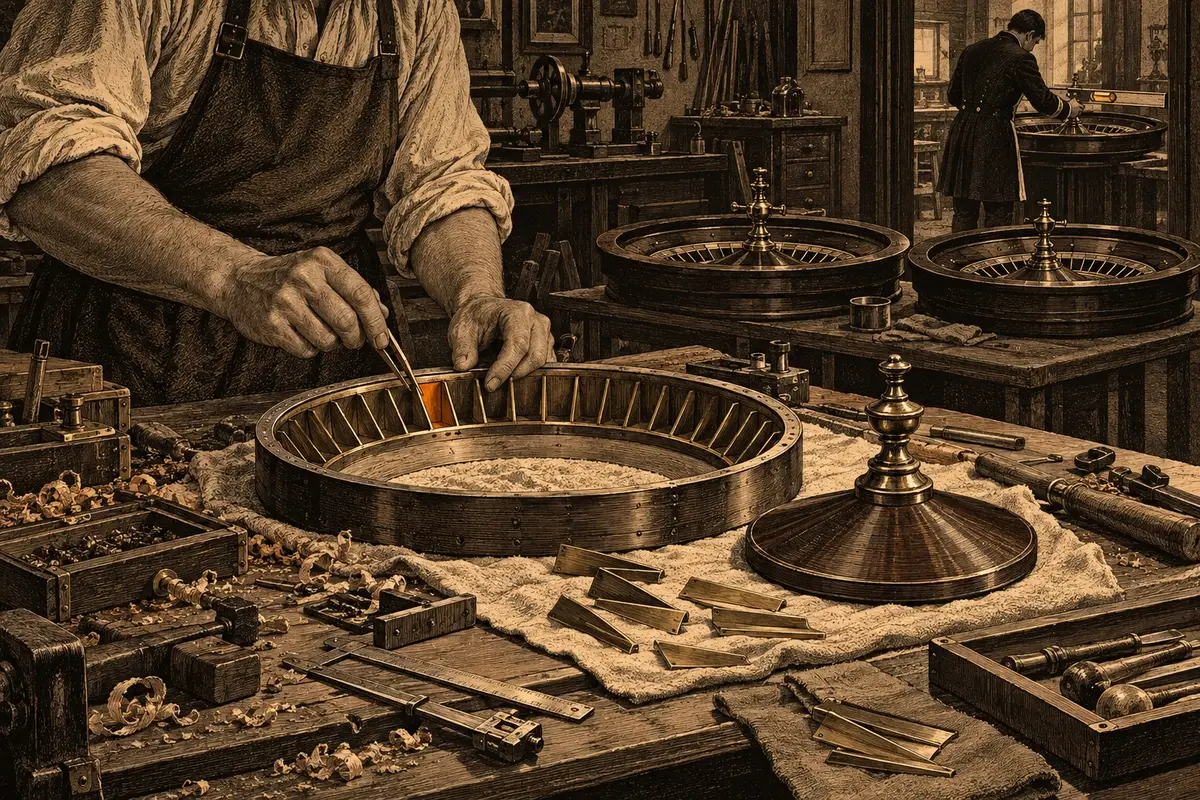
Bethell says the casino moved wheels between tables, then introduced replacement wheels with movable pocket partitions. In his account, identifying a previously favorable wheel eventually stopped being enough. This is his explanation of how the advantage ended, not a casino maintenance record or proof of the mechanism.
How big a bias has to be
For a straight-up bet paying 35 to 1, the expected net return per unitmoneyUnitA base amount used to express stakes or results.Read full definition → staked is 36p − 1, where p is the number’s true chance of winning. The bet breaks even at p = 1/36. A positive expected return requires more than that; a uniform single-zerowheelZeroThe 0 outcome, conventionally shown in green. Ordinary color, parity, high/low, dozen and column bets do not include it.Read full definition → wheel gives only 1/37.
Consider an illustrative 15,000-spin sample: 500 spins a day for 30 days. For one number chosen in advance on a uniform independent wheel, the expected count is about 405 and its standard deviationmathStandard deviationThe square root of variance: a measure of dispersion in the same units as the result.Read full definition → is about 20. Seeing 465 hits would be about three standard deviations above the expectation.
The observed rate, 465/15,000, gives an estimated return of +11.6%. It does not establish that the next bets have that edge. The estimate is uncertain, and picking a number after inspecting all 37 pockets makes an unusually high count less surprising. A useful investigation needs a test that accounts for that search and fresh data to check whether the effect persists. One month is not a guarantee of detecting a profitable bias. The assumed pace is not a historical measurement of Jagger’s tables.
| average spins per hit | expected net return per unit staked |
|---|---|
| 37 spins (a fair wheel) | −2.70% |
| 36 spins | 0% |
| 34 spins | +5.9% |
| 32 spins | +12.5% |
| 30 spins | +20% |
Afterwards
Fletcher’s newspaper extract describes Jagger investing in houses while continuing to live modestly in Bradford. Property ownership can help explain what happened after a reported win, but it does not by itself establish how much was won at roulette. A precise net profit would require reliable records of stakes, payoutsmoneyPayoutThe amount paid on a winning wager. Check whether the quoted figure is net profit or total return including the stake.Read full definition → and expenses.
The song
Fletcher explains that her family associated Jagger with “The Man Who Broke the Bank at Monte Carlo”. Her newspaper extract instead connects the song with Charles Wells. A shared nickname can blur two different stories; see The Man Who Broke the Bank for the account of Wells.
Questions
Bethell reports a substantial win, and Fletcher argues for a real event behind the family story. The sources discussed here do not provide an independently audited betting record or verify every detail of the method.
The sources reviewed here do not establish a verified family relationship.
Fletcher describes property purchases and a modest way of life. Those details do not establish an exact fortune at death, and a reported casino win should not be confused with the value of an estate.
Comic relief
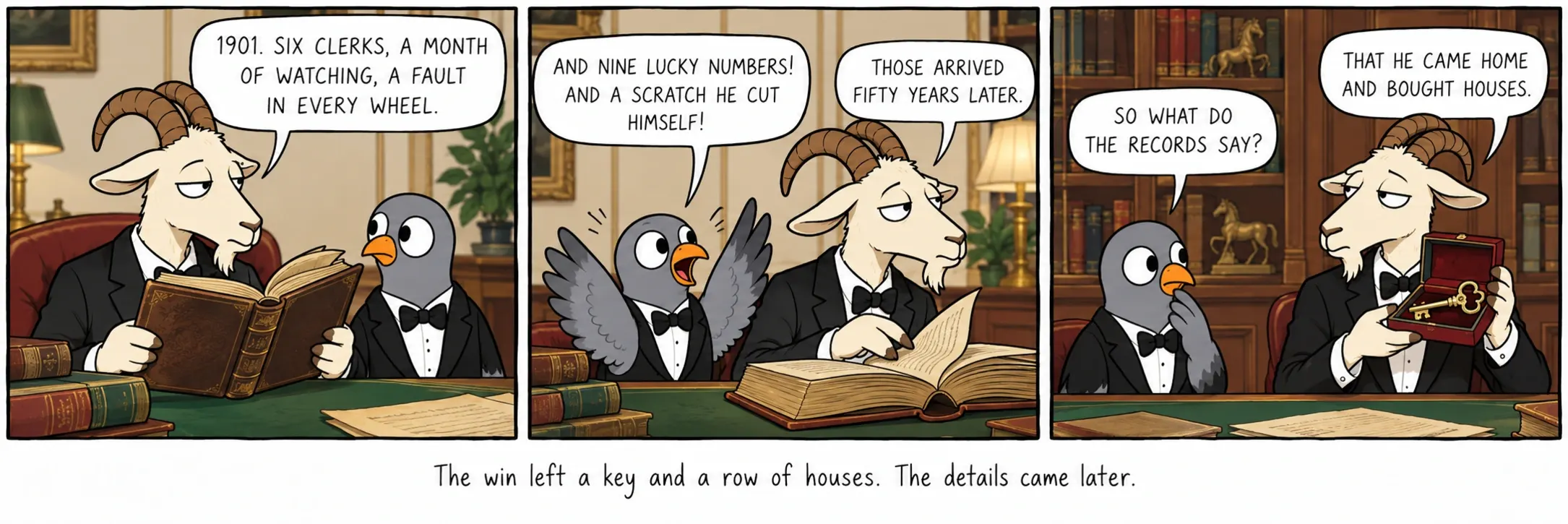
Later retellings can add details the earlier sources never gave.
Sources
- Fletcher, A. From the Mill to Monte Carlo.
- Fletcher, A. “The true story of the man who broke the Monte Carlo bank: Joseph Hobson Jagger.”
- Bethell, V. Monte Carlo Anecdotes and Systems of Play.
- Quinn, R. The Man Who Broke the Bank at Monte Carlo.
- Bethell, chapter “Jaggers’s System”, 1910 printing, pp. 63–66
- Anne Fletcher, Historia, 19 June 2021
- Anne Fletcher, Daily Mail Life extracts, 15 August 2018, pp. 30–31
- Anne Fletcher, Joseph Hobson Jagger: the true story, 23 November 2018