European vs American Roulette
Single zero, 37 pockets, 2.70%. The default wheel on this site and in most of the world outside the United States.
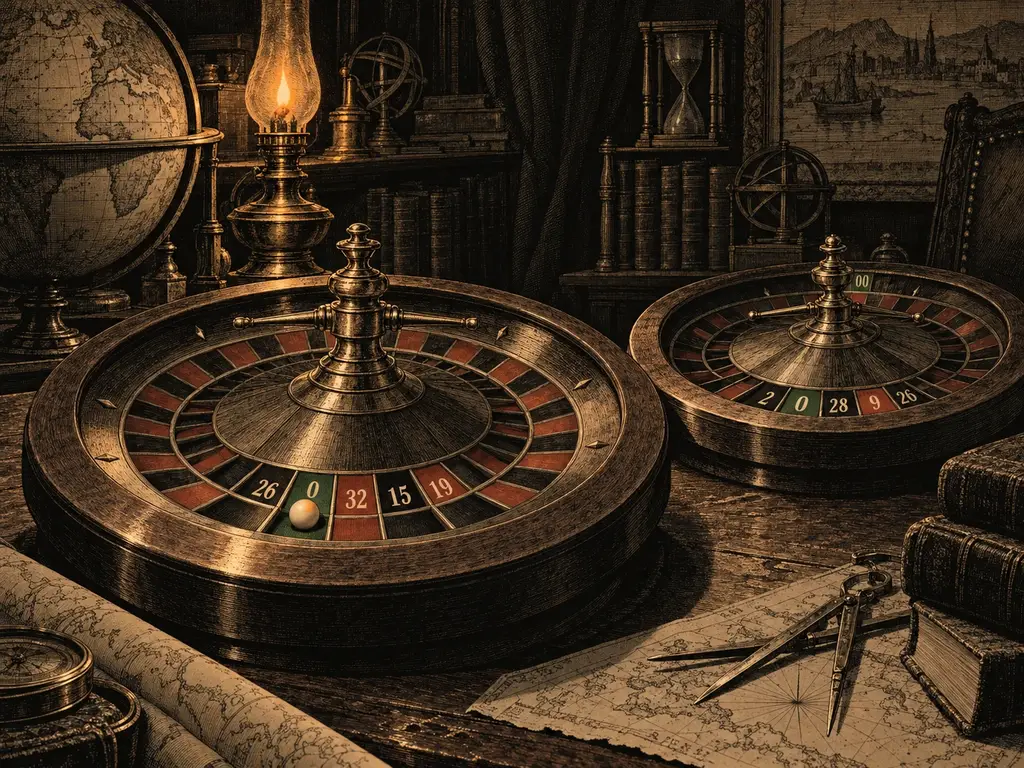
“European” means one zero. Compared with the American double-zero wheel the house edge is roughly half.
Variants at a glance
The word “roulette” covers three mainstream games and a handful of novelty formats. They share the layoutequipmentLayoutThe printed betting grid on the table. Also: table, felt, cloth.Read full →, the bets and the payoutmoneyPayoutWhat a winning bet returns, quoted as “X to 1” on top of the returned stake.Read full → table. They differ in the number of pocketsequipmentPocketOne of the 37 numbered compartments on the rotor. Also: slot, cup.Read full → and in what happens to even-money betsbetEven-money betRed/black, odd/even, high/low. 18 numbers, pays 1:1.Read full → when zerowheelZeroThe single green pocket that no even-money, dozen or column bet covers; the source of the house edge. Also: single zero, 0.Read full → hits. That is enough to move the house edgemathHouse edgeThe share of each stake the casino keeps on average: 2.70% in European roulette.Read full → from 1.35% to 7.69%.
Why one pocket matters so much
Payouts do not change when a pocket is added. A straight upbetStraight upA single number, pays 35:1.Read full → pays 35 to 1 on a 37-pocket wheel and 35 to 1 on a 38-pocket wheel. Every extra house pocket is therefore pure cost: it is one more way to lose on every bet while the price of winning stays the same. From 37 to 38 pockets the edge goes from 1/37 to 2/38, almost double.
What the difference costs
Over 100 spins at $10 the expected lossmathExpected lossExpected value times total amount wagered; the average amount lost over a session or a period.Read full → is about $27 on a European wheel and about $53 on an American one. Over a year of weekly sessions that is $1,400 against $2,700, for a game that looks and plays identically. The comparison is the strongest piece of practical advice on this site: if you have a choice of wheels, the number of zeros matters more than any system.
History in one paragraph
Both zeros were on the first Paris wheels of the 1790s. In 1843 François and Louis Blanc opened a casino at Bad Homburg with a single-zero wheel to undercut the spa casinos of Baden-Baden and Wiesbaden. The lower edge drew players; the wheel followed Blanc to Monte Carlo in 1863 and from there became the European standard. The double zerovariantDouble zeroThe 00 pocket of the American wheel. Its presence raises the house edge from 2.70% to 5.26%.Read full → survived in America, where the game arrived with French settlers before the change.
Finding the right table online
Look for “European” or “French” in the table name and check the info panel for la partageruleLa partageFrench rule: when zero hits, half of an even-money stake is returned. Halves the house edge on those bets to 1.35%.Read full →. Online lobbies list all three variants side by side and the American one is sometimes the default because the graphics are familiar to US players. The pockets are listed; count them.
Questions
Same wheel. French roulettevariantFrench rouletteSingle-zero wheel with la partage or en prison, lowering the even-money house edge to 1.35%.Read full → adds la partage or en prisonruleEn prisonFrench rule: when zero hits, an even-money bet is held for the next spin instead of lost. Halves the house edge on those bets.Read full →, which halves the edge on even-money bets. A European table without those rules is 2.70% on everything.
Revenue. Single-zero tables exist in US high-limit rooms where the minimums compensate.
Yes. European and American wheels use different sequences; see the wheel page.
Comic relief
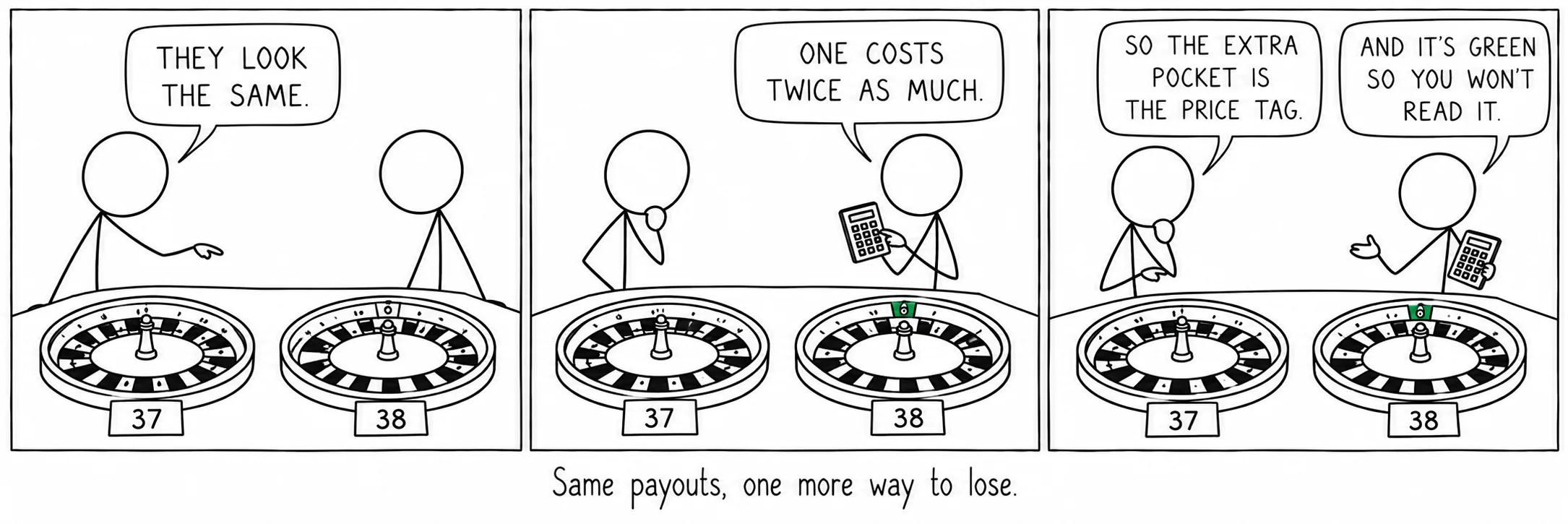
Same payouts, one more way to lose.
Sources
- Ethier, S. N. The Doctrine of Chances: Probabilistic Aspects of Gambling.
- Schwartz, D. G. Roll the Bones: The History of Gambling.