James Bond Roulette Strategy
A fixed spread of 20 units: 14 on 19–36, 5 on the 13–18 six line, 1 on zero.
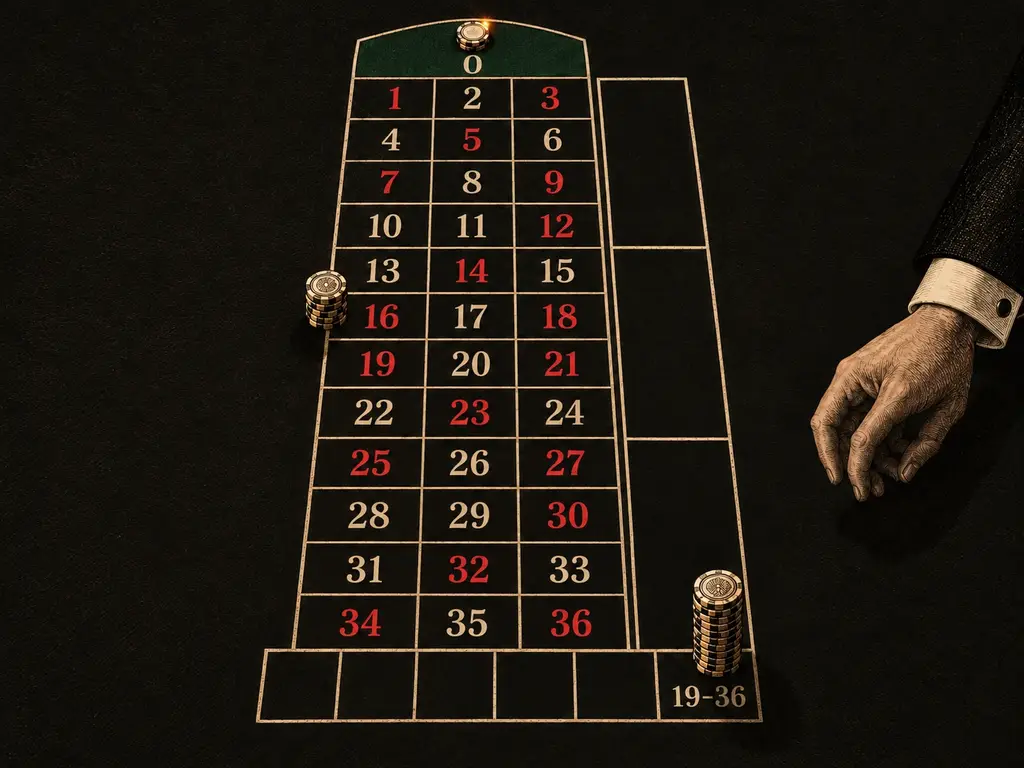
On a fair single-zero wheel, this spread has a 25/37 chance of profit, about 67.57%. Numbers 1–12 lose all 20 units. With standard payouts, expected loss is 20/37 units per spin, about 2.70% of the total stake.
What is the James Bond (007) roulette strategy?
Twenty unitsmoneyUnitA base amount used to express stakes or results.Read full definition → per spin, split three ways: 14 units on high (19–36), 5 units on the six linebetSix lineA bet on six numbers in two adjacent layout rows, ordinarily paying 5 to 1.Read full definition → 13–18, 1 unit straight upbetStraight upA wager on one number, ordinarily paying a profit of 35 to 1.Read full definition → on zerowheelZeroThe 0 outcome, conventionally shown in green. Ordinary color, parity, high/low, dozen and column bets do not include it.Read full definition →. Twenty-five numbers are covered; the twelve numbers 1 to 12 are not. In Chapter 7 of Ian Fleming’s Casino Royale (1953), Bond backs two dozensbetDozenA bet on 1–12, 13–24 or 25–36, ordinarily paying 2 to 1.Read full definition → at the table maximum. That passage describes a different bet from this 14–5–1 spread; it does not establish the spread’s origin.
What does each result pay?
19–36 hits (18 numbers): high pays 14, the six line and zero lose 6, net +8. 13–18 hits (6 numbers): the six line pays 25, high and zero lose 15, net +10. Zero hits: 35 − 19 = +16. 1–12 hits (12 numbers): everything loses, −20.
| ball lands on | numbers | probability | result (units) |
|---|---|---|---|
| 19–36 | 18 | 48.65% | +8 |
| 13–18 | 6 | 16.22% | +10 |
| 0 | 1 | 2.70% | +16 |
| 1–12 | 12 | 32.43% | −20 |
What does a session look like?
On each fair single-zero spin, the chance of a profit is 25/37 (about 67.57%); the chance of losing all 20 units is 12/37 (about 32.43%). For 37 fully funded independent spinsmathIndependent spinsSpins for which learning an earlier outcome does not change the probabilities assigned to a later one.Read full definition → at 20 units each, the total wagered is 740 units and the expected net result is −20 units. That is an average across repeated sessions under these assumptions, not a prediction of the counts or result in one session. Frequent smaller profits do not outweigh the larger losses in expectation.
- p10 −$500
- p25 −$500
- median −$280
- p75 −$86
- p90 +$120
What if you double it after a loss?
Some players double the whole spread after a losing spin (1–12). On independent fair single-zero spins, the probabilitymathProbabilityA measure of how likely an event is, from zero to one. Percentages express the same scale from 0% to 100%.Read full definition → that the next two spins both lose is (12/37)², about 10.52%. After those two losses, the next proposed stake is 80 units. At $1 per unit, five consecutive losses use stakes of $20, $40, $80, $160 and $320; the next $640 stake exceeds a $500 combined stake limit. Doubling this spread does not guarantee recovery on the next profitable spin. After losing 20 units, a doubled spread that wins on high nets 16 units, leaving the cycle down 4. Expected lossmathExpected lossThe probability-weighted average net loss under a stated model. With a constant edge, it equals edge times expected total stakes.Read full definition → per unit staked remains 1/37 under standard payoutsmoneyPayoutThe amount paid on a winning wager. Check whether the quoted figure is net profit or total return including the stake.Read full definition →.
Why is it popular?
The spread is easy to follow: three bets produce four possible net results. The chipmoneyChipA token used to place a wager, with a printed or assigned value. Also called a check in some casino terminology.Read full definition → on zero covers zero only; it does not protect against a result from 1 to 12. You can have a profit on the next spin with probability 25/37 and still lose money over a session. The 20-unit stake and the size of a full loss matter alongside the chance of a win.
Questions
The verified roulette passage in Chapter 7 of Casino Royale describes two-dozen betting, not the 14–5–1 spread. It does not identify who named this spread.
So that every winning outcome returns a profit. Scale them (140/50/10) and the proportions hold.
Compare equal total stakes of 20 units on a fair single-zero wheel with standard payouts. Ten units on each of two dozens nets +10 on 24 numbers and −20 on the other 13. The Bond spread nets +8, +10 or +16 on its 25 covered numbers and −20 on the other 12. Both have the same expected loss: 20/37 units per spin. Their probabilities and possible profits differ.
Comic relief
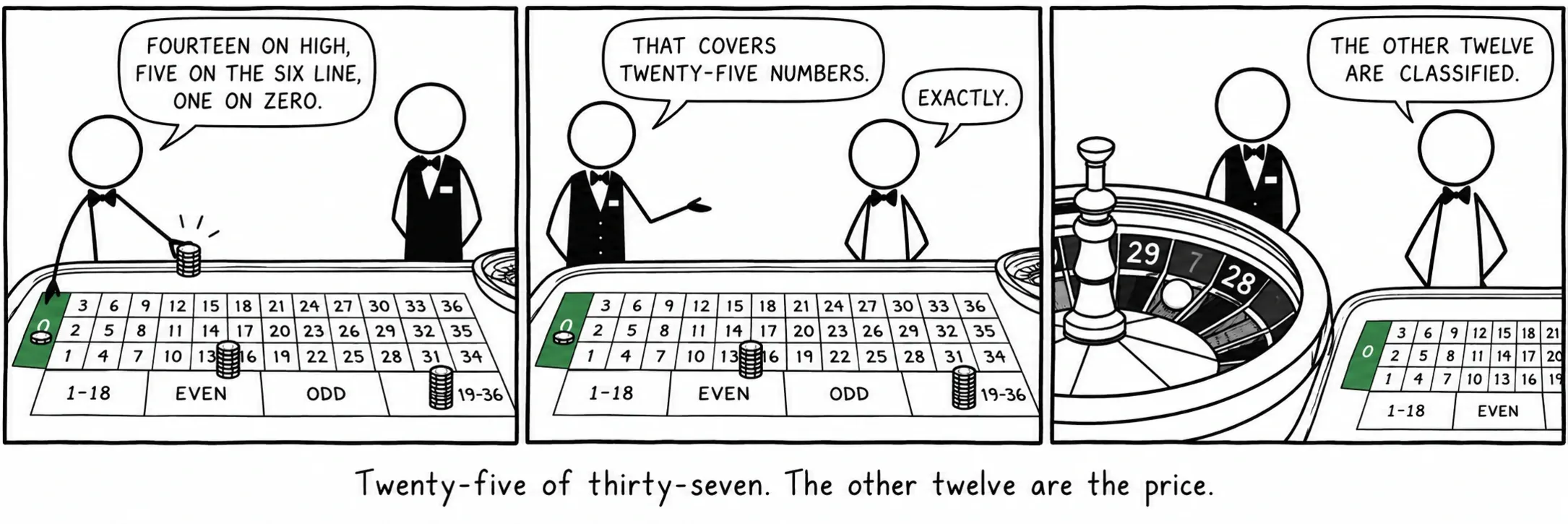
This 20-unit single-zero spread profits on 25 pockets and loses all 20 units on the other 12.
Sources
- RouletteDoc. Strategy description and examples.
- Roulette77. Strategy description and examples.
- Ethier, S. N. The Doctrine of Chances: Probabilistic Aspects of Gambling.
- Fleming, I. Casino Royale.