Walkthrough: A Martingale Session
Ten dollars on red, doubled after every loss, at a $500 table. Spin by spin, including the spin that ends it.
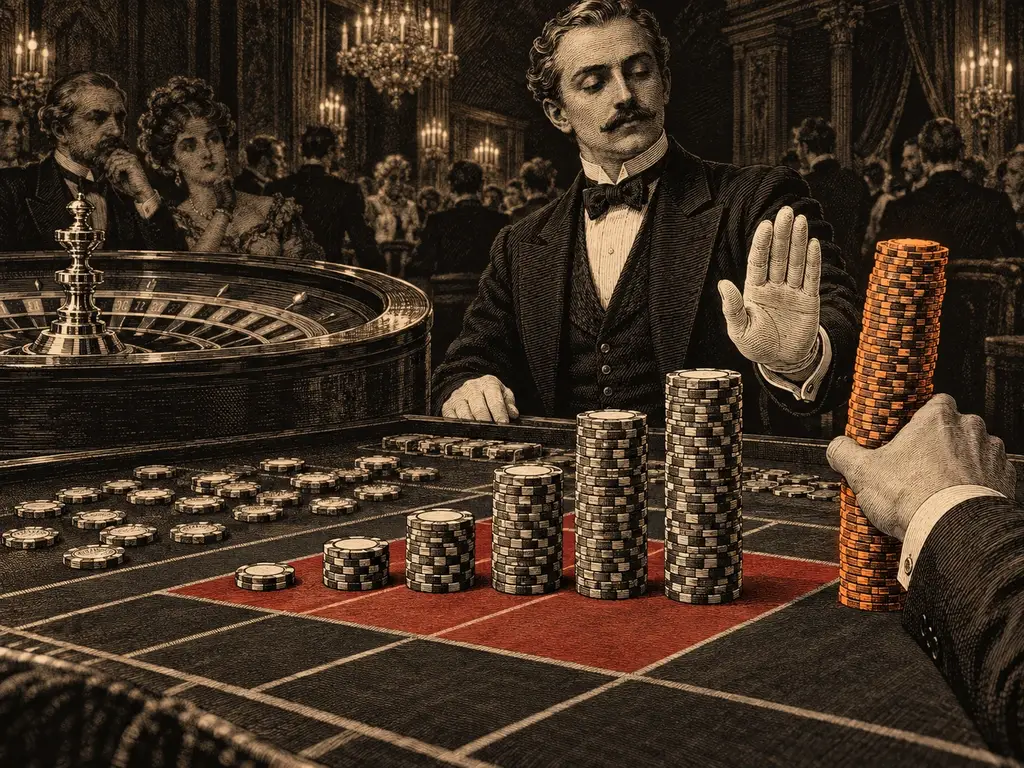
A simulated Martingale session from a $1,000 bankroll. Forty-one small wins, then six losses in a row and a refused seventh bet. The session ends down $220 after being up $410, which is what the system does.
The plan
Bet $10 on redbetRedEven-money bet on the 18 red numbers. French: rouge.Read full →. After a loss, double. After a win, back to $10. Table limittableTable limitMinimum and maximum bet allowed. The maximum is what stops doubling progressions.Read full → $500, so the stakes are 10, 20, 40, 80, 160, 320 and then a $640 bet that the table will refuse. Six consecutive losses break the system; each attempt has (19/37)⁶ ≈ 1.8% of doing so, and a 100-spin session contains about 50 attempts. Expected: roughly a 60% chance of breaking within 100 spins, and a loss of $630 when we do.
Spins 1–30
Ordinary MartingalestrategyMartingaleProgression that doubles the bet after each loss. See the Strategy section for what it does and does not do.Read full →: strings of one to three losses, each ended by a win that nets +$10. By spin 30 we have had 17 wins, each closing a cycle, and are up $170. The largest stake so far was $80 after three losses. It feels like a machine for printing $10 bills.
Spins 31–60
More of the same, with one four-loss cycle (stakes to $160, then a win) that briefly put $310 on the table and felt like courage. After 60 spins: 41 cycles completed, up $410, and the bankrollmoneyBankrollThe total amount set aside for play. Bankroll management is deciding how much of it to risk per bet and per session.Read full →’s low point was $1,040. The histogram of every Martingale session looks like this for most of its length.
Spins 61–66
L L L L L L. Stakes 10, 20, 40, 80, 160, 320: $630 lost. The next bet would be $640; the limit is $500. The system is broken. We can bet $500 (and if it wins, still be $130 down on the cycle) or reset to $10 and accept the loss. Six blacksbetBlackEven-money bet on the 18 black numbers. French: noir.Read full → or zeroswheelZeroThe single green pocket that no even-money, dozen or column bet covers; the source of the house edge. Also: single zero, 0.Read full → in a row has probabilitymathProbabilityChance of an outcome, from 0 to 1 or 0% to 100%. One number: 1/37 = 2.70%.Read full → 1.8% per cycle. We had run about 45 cycles. The chance of reaching this point somewhere in 45 cycles was about 55%. It was not bad luck; it was the median.
- p10 −$1,000
- p25 −$1,000
- median −$1,000
- p75 +$790
- p90 +$1,690
The accounts
Up $410 after 60 spins, down $220 after 66. Total wagered: about $2,100 over 66 spins, against $660 for a flat $10 bettor. Expected lossmathExpected lossExpected value times total amount wagered; the average amount lost over a session or a period.Read full → on $2,100 of turnovermoneyTurnoverThe total amount wagered over a session or period, counting re-bet winnings. Also: handle, action.Read full → is $57; our actual −$220 is about a third of a standard deviationmathStandard deviationSquare root of variance; the typical distance of a result from the expected value.Read full → below that, which is unremarkable for a system whose distribution has a long left tail. Had we stopped at spin 60 with a stop-winstrategyStop-winA pre-set profit target at which you end the session.Read full → of $400, we would have left up $410, and the next session would have carried the same 1.8% per cycle.
What the session shows
Martingale converts a 48.65% bet into a sequence that wins 98% of its cycles and loses 63 unitsmoneyUnitThe base stake a system or a player works in. Progressions are described in units so they apply at any table.Read full → on the other 2%. It does not change the expected loss per dollar; it multiplies the dollars. The flat bettor beside us wagered a third as much and lost, on average, a third as much. The player who runs this system for a year will win most evenings and lose the year.
How often a losing streak comes
An even-money bet on a single-zero wheel loses 19 spins in 37. Each row is the chance that a given run of spins all lose, and what a Martingale player, who doubles after every loss, has lost by then.
| losses in a row | chance | about 1 in | lost so far | next bet |
|---|---|---|---|---|
| 1 | 51.4% | 2 | $1 | $2 |
| 2 | 26.4% | 4 | $3 | $4 |
| 3 | 13.5% | 7 | $7 | $8 |
| 4 | 7.0% | 14 | $15 | $16 |
| 5 | 3.6% | 28 | $31 | $32 |
| 6 | 1.8% | 55 | $63 | $64 |
| 7 | 0.94% | 106 | $127 | $128 |
| 8 | 0.48% | 207 | $255 | $256 |
| 9 | 0.25% | 403 | $511 | $512 |
| 10 | 0.13% | 784 | $1,023 | $1,024 |
| 11 | 0.065% | 1527 | $2,047 | $2,048 |
| 12 | 0.034% | 2974 | $4,095 | $4,096 |
| 13 | 0.017% | 5792 | $8,191 | $8,192 |
| 14 | 0.0089% | 11279 | $16,383 | $16,384 |
| 15 | 0.0046% | 21965 | $32,767 | $32,768 |
The chance is 19/37 multiplied by itself once per loss, counted from one given spin. A long session has many spins where such a run can start, so over an evening it is far more likely than one row suggests.
Questions
Nine losses break it instead of six: 0.25% per cycle, and $5,110 lost when it happens. Rarer cliff, higher cliff, same −2.70%.
It would have won 48.65% of the time and left the cycle at −$130 anyway. There is no good move after a broken Martingale; there is only the stake you choose next.
Yes, for that session. Not for the mean over all sessions.
Fun with Math
Try these yourself first. Each solution is folded; open it when you are ready.
At a $1 to $500 table, a MartingalestrategyMartingaleProgression that doubles the bet after each loss. See the Strategy section for what it does and does not do.Read full → player starts at $1 on redbetRedEven-money bet on the 18 red numbers. French: rouge.Read full → on a single-zerowheelZeroThe single green pocket that no even-money, dozen or column bet covers; the source of the house edge. Also: single zero, 0.Read full → wheel. How many losses in a row stop the doubling, how much has been lost by then, and how often does it happen?
Show the solution
Answer Nine losses: $511 lost, and the next bet would be $512. It happens once in about 403 sequences.
The stakes are 1, 2, 4, 8, 16, 32, 64, 128 and 256: together $511. The tenth would be $512, over the limit. A $500 bet that wins still leaves the player $11 down; one that loses leaves them $1,011 down.
Red loses with chance 19/37, so nine losses in a row have a chance of (19/37)⁹ ≈ 0.25%, once in about 403 sequences. Each completed sequence wins $1, so the player expects about $402 of small wins before the one $511 loss, and the 2.70% of everything wagered is still lost on average.
On a double-zero wheel the chance is (20/38)⁹, once in about 323. Bollman (2021) prints “about 1 in 833”, which is (18/38)⁹, the chance of nine wins in a row.
Comic relief
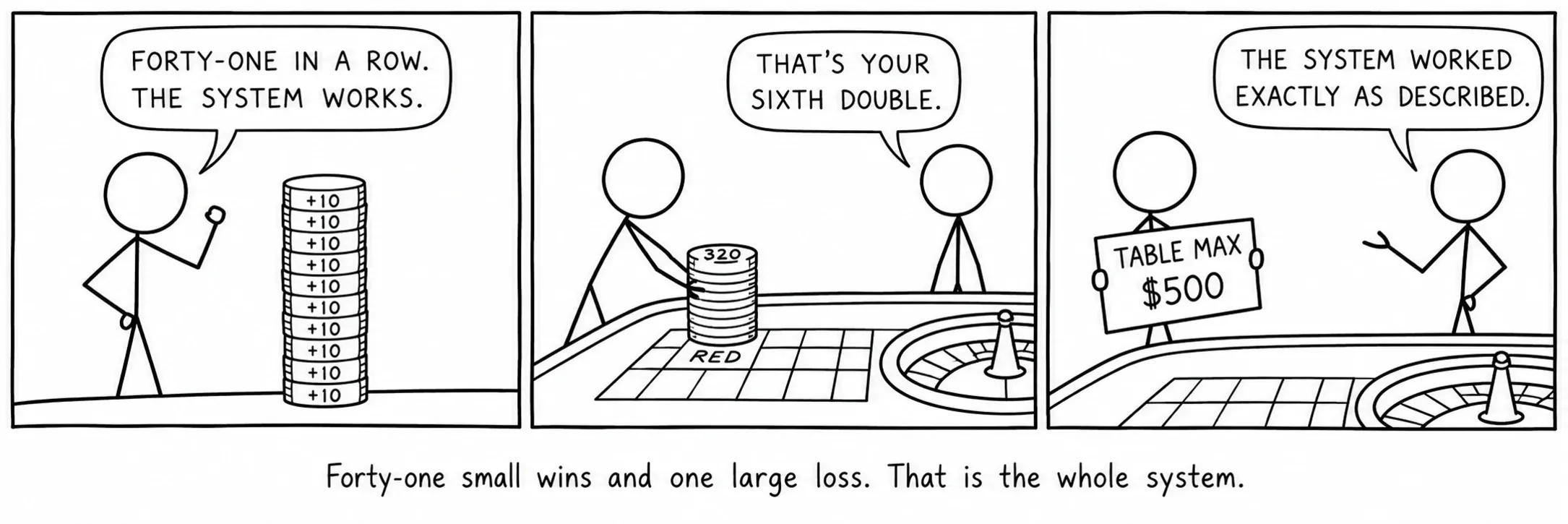
Forty-one small wins and one large loss. That is the whole system.
Sources
- Ethier, S. N. The Doctrine of Chances: Probabilistic Aspects of Gambling.
- Thorp, E. O. “Optimal gambling systems for favorable games.”