The Cost of an Hour, Compared
Expected loss helps compare bets and playing speeds. It is an average, so it cannot serve as a fixed price or a spending limit.
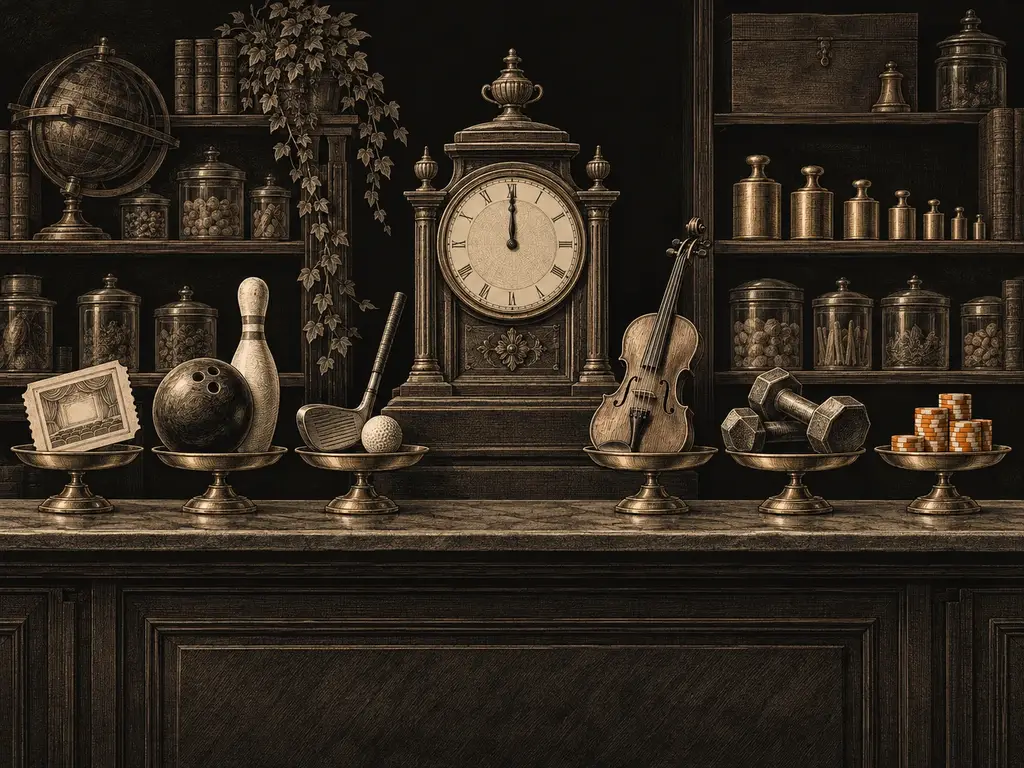
At an assumed 50 bets per hour and $10 per bet, standard single-zero roulette has an expected loss of $13.51. Eligible half-back even-money bets reduce that to $6.76. Your actual result can differ sharply; compare an uncertain gambling result with a known entertainment price carefully.
The roulette column
Expected lossmathExpected lossThe probability-weighted average net loss under a stated model. With a constant edge, it equals edge times expected total stakes.Read full definition → equals total wagering multiplied by the relevant house edgemathHouse edgeThe casino’s expected net gain expressed as a fraction of the stake, under specified probabilities and payouts.Read full definition →. For fixed stakes, total wagering is stake per bet times the number of bets. Standard single-zerowheelZeroThe 0 outcome, conventionally shown in green. Ordinary color, parity, high/low, dozen and column bets do not include it.Read full definition → bets with full loss on zero use an edge of 1/37; eligible even-money betsbetEven-money betA bet paying a profit equal to the stake, such as red/black, odd/even or high/low.Read full definition → with half back on zero use 1/74.
The examples below specify the pace rather than claiming measured speeds for live, automatic or RNG tables. If you stop early or change stakes, the total wagered changes.
The comparison
A ticket price and an expected gambling loss answer different questions. A cinema ticket tells you a known admission cost; roulette’s expected loss describes an average across possible outcomes. Your own result may be a win, a modest loss or the loss of your entire permitted stake.
Compare current local prices that you can actually buy. For a membership or subscription, the hourly cost also depends on how much you use it. The illustrative figures below are assumptions, not a survey of 2026 prices.
What the variance buys
VariancemathVarianceThe expected squared distance of a result from its expected value. It measures dispersion in squared units.Read full definition → describes the spread of possible results around the expectation. It does not establish why people choose an activity, and it does not make an expected loss a safe budget.
For example, 50 independent $10 bets on redbetRedAn even-money wager on the 18 red numbers. French: rouge.Read full definition → on a fair single-zero wheel, with full loss on zero, have an expected net result of −$13.51 and a standard deviationmathStandard deviationThe square root of variance: a measure of dispersion in the same units as the result.Read full definition → of about $70.68. The standard deviation is a measure of spread, not a guaranteed range. The probabilitymathProbabilityA measure of how likely an event is, from zero to one. Percentages express the same scale from 0% to 100%.Read full definition → of finishing ahead also depends on the bet, number of spins and stopping rule; there is no universal percentage for a winning hour.
Stretching the hour
For the same rules and number of bets, halving the stake halves expected loss. Placing half as many bets at the same stake has the same effect. Half back on zero halves the edge on eligible single-zero even-money bets, but does not apply to every wager or every table described as French.
At an assumed 50 rounds per hour, placing 25 bets of $5 with half back on zero gives an expected loss of $125/74, about $1.69. That is not a promise that the session will cost $1.69 or that a small bankrollmoneyBankrollThe amount set aside for play. Bankroll management concerns stakes and limits within that amount.Read full definition → will last.
The honest summary
Choose a spending and time limit based on what you can afford to lose, not only on the expected loss. Stakes, number of bets and rules affect the average; they do not let you control the result of a session. If comparing roulette with another activity, keep the uncertainty visible alongside the price.
Questions
No. Expected loss depends on the stake, number of bets and return for the particular games. A game label alone is not enough to compare hourly cost.
It helps compare specified bets and amounts wagered. Use it alongside the possible losses and your spending limit; it does not predict your session.
No. It changes your actual result. Under the same independent model and unchanged rules, the next bet has the same expectation.
Comic relief
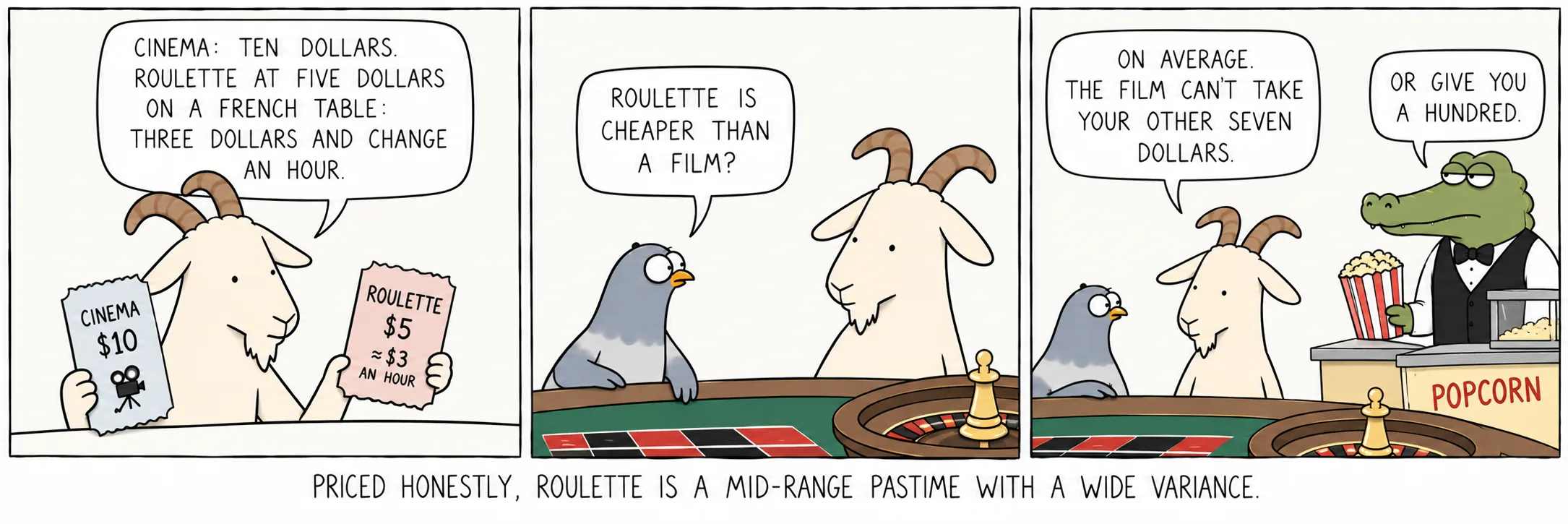
An expected loss is not a ticket price.
Sources
- Ethier, S. N. The Doctrine of Chances: Probabilistic Aspects of Gambling.