Walkthrough: 1-3-2-6
Stakes of 1, 3, 2 and 6 units on consecutive wins, back to 1 on any loss. The positive-progressionstrategyProgressionAny rule that changes the stake based on previous results. Negative progressions raise it after losses, positive after wins.Read full → sequence, spin by spin.
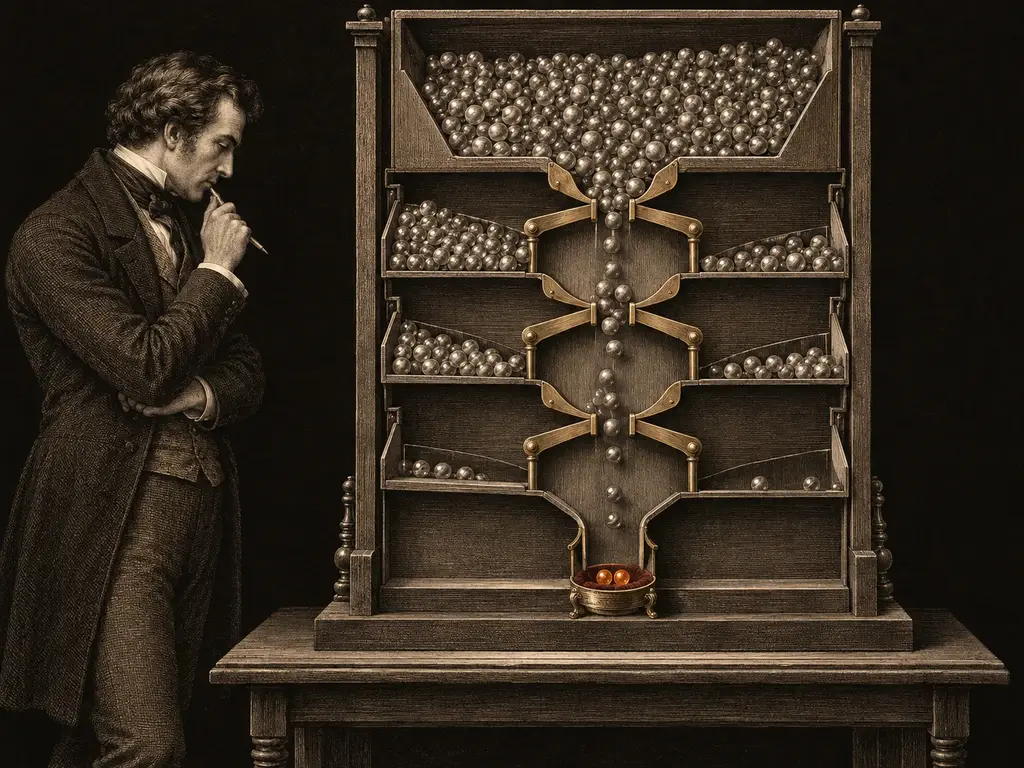
A simulated 60-spin 1-3-2-6 session at $10 a unit on redbetRedEven-money bet on the 18 red numbers. French: rouge.Read full →. Thirty-three attempts: sixteen got past step one, seven past step two, two completed for +$120 each. Net −$50 after being up $80. A Paroli with a pause built in.
Walk the system
A win moves one step on. A loss, or a fourth win, goes back to the start.
Stakes and results are in units of the base bet.
The plan
Bet 1 unitmoneyUnitThe base stake a system or a player works in. Progressions are described in units so they apply at any table.Read full →. On a win, bet 3 (the 2 now on the table plus 1 more of ours). On a second win, bet 2 and pocket the rest. On a third win, bet 6. A fourth win completes the sequence for +12 units; any loss returns to 1. The sequence is arranged so that a loss at step two costs 2 units net, at step three it still leaves us +2 (we are +4 after step two and risk 2), and at step four it leaves us level (we are +6 and risk 6). The attraction is that losses at steps three and four cost little of our own money.
Spins 1–30
Eighteen attempts. Ten lost at step one (−$10 each), five at step two (−$20 each), two at step three (+$20 each), one completed at spins 27–30 (R R R R, +$120). Net −$40 after 30 spins, having been −$160 at spin 26. The completed sequence felt like the system working; it was the 5.6% arriving on schedule.
Spins 31–60
Fifteen attempts, one completed at spins 44–47 for +$120, two that reached step four and lost there (each $0 net: +$60 won, then $60 staked and lost). Net −$10 for the stretch; final −$50; peak +$80 at spin 47. Two completions in 33 attempts, against 1.8 expected: a fair sample.
- p10 −$800
- p25 −$520
- median −$240
- p75 +$70
- p90 +$350
The accounts
Total wagered about $1,200 against $600 flat. Expected lossmathExpected lossExpected value times total amount wagered; the average amount lost over a session or a period.Read full → $32; actual −$50, inside one standard deviationmathStandard deviationSquare root of variance; the typical distance of a result from the expected value.Read full →. The sequence’s design means most of the money across the table in a long attempt is money we won two spins earlier, which is the illusion that makes it comfortable. It is our money from the moment the dealer pays it.
What the session shows
1-3-2-6 is a ParolistrategyParoliPositive progression: double after a win, reset after a loss or after three wins in a row. Also: reverse Martingale.Read full → with the stake sizes tuned so that the later steps feel free. The completion probabilitymathProbabilityChance of an outcome, from 0 to 1 or 0% to 100%. One number: 1/37 = 2.70%.Read full → (18/37)⁴ = 5.6% and the completion payoutmoneyPayoutWhat a winning bet returns, quoted as “X to 1” on top of the returned stake.Read full → of 12 units are fixed by the arithmetic; the staking pattern decides only how the inevitable 2.70% is distributed between many small losses and a few large wins. For a player who enjoys a sequence to follow, it is harmless. It is not a method.
Questions
1-2-4-8 is the Paroli to four wins; it risks the whole pile at each step. The 1-3-2-6 banks 2 units after step two, so a loss at step three costs nothing of your own. Same expectation.
Slightly down, with one or two spikes. About two sessions in five end ahead after 60 spins at this unit.
Some players continue 1-3-2-6-12. The next step wins 2.7% of the time (five reds in a row) and the shape is the same.
Comic relief
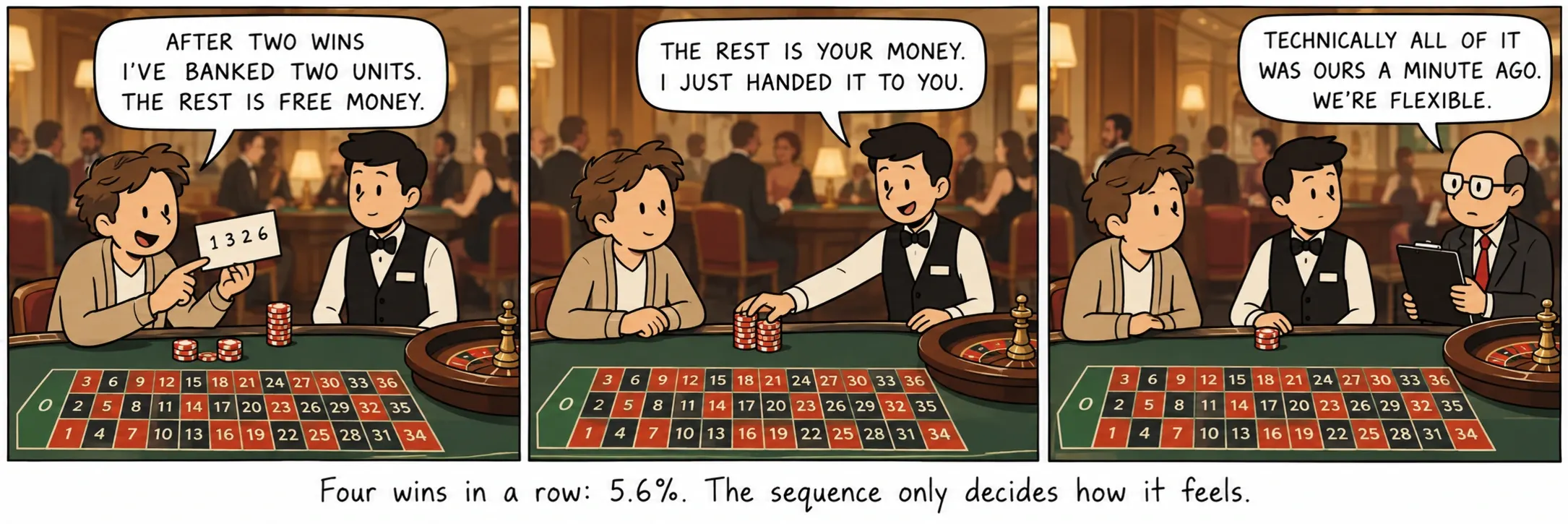
Four wins in a row: 5.6%. The sequence only decides how it feels.
Sources
- Ethier, S. N. The Doctrine of Chances: Probabilistic Aspects of Gambling.