Roulette Probability
Every roulette probability is a count of pockets divided by 37.
p = numbers covered / 37. One number: 2.70%. Eighteen: 48.65%. The chance of a specific sequence multiplies the single-spin probabilities.
Single spins
Each of the 37 pocketsequipmentPocketOne of the 37 numbered compartments on the rotor. Also: slot, cup.Read full → is equally likely, so probabilitymathProbabilityChance of an outcome, from 0 to 1 or 0% to 100%. One number: 1/37 = 2.70%.Read full → is counting. A bet on four numbers wins 4/37 of the time, about 10.8%. There is nothing more to a single-spin probability than that, which is why the whole game can be analyzed on a napkin.
Several spins
Spins are independent, so the probabilities of a sequence multiply. Two redsbetRedEven-money bet on the 18 red numbers. French: rouge.Read full → in a row: (18/37)² = 23.7%. Red then zerowheelZeroThe single green pocket that no even-money, dozen or column bet covers; the source of the house edge. Also: single zero, 0.Read full →: (18/37)(1/37) = 1.3%. Seventeen twice running: (1/37)² = 0.073%, about one in 1,369. The order matters for a specific sequence and not for a count: “red then blackbetBlackEven-money bet on the 18 black numbers. French: noir.Read full →” is 25.0% but “one red and one black in two spins, either order” is 50.0%.
At least once
Use the complement. The chance of no hit on a straight upbetStraight upA single number, pays 35:1.Read full → in 37 spins is (36/37)³⁷ = 36.3%, so the chance of at least one hit is 63.7%, not the “certainty” many players expect from 37 chances at 1 in 37. The same calculation says a number has about a 1 in 3 chance of not appearing at all in 37 spins, which is why the results board always shows a few “cold” numbers.
Expected waiting time
On average a straight-up number appears once every 37 spins, but the wait is wildly variable: the median wait is about 25 spins (half the time it comes sooner) and one wait in twenty exceeds 110 spins. Waiting times for a geometric process are long-tailed, and a player who “knows” a number is due after 60 spins is describing something that happens one time in five.
Common errors
Adding probabilities for events that can both happen (red or odd is not 36/37; it is 26/37, because ten numbers are both). Multiplying for events on the same spin (red and odd on one spin is 10/37, not 18/37 × 18/37). Treating past spins as part of the sequence you are now betting on: after ten reds, the chance of an eleventh is 18/37, not (18/37)¹¹.
Odds versus probability
Casinos quote payoutsmoneyPayoutWhat a winning bet returns, quoted as “X to 1” on top of the returned stake.Read full → as odds. A probability of 1/37 is odds of 36 to 1 against. A payout of 35 to 1 is therefore one unitmoneyUnitThe base stake a system or a player works in. Progressions are described in units so they apply at any table.Read full → short, which is the house edgemathHouse edgeThe share of each stake the casino keeps on average: 2.70% in European roulette.Read full → in its original form. Converting: odds against = (1 − p)/p; probability = 1/(odds + 1).
Formula
Questions
(1/37)² = 1/1369 ≈ 0.073%.
36/37 = 97.3%. Zero is the rest.
All 37 are 1/37. Seventeen is the most bet number, which is a fact about people.
Fun with Math
Try these yourself first. Each solution is folded; open it when you are ready.
You bet on redbetRedEven-money bet on the 18 red numbers. French: rouge.Read full →, spin after spin. What is the chance that your fifth win comes on exactly the eighth spin? And that you have five wins within the first eight spins?
Show the solution
Answer 12.9%, about 1 in 8, for the fifth win on spin eight. 33.4% for five wins by then.
The fifth win on spin eight means two things: spin eight wins, and the first seven spins hold exactly four wins and three losses, in any order. There are 35 ways to place four wins among seven spins.
So the chance is 35 × (18/37)⁵ × (19/37)³ = 35 × 0.02725 × 0.1354 = 12.9%.
For five wins by spin eight, add the same kind of term for the fifth win on spins five, six and seven: 2.7% + 7.0% + 10.8% + 12.9% = 33.4%. Statisticians call this the negative binomial distribution: how many tries a fixed number of successes takes. Taylor (2021) works the same question on an American wheel, 12.2%.
Comic relief
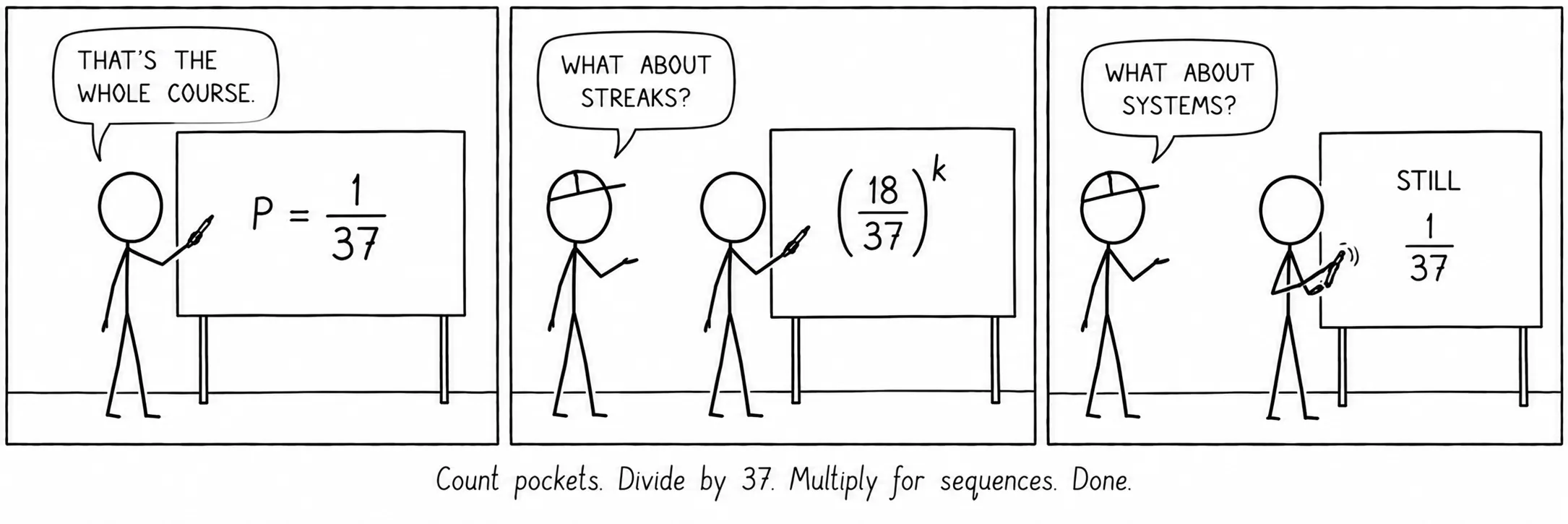
Count pockets. Divide by 37. Multiply for sequences. Done.
Sources
- Feller, W. An Introduction to Probability Theory and Its Applications, Vol. 1.
- Ethier, S. N. The Doctrine of Chances: Probabilistic Aspects of Gambling.
- Taylor, D. G. Games, Gambling, and Probability: An Introduction to Mathematics, 2nd ed.