Walkthrough: A $100 Evening on Red
One hundred dollars, five-dollar chips, red every spin, and a stop rule. Spin by spin.

A simulated evening at a live table: up to 60 spins of $5 on red from a $100 budget, with a $50 stop-loss and a $50 stop-win. The stop-loss ended it at spin 36. The session shows what variance looks like in real time and why the stop rule is the only decision that mattered.
The plan
Budget $100, which is money we can lose. Stake $5, 5% of the budget, which gives us about twenty losing bets in hand. Stop-lossstrategyStop-lossA pre-set amount of loss at which you end the session.Read full → at −$50 and stop-winstrategyStop-winA pre-set profit target at which you end the session.Read full → at +$50, decided now. Expected lossmathExpected lossExpected value times total amount wagered; the average amount lost over a session or a period.Read full → over 60 spins is 60 × $5 / 37 = $8.11. We expect to leave with about $92 and to be anywhere between $20 and $170 with reasonable probabilitymathProbabilityChance of an outcome, from 0 to 1 or 0% to 100%. One number: 1/37 = 2.70%.Read full →.
Spins 1–20
R B B R R 0 B R R B R B B B R R B R B R. Ten redsbetRedEven-money bet on the 18 red numbers. French: rouge.Read full →, nine blacksbetBlackEven-money bet on the 18 black numbers. French: noir.Read full →, one zerowheelZeroThe single green pocket that no even-money, dozen or column bet covers; the source of the house edge. Also: single zero, 0.Read full →: +$50 − $45 − $5 = $0. Balance $100. The zero at spin 6 cost a chipmoneyChipA token representing a fixed amount, placed on the layout to make a bet. Also: check.Read full → and was, at 1/37, a little early. Nothing here is unusual. We are level after twenty spins.
Spins 21–36
B B B B B R B B R B B R B B B B. Five blacks to open, thirteen in all: three reds, thirteen blacks, +$15 − $65 = −$50. Balance $50. This is the stretch that makes people change their bet, double up or switch colors. The probability of 13 or more blacks in 16 spins is under 1%; it was going to happen to somebody tonight. We are down $50 from the start, the stop-loss fires at spin 36, and we stand up.
Spins 37–60, without us
R B R B, then R R B R 0 R B R R B R R B B R R B R B R. Fourteen reds, nine blacks, one zero: had we stayed, +$70 − $45 − $5 = +$20 and a balance of $70 at spin 60. Thirty-six spins at a live table is about 45 minutes. We left with $50, down $50, against an expected −$4.86 for 36 spins. Thirteen reds, twenty-two blacks, one zero.
- p10 −$100
- p25 −$100
- median −$100
- p75 +$0
- p90 +$70
What happened
We paid about $5 for 45 minutes of roulette, plus $45 of bad luck. Thirteen reds in 36 spins is well below the expected 17.5, and nine reds short of the blacks is −$45 before the zero. The evening was decided by variancemathVarianceA measure of how widely results spread around the expected value. High for straight up, low for even-money bets.Read full →; the price was decided by the stake and the spins; the stop-loss decided when it ended. Staying would have recovered $20 by spin 60, and that is not a reason to stay: the recovery was variance too, and so was the black run that came before it.
What we did not do
Change the stake after a loss (that is a progressionstrategyProgressionAny rule that changes the stake based on previous results. Negative progressions raise it after losses, positive after wins.Read full →, and it raises turnovermoneyTurnoverThe total amount wagered over a session or period, counting re-bet winnings. Also: handle, action.Read full →). Switch colors after the black run (identical odds). Stay past 60 spins because we were “nearly even” (that is the stop-loss being renegotiated). Bet the dozenbetDozen1–12, 13–24 or 25–36, pays 2:1.Read full → that “hadn’t come up” (same edge, different shape). Every one of these would have changed the shape of the evening and none would have changed its expected cost.
Questions
Twenty chips in hand instead of ten. The evening lasts; the cost per spin halves.
Expected loss $4.05 instead of $8.11. Yes.
Of nothing. Thirteen blacks in sixteen spins happens about one evening in 125.
Comic relief
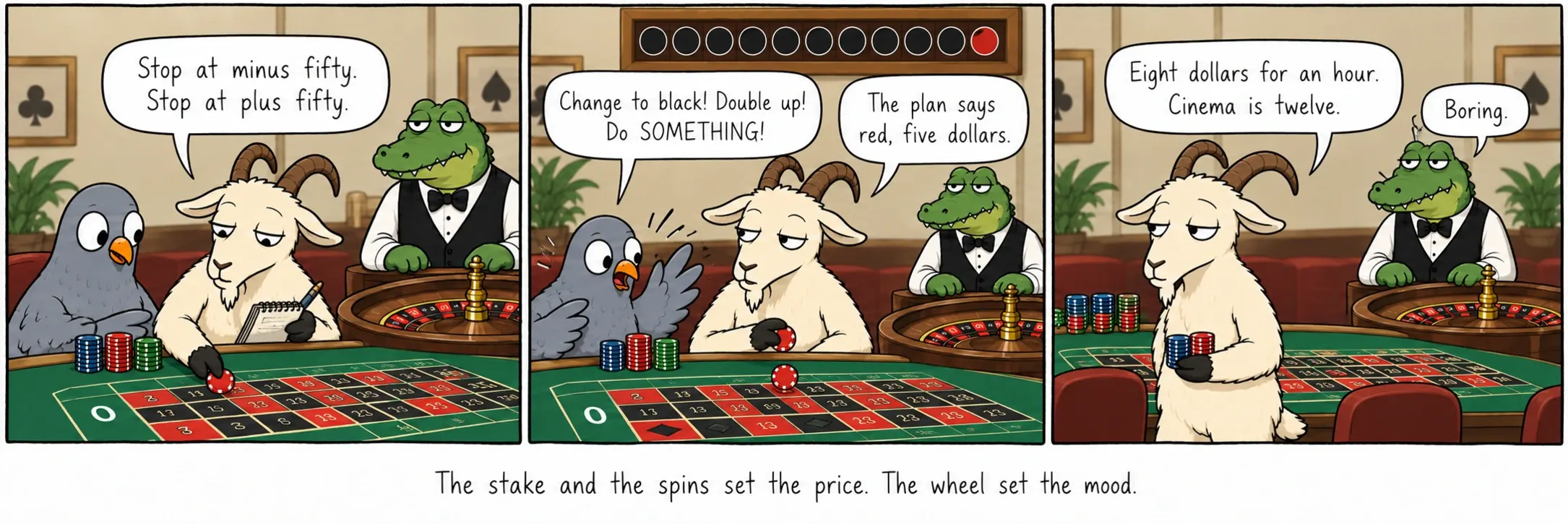
The stake and the spins set the price. The wheel set the mood.
Sources
- Ethier, S. N. The Doctrine of Chances: Probabilistic Aspects of Gambling.