Roulette Lucky Numbers and Superstitions
A favorite number can have personal meaning without having better odds.
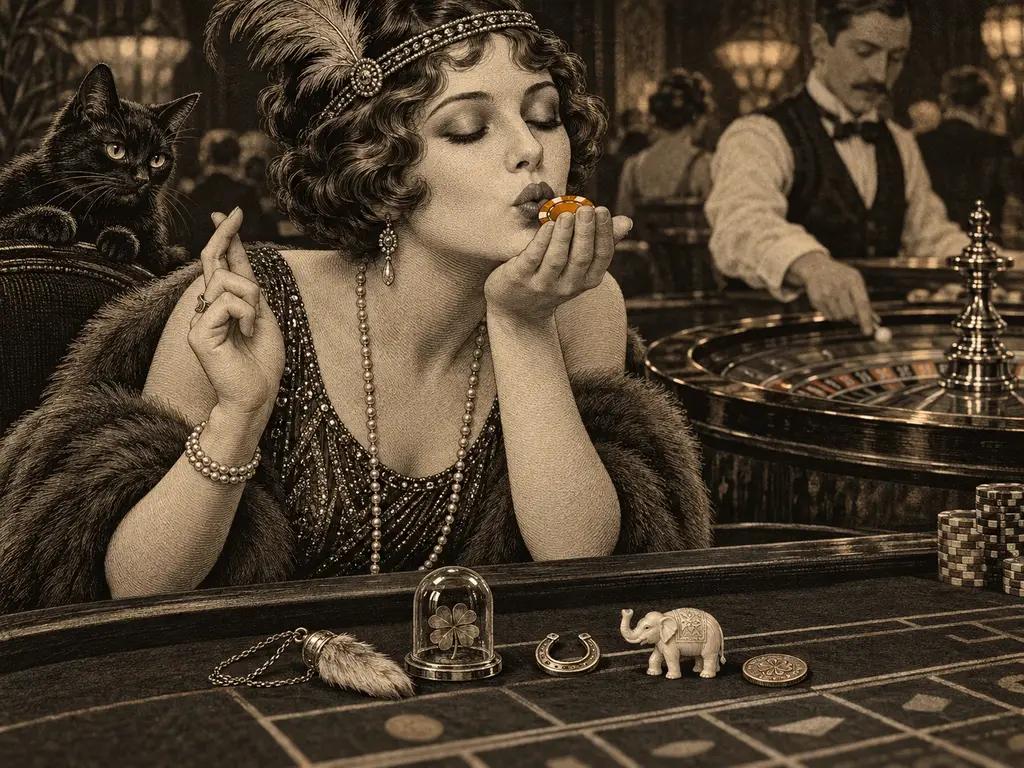
People may connect wins with a number, seat, dealer or ritual. Under an independent uniform wheel model, those associations do not increase the next bet’s chance of winning. A habit becomes a concern if it encourages more spending or makes stopping harder.
Lucky numbers in roulette
A birthday, a cultural association or a remembered win can make a number feel special. That personal meaning is different from a higher probabilitymathProbabilityA measure of how likely an event is, from zero to one. Percentages express the same scale from 0% to 100%.Read full definition → of winning. This page does not have representative betting data to declare one number the most popular worldwide or another the least popular.
On an independent uniform single-zerowheelZeroThe 0 outcome, conventionally shown in green. Ordinary color, parity, high/low, dozen and column bets do not include it.Read full definition → wheel, every pocketequipmentPocketA compartment on the rotor in which the ball can settle. The number of pockets depends on the wheel.Read full definition → has probability 1/37. Standard straight-up bets pay 35 to 1 net, including zero. Choosing a less popular number does not increase that payoutmoneyPayoutThe amount paid on a winning wager. Check whether the quoted figure is net profit or total return including the stake.Read full definition → as it might in a shared-prize game.
Rituals
A player might place chipsmoneyChipA token used to place a wager, with a printed or assigned value. Also called a check in some casino terminology.Read full definition → in a particular order or repeat a gesture associated with a previous win. The sequence of events does not show that the gesture caused the result.
Rituals are not automatically harmless. If a habit creates pressure to bet, increases spending or makes it harder to leave, its effect on the person matters even though it does not change the model’s odds. Follow the game’s rules about handling chips and consider support if gambling is becoming difficult to control.
Lucky dealers, seats and tables
Winning with one dealer or from one seat does not by itself show a better chance on the next spin. Checking such a claim needs a defined comparison and complete data, including losses. Selecting the most successful combination after trying many is particularly misleading.
A physical-prediction hypothesis is a separate claim that needs measurement. It should not be accepted or rejected merely because it resembles a story about luck. The Lab pages explain the evidence such a claim would need.
A historical experiment
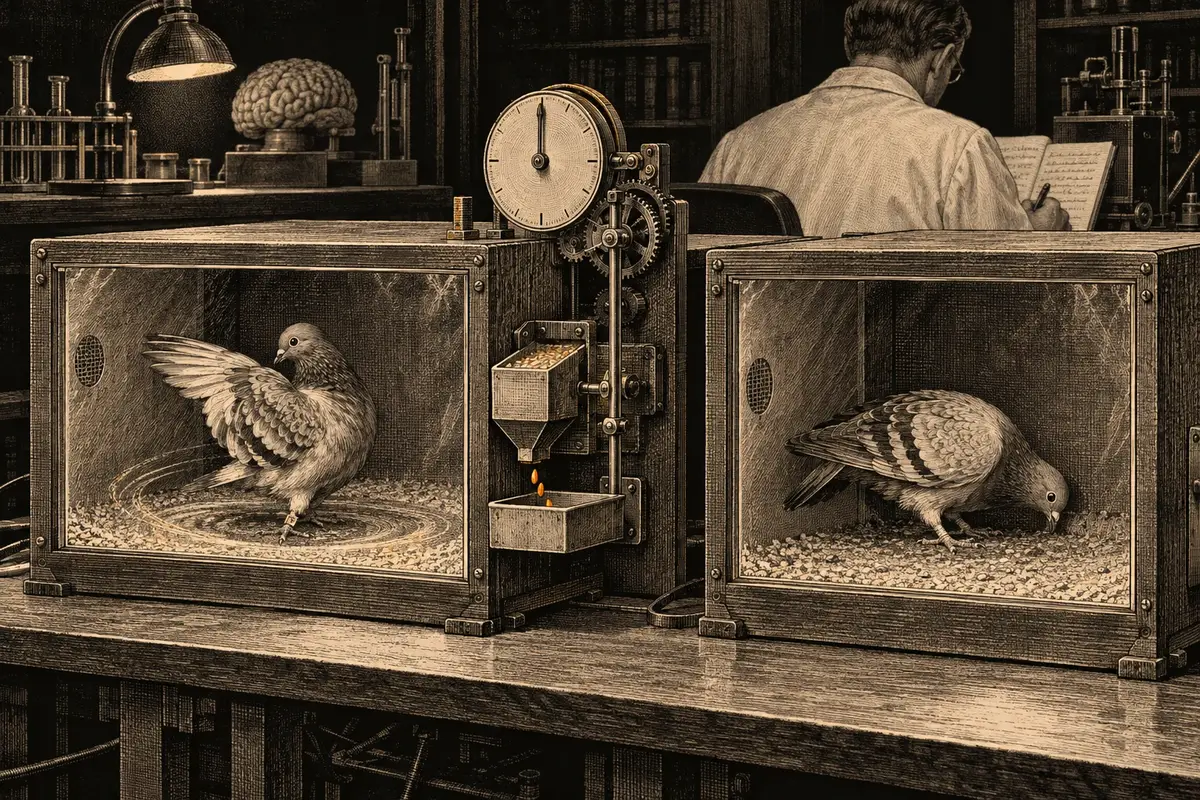
In 1948, B. F. Skinner described pigeons given food at regular intervals regardless of their behavior. He reported clearly identifiable repeated actions in six of eight birds and interpreted them in terms of reinforcement.
This was an animal experiment, not a test of roulette players or proof that every human ritual has the same cause. Its historical interest lies in the distinction between an event following an action and an event being caused by that action.
Limits are decisions, not omens
Leaving a game does not require a sign from a lucky or unlucky number. You can choose not to place another bet. Past losses do not make a recovery due, and a past win does not create an obligation to continue.
If a limit is repeatedly hard to keep, consider additional support rather than treating it as a failure of willpower. The Responsible Gambling page links to help.
Questions
No, under the independent uniform model. A standard straight-up payout is fixed by the game rules, not divided among the people who chose the number.
No. The historical details require their own evidence. Mathematically, a preselected number hitting on three preselected consecutive independent single-zero spins has probability (1/37)^3 = 1/50,653. That is different from searching many spins for any memorable streak.
Zero is an ordinary possible result with special consequences for some bets. Under a uniform single-zero model its probability is 1/37; its treatment in the payout rules contributes to the house edgemathHouse edgeThe casino’s expected net gain expressed as a fraction of the stake, under specified probabilities and payouts.Read full definition →.
Comic relief
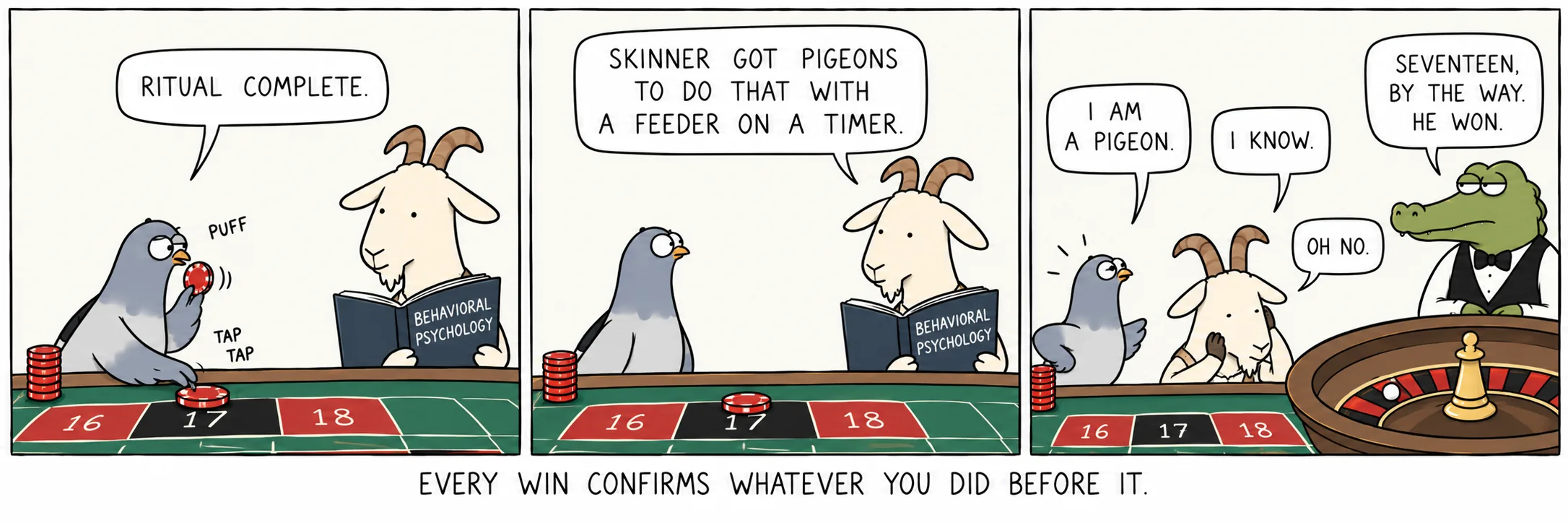
A win does not establish what caused it.
Sources
- Skinner, “Superstition” in the pigeon, 1948 — original paper
- NHS, Help for problems with gambling