Roulette Rules
The rules of European roulettevariantEuropean rouletteSingle-zero wheel, 37 pockets, house edge 2.70%. The canonical model on this site.Read full → fit on one page: 37 pockets, fixed payouts, bets settled after every spin.
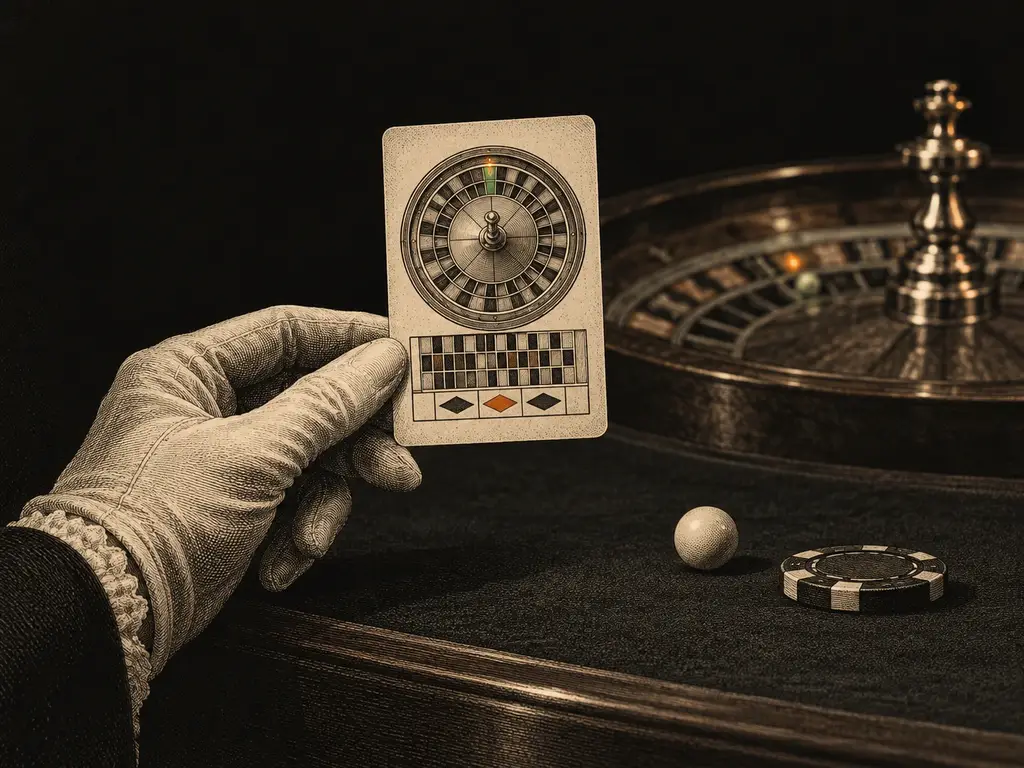
You bet on where the ball lands. Every bet pays as if there were 36 pockets; the 37th, zero, is the house edge.
The object of the game
A ballequipmentBallThe small ball launched along the track against the rotor. Modern balls are ivorine or Teflon, 18–21 mm.Read full → is spun around a wheel with 37 numbered pocketsequipmentPocketOne of the 37 numbered compartments on the rotor. Also: slot, cup.Read full →, 0 to 36. Before it drops you place chipsmoneyChipA token representing a fixed amount, placed on the layout to make a bet. Also: check.Read full → on a printed layoutequipmentLayoutThe printed betting grid on the table. Also: table, felt, cloth.Read full → to predict where it will land: a single number, a group of numbers, a color, odd or even, high or low. Everything that is not covered by one of your chips loses when the ball settles. There is no dealer hand to beat and no decision to make after the ball is launched. Roulette is a pure wager on a single random event, repeated.
The rules below describe the European single-zerowheelZeroThe single green pocket that no even-money, dozen or column bet covers; the source of the house edge. Also: single zero, 0.Read full → game. The American wheel adds a 00 pocket and the French game adds two rules about zero; both are covered on their own pages.
Placing bets
Chips go on the layout from the moment the previous round is paid until the dealer calls “no more betsprocedureNo more betsThe dealer’s call (or the on-screen prompt) that closes betting. Chips may no longer be placed, moved or removed.Read full →”, usually when the ball has three or four revolutions left. Inside betsbetInside betAny bet placed on or between the numbers of the grid: straight up, split, street, corner, six line.Read full → sit on or between the numbers of the grid; outside betsbetOutside betA bet on the boxes surrounding the grid: dozens, columns and even-money bets.Read full → sit in the boxes around it. You may place as many bets as you like in one round, including bets that overlap or contradict each other.
Each table posts a minimum and a maximum. Most tables apply the minimum separately: your total on inside bets must reach it, and each outside bet must reach it on its own. A $5 table therefore accepts five $1 chips on five different numbers, but not a single $1 chip on redbetRedEven-money bet on the 18 red numbers. French: rouge.Read full →.
The bets and what they pay
Every payoutmoneyPayoutWhat a winning bet returns, quoted as “X to 1” on top of the returned stake.Read full → is produced by one formula: 36 divided by the number of pockets covered, minus one. Cover one number and win 35 to 1. Cover two and win 17 to 1. Cover eighteen and win 1 to 1. The formula pretends the wheel has 36 pockets. It has 37, and that one unanswered pocket is the whole house edgemathHouse edgeThe share of each stake the casino keeps on average: 2.70% in European roulette.Read full →.
Settling the spin
When the ball settles the dealer announces the number and color, places a marker called the dollyequipmentDollyThe marker placed on the winning number on the layout while bets are settled.Read full → on the winning number, and clears the table in a fixed order: losing chips are swept first, then outside bets are paid, then inside bets, nearest the dealer last. Winnings are placed next to your original chip. The original chip stays on the layout and will ride again unless you pick it up.
While the dolly is on the table nothing may be placed or moved. The dealer lifts it only when every bet is paid, and that is the signal that the next round is open.
- “No more bets” is final. A chip that lands after the call is returned, not paid, even if it would have won.
- A chip that sits ambiguously between two bets is settled the way the dealer reads it. Ask them to confirm a tricky placement before the spin.
- Winning chips left on the table are a bet on the next spin. Collect them if you do not mean that.
Zero
Zero is a number like any other for inside bets: a straight upbetStraight upA single number, pays 35:1.Read full → on 0 pays 35 to 1, a splitbetSplitTwo adjacent numbers, pays 17:1.Read full → 0–1 pays 17 to 1, and the four-number basketbetBasketOn a single-zero wheel: 0, 1, 2, 3 with one chip, pays 8:1. Also: first four, quatre premiers.Read full → 0-1-2-3 pays 8 to 1. For outside bets it is a loss. Red, blackbetBlackEven-money bet on the 18 black numbers. French: noir.Read full →, odd, even, high, low, dozensbetDozen1–12, 13–24 or 25–36, pays 2:1.Read full → and columnsbetColumnTwelve numbers in one vertical column of the layout, pays 2:1.Read full → all exclude it. On a plain European table you lose the whole stake when zero hits. On a French table the la partageruleLa partageFrench rule: when zero hits, half of an even-money stake is returned. Halves the house edge on those bets to 1.35%.Read full → rule returns half of an even-money stake, or en prisonruleEn prisonFrench rule: when zero hits, an even-money bet is held for the next spin instead of lost. Halves the house edge on those bets.Read full → holds it for one more spin.
What the rules do not say
There is no rule about sequences, streaks, hot numbersmythHot numberA number that has appeared more often than expected recently. On a fair wheel it predicts nothing.Read full → or systems because the rules do not need one. Every spin is settled on its own and the wheel carries no memory from one to the next. The betting history board at a live table is a courtesy, not a clue.
A short worked round
You place $5 on red, $5 on the second dozen and $1 straight up on 17. The ball lands on 17 (black, second dozen). Red loses: −$5. The dozen pays 2 to 1: +$10. The straight up pays 35 to 1: +$35. Net for the round: +$40, and $11 of chips still on the layout for the next spin unless you lift them.
Had the ball landed on 0 you would have lost all three bets, $11. Had it landed on 5 (red, first dozen) you would have won $5 on red and lost $6 on the other two, net −$1.
Questions
Yes. Any combination is allowed, including overlapping bets. Each is settled on its own.
Mathematically even; at the table, neither. Odd and even bets both lose on zero.
No. At a busy physical table standing players bet over the shoulders of seated ones, with permission. Online the question does not arise.
The spin is void and replayed. It happens, rarely, on worn tracks or hard launches.
Comic relief
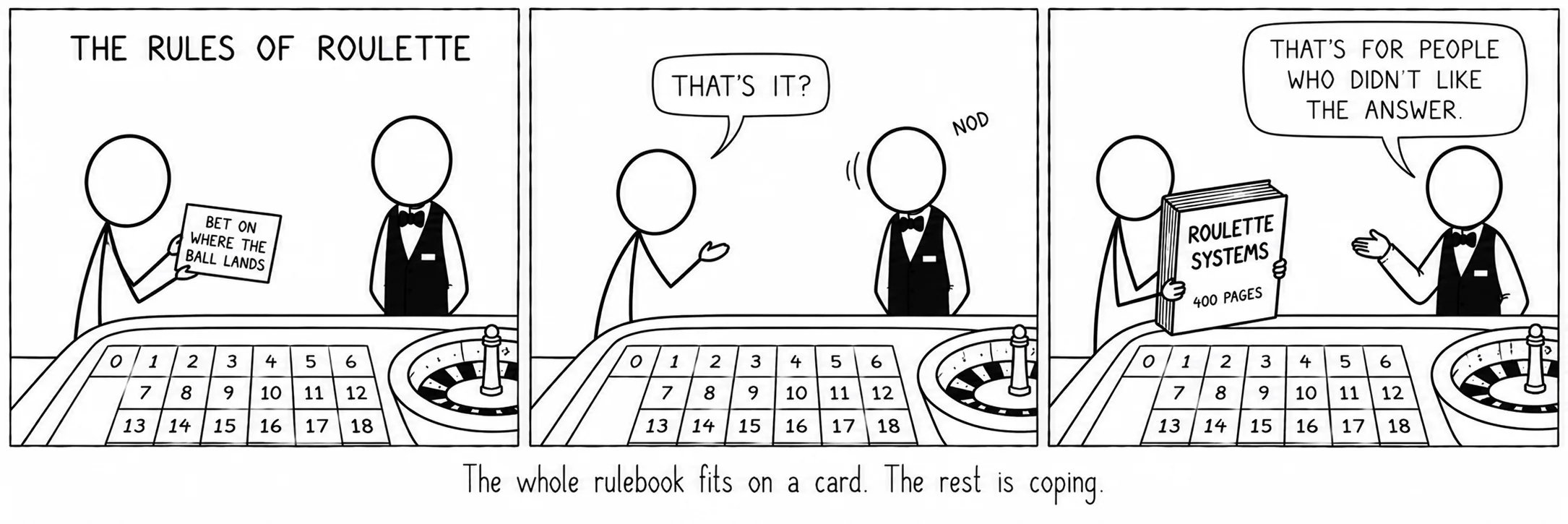
The whole rulebook fits on a card. The rest is coping.
Sources
- Ethier, S. N. The Doctrine of Chances: Probabilistic Aspects of Gambling.
- Epstein, R. A. The Theory of Gambling and Statistical Logic, 2nd ed.