Roulette Ball Physics
The track guides the ball; losses and contact forces change its motion.
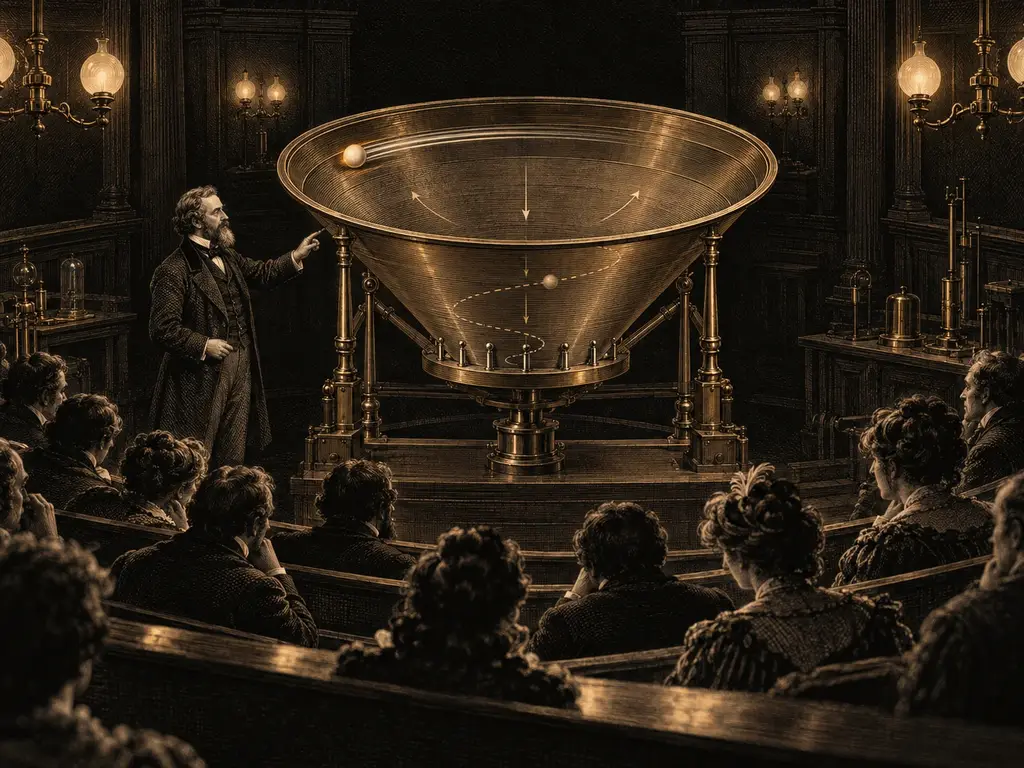
The ball needs inward acceleration to follow the circular track. As it slows, its path changes; later collisions alter its direction and speed. Ball size, material and wheel geometry belong to the specific equipment.
The ball
Mass, diameter, surface and material affect rolling and collisions. It is too simple to say that every heavier ballequipmentBallThe small ball that settles in a numbered pocket to determine a physical roulette result.Read full definition → bounces less or that every smaller ball scatters farther: contact properties and the wheel matter too. Use the manufacturer’s specification for a particular ball.

On the track
For circular motion at speed v and radius r, inward acceleration is v²/r. In a simplified level conical-track model, departure occurs at v = √(rg tan(α)). This threshold comes from the assumed geometry; it is not a universal speed of 1–1.3 m/s.
| quantity | meaning |
|---|---|
| v | ball speed along the circular path |
| r | path radius |
| g | gravitational acceleration |
| α | slope angle from horizontal |
Deceleration pattern
Resistance reduces the ball’s speed. Timing repeated passages of a reference point estimates average speed over each lap. Several observations can support a fitted model, but a few lap times do not guarantee a particular prediction error. Validate the model on separate spins.
Scatter
A scatter distribution describes the final pocketequipmentPocketA compartment on the rotor in which the ball can settle. The number of pockets depends on the wheel.Read full definition → relative to a specified reference, such as the rotorequipmentRotorThe rotating part of a physical roulette wheel, carrying the numbered pockets.Read full definition → position at departure. Its shape must be estimated from data. Different balls, directions and operating conditions may produce different distributions; an illustrative chart is not evidence of a measured range.
What this means for the player
Physical outcomes follow motion and contact dynamics. Difficulty measuring those dynamics can make prediction impractical, but it does not logically prove that all useful information is destroyed. The standard 1/37 model should be distinguished from a claim about one measured wheel.
Questions
That needs evidence. The standard model assumes uniform outcomes; equipment changes can alter physical behavior.
Inspection, wear or operating procedures can call for replacement. A claim about a particular casino’s motive needs a source.
Follow that game’s invalid-spin rules. The cited original Lightning rules specify a re-spin for an invalid spin, so “always void” is too broad.
Comic relief
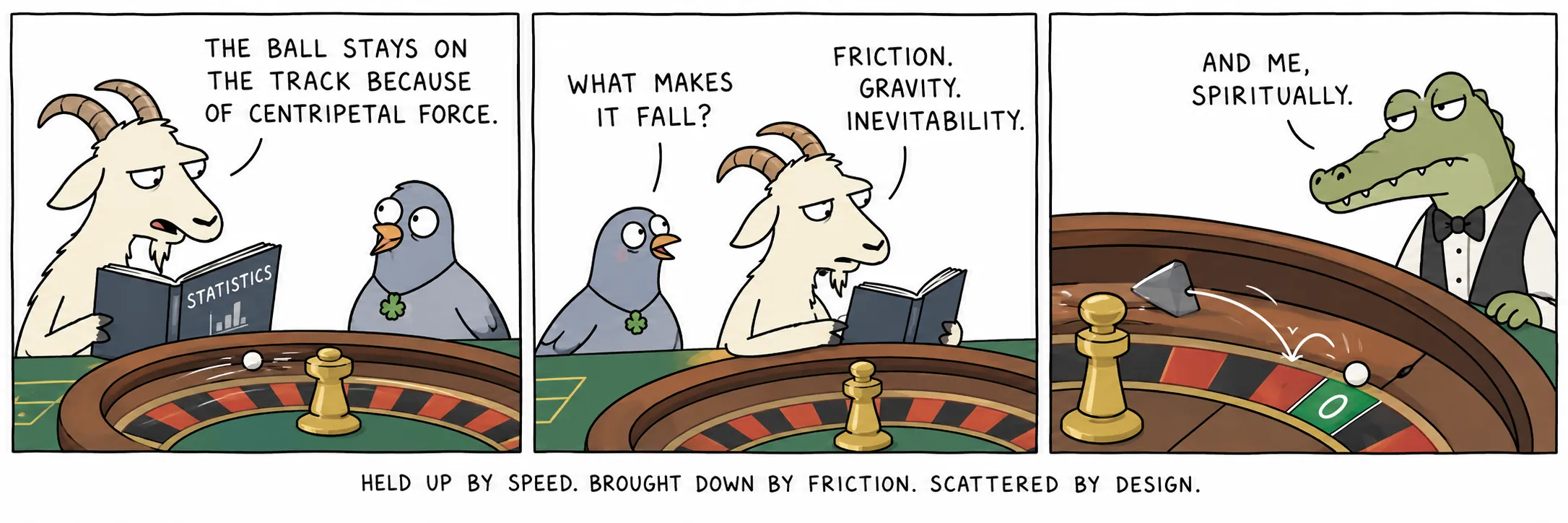
Motion follows mechanics; useful prediction still needs evidence.
Sources
- Small and Tse (2012), Predicting the outcome of roulette
- Atlantic Lottery, Lightning Roulette — invalid-spin rules
- Illustrative kinematics