Roulette Payouts
Every payout follows one rule: 36 divided by the numbers covered, minus one.
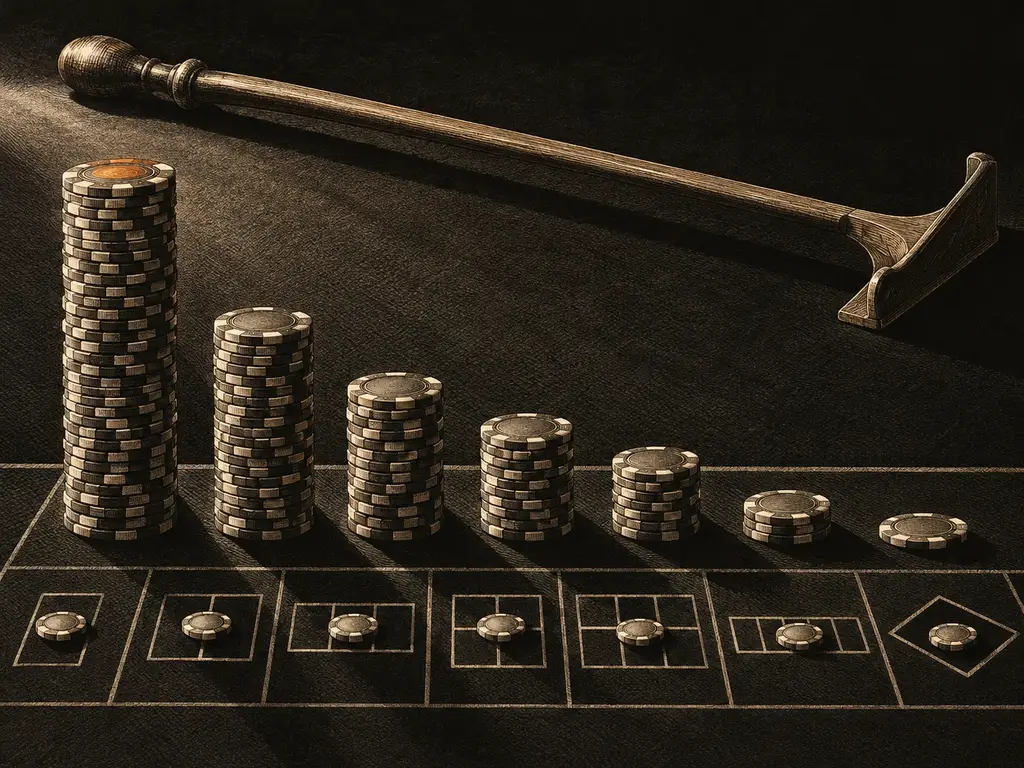
Payout = 36/n − 1. One number pays 35:1, two pay 17:1, eighteen pay 1:1. The formula pretends there are 36 pockets; there are 37.
The full table
There are only seven distinct payoutsmoneyPayoutWhat a winning bet returns, quoted as “X to 1” on top of the returned stake.Read full → in European roulettevariantEuropean rouletteSingle-zero wheel, 37 pockets, house edge 2.70%. The canonical model on this site.Read full →, one for each possible coverage. Learn the rule and you never need the table; learn the table and the rule becomes obvious.
Why the same edge everywhere
A fair payout for a bet that covers n of 37 pocketsequipmentPocketOne of the 37 numbered compartments on the rotor. Also: slot, cup.Read full → would be (37 − n)/n to 1. The casino pays (36 − n)/n to 1. Subtract and the difference is exactly 1/n unitmoneyUnitThe base stake a system or a player works in. Progressions are described in units so they apply at any table.Read full → on each win; multiply by the win probabilitymathProbabilityChance of an outcome, from 0 to 1 or 0% to 100%. One number: 1/37 = 2.70%.Read full → n/37 and the expected shortfall is 1/37 of the stake on every bet. This is why no combination of bets can escape the edge: you are adding negative numbers.
“To” versus “for”
35 to 1 means that a winning $1 chipmoneyChipA token representing a fixed amount, placed on the layout to make a bet. Also: check.Read full → returns $35 of winnings and you keep the $1. 35 for 1, a phrase that appears on some American layoutsequipmentLayoutThe printed betting grid on the table. Also: table, felt, cloth.Read full → and slot machines, means the $1 is included in the $35, so the real payout is 34 to 1. Roulette almost everywhere uses “to”. If a table says “for”, the house edgemathHouse edgeThe share of each stake the casino keeps on average: 2.70% in European roulette.Read full → on that bet is higher than it looks.
Worked examples
Ten dollars on a cornerbetCornerFour numbers sharing a corner on the layout, pays 8:1.Read full → that hits: 8 × $10 = $80 of winnings, $90 back including the stake. Ten dollars on a dozenbetDozen1–12, 13–24 or 25–36, pays 2:1.Read full → that hits: $20 of winnings, $30 back. Ten dollars on a neighborsbetNeighborsA number and the two pockets on either side of it on the wheel, five straight-up chips.Read full → bet (five $2 chips) with one hit: that chip pays 35 × $2 = $70, the other four lose $8, net +$62. Ten dollars on voisins du zéroFR · sectorVoisins du zéro“Neighbors of zero”: the seventeen numbers from 22 to 25 on the wheel, bet with nine chips.Read full → (nine chips, so $1.11 each in practice, rounded to table increments) pays between +$10 and +$16.67 depending on which pocket hits, because the bet weights some pockets twice.
- Straight upbetStraight upA single number, pays 35:1.Read full →, $10: +$350 on a win, $360 back.
- SplitbetSplitTwo adjacent numbers, pays 17:1.Read full →, $10: +$170.
- StreetbetStreetThree numbers in a row of the layout, pays 11:1. French: transversale.Read full →, $10: +$110.
- Corner, $10: +$80.
- Six linebetSix lineSix numbers in two adjacent rows, pays 5:1. French: sixain.Read full →, $10: +$50.
- Dozen or columnbetColumnTwelve numbers in one vertical column of the layout, pays 2:1.Read full →, $10: +$20.
- Even money, $10: +$10.
What a multi-bet round pays
Bets are settled independently and then summed. $5 on redbetRedEven-money bet on the 18 red numbers. French: rouge.Read full →, $5 on blackbetBlackEven-money bet on the 18 black numbers. French: noir.Read full → and $1 on zerowheelZeroThe single green pocket that no even-money, dozen or column bet covers; the source of the house edge. Also: single zero, 0.Read full →: on any red or black number you win $5 and lose $5, net −$1 (the zero chip). On zero you lose $10 and win $35, net +$25. The expected valuemathExpected valueThe average result per bet over the long run. −1/37 of the stake for every standard European bet.Read full → is still −2.70% of the $11 staked, about −$0.30 per spin, because each component is −2.70% on its own.
Rounding at the table
Casinos pay in chip denominations, so odd stakes on call betstableCall betA bet announced to the dealer rather than placed by hand, usually a wheel-sector bet such as voisins or tiers. Also “announced bet”.Read full → are rounded. Online tables pay to the cent. Where rounding goes against the player (for example a $0.333 chip paid as $0.33), the effect is a fraction of a percent of a fraction of your stake, and it is listed here only because people ask.
Why 36
36 divides by 1, 2, 3, 4, 6, 9, 12, 18 and 36, so every standard bet gets a whole-number payout. Biribi, an Italian ancestor of roulette, had 70 numbers and paid back 64 for 1 on one of them; a payout rule built on 64 divides cleanly for 1, 2, 4, 8, 16 and 32 numbers but not for 3, 5 or 6, so many bets would have needed rounding. Two rarer bets follow the same 36/n − 1 rule as the rest: the double column, which covers 24 numbers and pays ½ to 1 (a $10 winner pays $5), and a 9-number bet at 3 to 1, which some electronic and card games offer. On a single-zero wheel both cost 2.70%, like everything else.
Formula
Questions
No. Zero is a pocket like any other: 35 to 1.
Not on a standard European table. Game-show variants add multipliers, paid for by cutting the base payout to 29 to 1.
The European basketbetBasketOn a single-zero wheel: 0, 1, 2, 3 with one chip, pays 8:1. Also: first four, quatre premiers.Read full → covers 4 of 37 and follows the formula. The American 0-00-1-2-3 covers 5 of 38 and 36/5 − 1 is 6.2, rounded down to 6: a 7.89% edge, the worst standard bet in roulette.
Comic relief
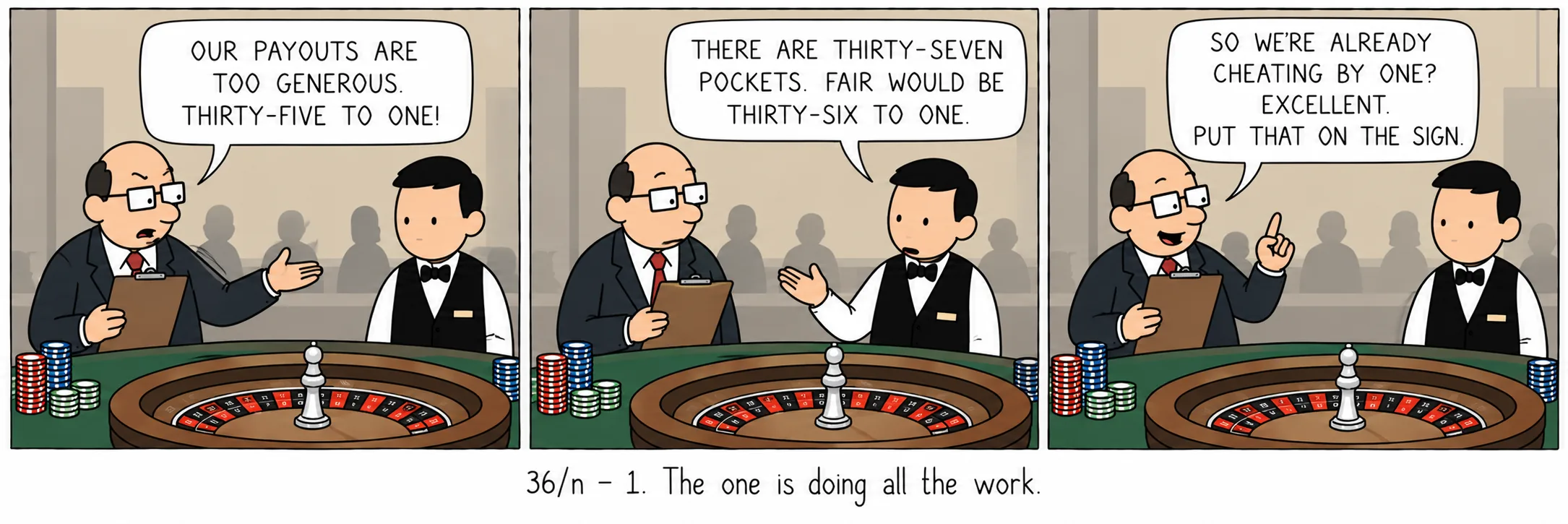
36/n − 1. The one is doing all the work.
Sources
- Ethier, S. N. The Doctrine of Chances: Probabilistic Aspects of Gambling.
- Epstein, R. A. The Theory of Gambling and Statistical Logic, 2nd ed.
- Bollman, M. Mathematics of the Big Four Casino Table Games: Blackjack, Baccarat, Craps, & Roulette.