Multi-Wheel Roulette
One bet, up to eight European wheels spinning at once.
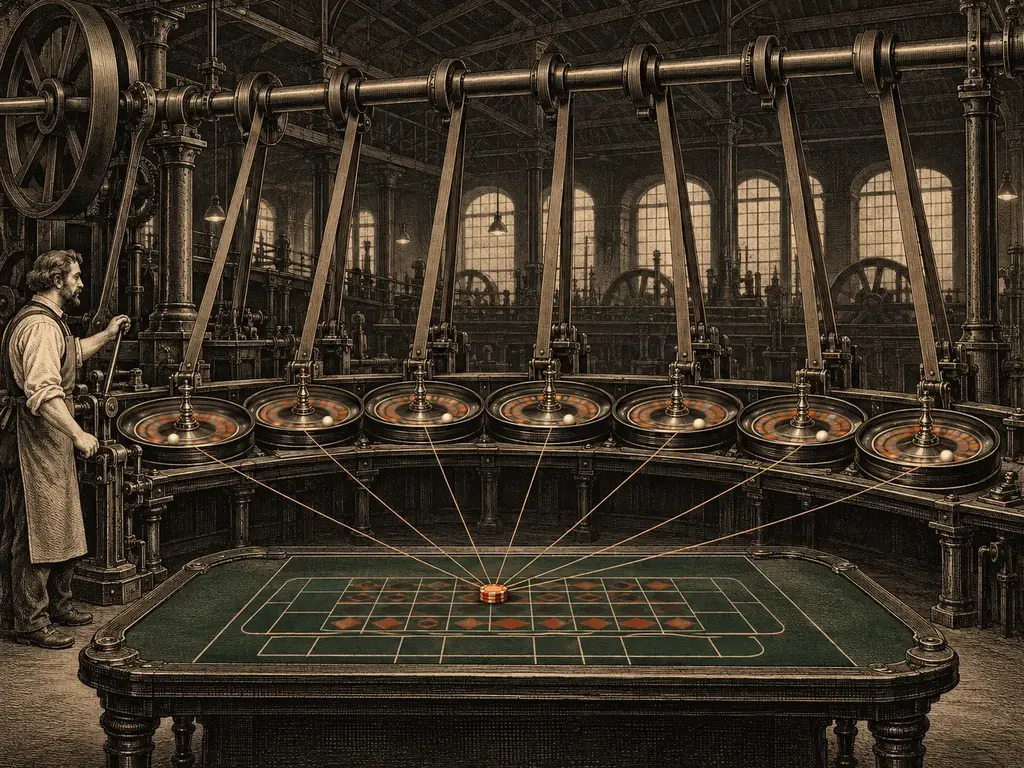
This page models fair single-zero wheels with standard payouts and independent results. Each wheel has a house edge of about 2.70%. Copying the same bet to eight wheels stakes eight times as much per round.
How to play multi-wheel roulette
You place a layoutequipmentLayoutThe marked betting surface, whether printed on a table or displayed on a screen.Read full definition → bet; it is copied to each active wheel. A $1 chipmoneyChipA token used to place a wager, with a printed or assigned value. Also called a check in some casino terminology.Read full definition → on redbetRedAn even-money wager on the 18 red numbers. French: rouge.Read full definition → across six wheels costs $6 and is paid per wheel: each wheel that lands red pays $1, each that lands blackbetBlackAn even-money bet on the 18 black numbers. French: noir.Read full definition → or zerowheelZeroThe 0 outcome, conventionally shown in green. Ordinary color, parity, high/low, dozen and column bets do not include it.Read full definition → loses $1. The calculations below assume fair, independent single-zero results and standard payoutsmoneyPayoutThe amount paid on a winning wager. Check whether the quoted figure is net profit or total return including the stake.Read full definition →. Check the actual game rules; several wheel displays do not by themselves establish independence.
What changes
At the same total stake, splitting a bet equally among six independent wheels divides its variancemathVarianceThe expected squared distance of a result from its expected value. It measures dispersion in squared units.Read full definition → by six compared with putting that total on one wheel. At the same stake per wheel, however, dollar variance rises sixfold: six $1 bets fluctuate more than one $1 bet. TurnovermoneyTurnoverThe sum of amounts wagered over a session or period, including money wagered again after a return. Also called handle or action.Read full definition → per round rises by the same factor. Expected lossmathExpected lossThe probability-weighted average net loss under a stated model. With a constant edge, it equals edge times expected total stakes.Read full definition → per hour multiplies by the number of wheels only if the stake per wheel and the number of completed rounds per hour both stay the same. Dividing the stake per wheel by six keeps the total stake per round, and therefore the expected loss per round, unchanged.
Where you find it
RNG lobbies, as a novelty format. A few live studios have run multi-wheel tables with several physical wheels in frame. It is uncommon on casino floors for obvious reasons of space.
Two rings, one ball: Double Action
TCS John Huxley’s Double Action Roulette, shown in 2012 and dealt at the M casino in Las Vegas, has two rings of numbers turning separately, so one ballequipmentBallThe small ball that settles in a numbered pocket to determine a physical roulette result.Read full definition → gives two results. A bet on one ring is ordinary roulette. A bet on both rings, red on the outer and red on the inner, is two spins in one and pays 3 to 1. It costs 5.33% on a single-zero wheel and 10.25% on a double-zero one, the price of two spins. A dozenbetDozenA bet on 1–12, 13–24 or 25–36, ordinarily paying 2 to 1.Read full definition → on both rings pays 8 to 1 at the same price. The same number on both rings pays 1,200 to 1; on a single-zero wheel the odds are 1,368 to 1, and the bet costs 12.27%. Bollman (2024) reports that the M paid 18 of these 1,200 to 1 wins in the trial’s first month. Bollman also describes a short-lived Double Roulette at Monte Carlo in 1936, with two concentric wheels and two balls, citing an earlier edition of Epstein.
Three balls, three numbers: Roulette Express
Gamesys’s online Roulette Express drops three balls on one single-zero wheel, always into three different pocketsequipmentPocketA compartment on the rotor in which the ball can settle. The number of pockets depends on the wheel.Read full definition →. A bet spread across the three balls is ordinary roulette at 2.70%. An Express bet needs all three. Since no number repeats, there are 7,770 possible sets of three, and the counts come from combinations: 816 sets are all red, 220 all in one columnbetColumnTwelve numbers in one vertical layout column, ordinarily paying 2 to 1.Read full definition →. Three reds pay 8 to 1 and cost 5.48%; three in a column pay 33 to 1 and cost 3.73%. A “No House EdgemathHouse edgeThe casino’s expected net gain expressed as a fraction of the stake, under specified probabilities and payouts.Read full definition →” version paid the fair price and took 10% of a session’s net winnings instead.
Who it suits
Players who like smoother results and more things happening per round. The comparison depends on stake size: spreading a fixed total across independent wheels smooths results, while copying the same chip onto more wheels increases turnover and dollar variance.
Questions
The calculations here assume independent wheel results. Check how the particular game generates and settles its outcomes; multiple displays alone do not prove independence.
Usually not; the bet is mirrored. Some versions let you select which wheels are active.
Comic relief
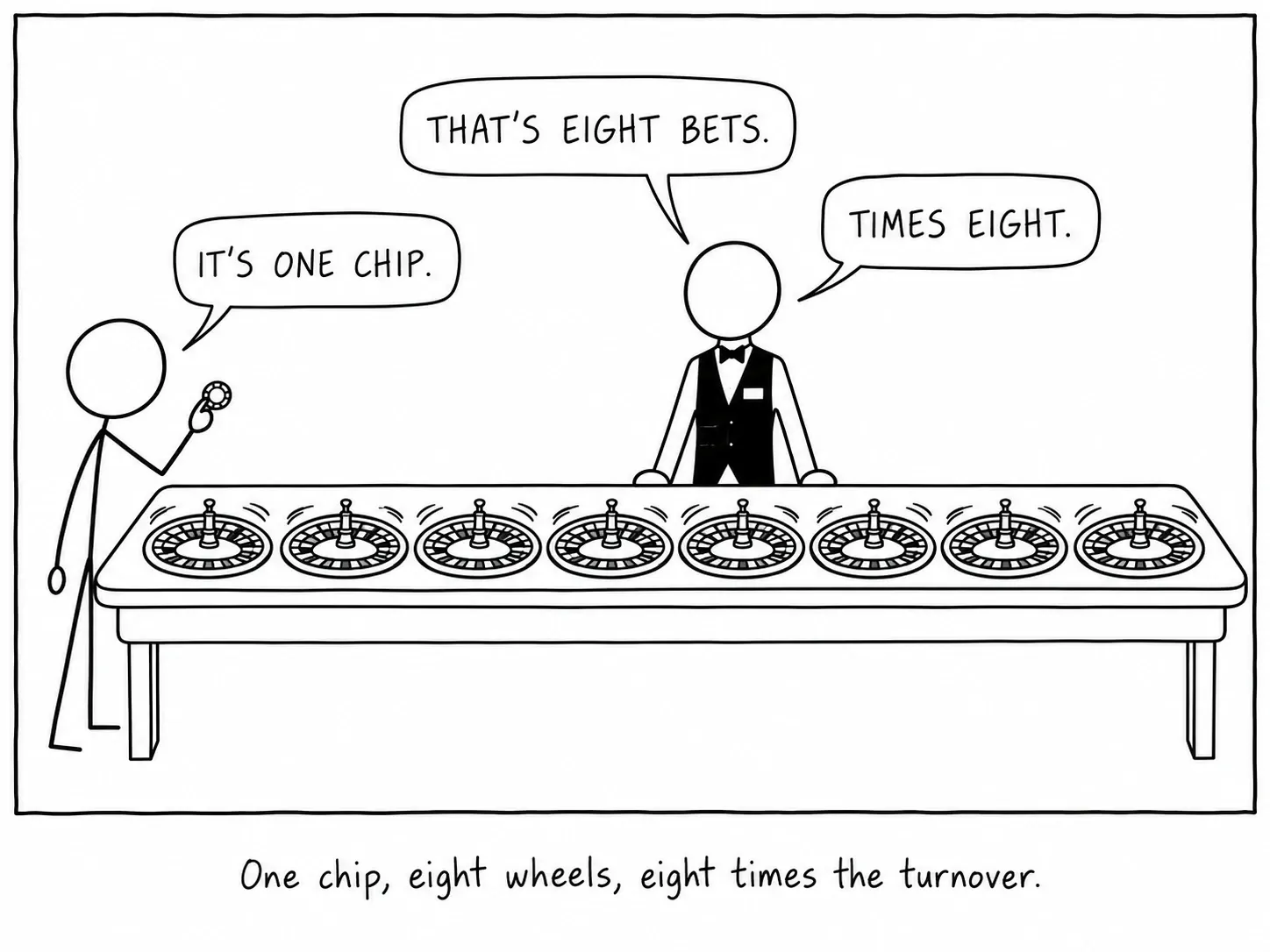
Copying a one-unit bet to each of eight wheels stakes eight units in total.
Sources
- Wizard of Odds. “Double Action Roulette” and “Roulette Express.”
- Bollman, M. Basic Gambling Mathematics: The Numbers Behind the Neon, 2nd ed.
- Epstein, R. A. The Theory of Gambling and Statistical Logic, 2nd ed.