The History of Roulette
A physics experiment that failed, a Paris gaming room, two brothers in a German spa town, and the casino that made a single green pocket the European standard.
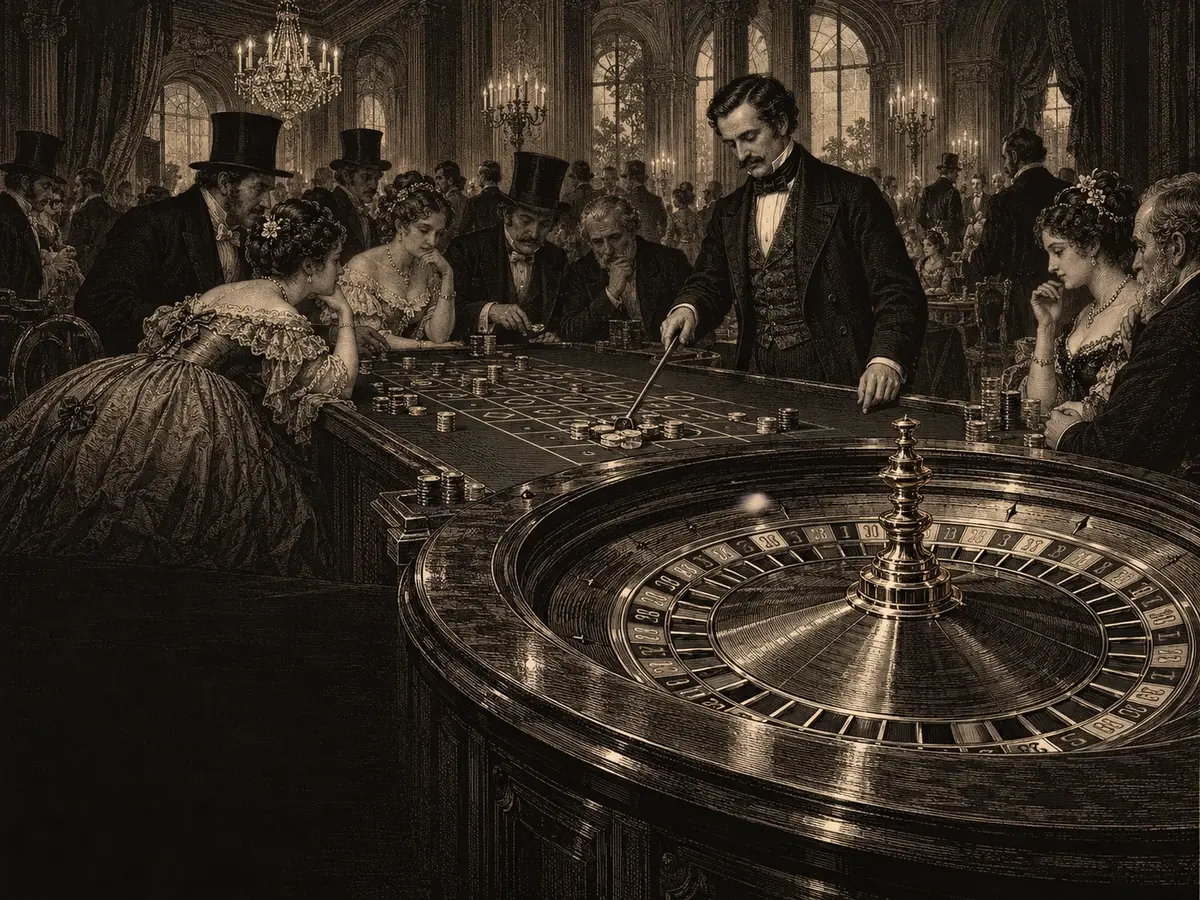
Before the wheel
- 1654
Pascal and Fermat: the problem of points; expected value.
Expected Value - 1655A wheel without a purpose
Blaise Pascal, searching for a perpetual-motion machine, builds a finely balanced spinning wheel. The machine fails; the wheel remains as a near-frictionless, apparently random device.
Blaise Pascal - 1657
Huygens publishes the first treatise on expectation.
- 1713
Jakob Bernoulli, Ars Conjectandi: the law of large numbers.
Long-Run Convergence - 1740sRoly-poly and E.O.
English gaming houses spin wheels with even and odd slots. The games are banned repeatedly, which pushes variants onto the Continent.
Origin of Roulette - 1754
d’Alembert publishes the fallacy later named for him as a system.
D'Alembert - 1758
New France (Quebec) bans dice, hoca, faro and “roulette”: one of the earliest records of the name for a gambling game.
- 1760s
“Martingale” enters French dictionaries as gambling slang.
Martingale
The game
- 1796Paris, Palais-Royal
Jaques Lablée’s novel La Roulette describes a wheel with two house pockets, 0 and 00, in a gaming house in the Palais-Royal. This is the earliest full description of the modern game.
Roulette in Literature - 1800s
American wheels add an eagle pocket: three house numbers.
American Roulette - 1837
France bans casinos; play moves to the German spas.
- 1841
The Blanc brothers take the Bad Homburg concession.
François Blanc - 1843Bad Homburg
François and Louis Blanc open a casino in the German spa town and remove the double zero. The single-zero wheel halves the house edge and draws players away from rival resorts.
Bad Homburg and the Spa Casinos - 1863Monte Carlo
With gambling outlawed across Germany, Blanc takes over the struggling casino in Monaco. Monte Carlo becomes the reference for European roulette; the single zero is its standard.
Monte Carlo Roulette - 1866
Dostoevsky, The Gambler.
Dostoevsky’s Roulettenburg - 1868
Railway from Nice to Monte Carlo.
Casino de Monte-Carlo - 1869
Monaco abolishes income tax.
- 1872
Prussia closes the German casinos.
Players and tests
- 1870s
Labouchère popularizes the cancellation system in London.
Labouchère - c. 1880Jagger’s wheel
Joseph Jagger, a Yorkshire textile businessman, has the wheels at Monte Carlo recorded and bets the numbers that come up too often. He wins a fortune; the casino moves its wheels about, then replaces them.
Joseph Jagger - 1891The man who broke the bank
Charles Wells runs a table out of chips several times in a few days, prompting the music-hall song. Investigations find no system, only luck and, later, fraud elsewhere.
The Man Who Broke the Bank - 1900
Pearson publishes the chi-square test with Monte Carlo spin data.
Chi-Square Test - 1907
France re-legalizes casinos in spa and seaside towns.
- 1913
26 blacks in a row at Monte Carlo.
Gambler's Fallacy - 1931
Nevada legalizes casino gambling.
Las Vegas Wheels - 1940s
Ulam and von Neumann name the Monte Carlo method.
- 1953
Fleming, Casino Royale: Bond backs two dozens at roulette.
James Bond Strategy - 1961
Thorp and Shannon build the first wearable roulette computer.
Roulette Computers - 1965
Dubins and Savage prove bold play is optimal in subfair games.
- 1969
Thorp’s proof that no betting system beats a negative-expectation game.
Myth: Systems Beat the Wheel - 1977–81
The Eudaemons’ hidden computers in Nevada: under the arm in 1978, in a shoe in 1981.
The Eudaemons - 1985
Nevada criminalizes prediction devices. Bass publishes The Eudaemonic Pie.
Cheating at Roulette
The modern game
- 20th c.From spa towns to screens
Roulette travels to Las Vegas with the double zero restored, then to online RNG tables in the 1990s and to live-streamed studio wheels in the 2000s.
European vs American Roulette - 1990s
García-Pelayo family exploit biased wheels near Madrid; barred; the courts overturn the ban (2004).
Gonzalo García-Pelayo - 1996
First online casinos with RNG roulette.
Live vs RNG Roulette - 2003–06
Live-dealer roulette streamed from studios; Riga and Malta become hubs.
How Live Roulette Works - 2004
Ritz team wins £1.3m by predicting the ball; a reported laser is never found; no charge.
Advantage Play - 2005
UK Gambling Act: comprehensive remote-gambling licensing.
Roulette in the United Kingdom - 2012
Small and Tse publish the physics of roulette prediction.
Roulette Wheel Physics - 2013
New Jersey launches regulated online casinos.
Roulette in the United States - 2016
Triple-zero roulette on the Las Vegas Strip.
Triple Zero Roulette - 2018
US federal sports-betting ban struck down; states legislate.
- 2021
Germany and the Netherlands license online casino games.
Roulette in Europe - 2026
This site: every date above, with the arithmetic.

The one line that matters
In two and a half centuries the odds of roulette changed once in the player’s favor (1843, one zero removed) and twice against (the eagle in the 1800s, the triple zero in 2016). Everything else, the systems, the computers, the studios, the lights, left the arithmetic where Lablée found it: 36/n − 1 against a wheel with one more pocket than that.
Questions
Pascal’s. The wheel experiments are real; the link to roulette is traditional.
During the 19th century; the European order used today was standard by the Monte Carlo era.
Probably a regulatory one. The wheel is finished.
Comic relief
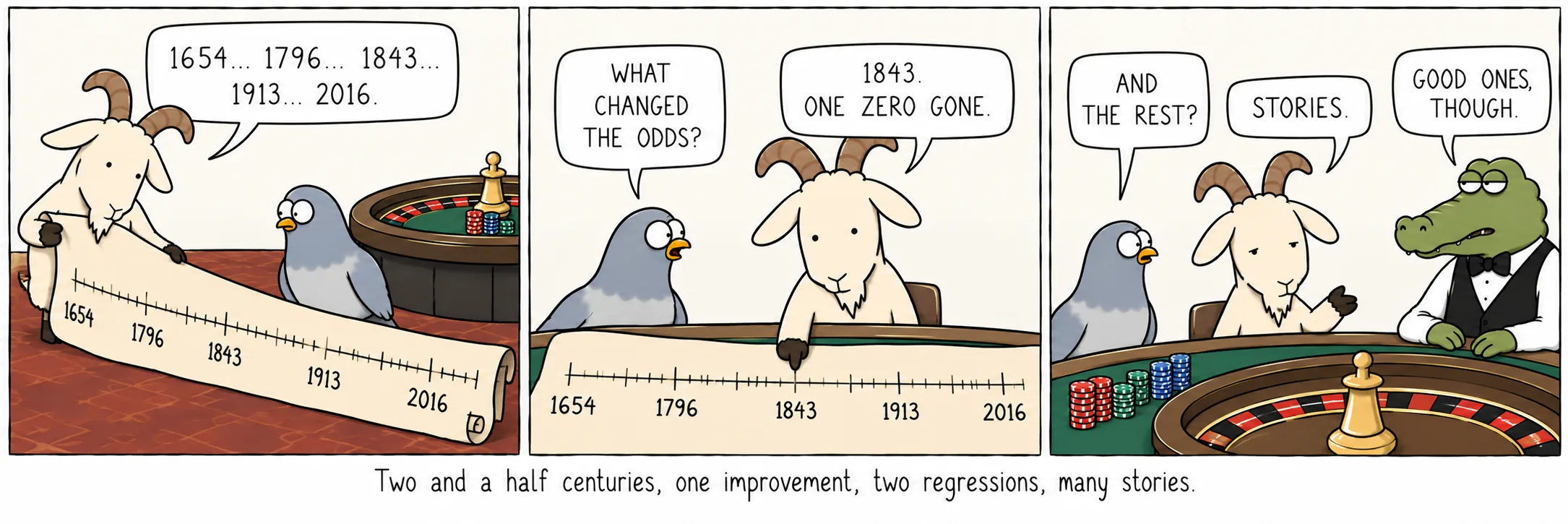
Two and a half centuries, one improvement, two regressions, many stories.
Sources
- Schwartz, D. G. Roll the Bones: The History of Gambling.
- Kavanagh, T. M. Dice, Cards, Wheels: A Different History of French Culture.
- Bass, T. A. The Eudaemonic Pie.
- Thorp, E. O. “Optimal gambling systems for favorable games.”
- Chellel, K. “The Gambler Who Beat Roulette.”
- Shelley, R. Roulette Wheel Study.