Is Online Roulette Rigged? The Myth
A losing session does not prove rigging. A license does not prove that errors are impossible.

Assess an online game through its rules, operator authorization, applicable technical standards and records. Long losing runs can occur in a fair model. A suspected malfunction or manipulation needs evidence; neither a bad session nor a certification badge settles the question.
The claim
Is online roulette rigged? The story goes that it is programmed to lose when you bet big, to hit zerowheelZeroThe 0 outcome, conventionally shown in green. Ordinary color, parity, high/low, dozen and column bets do not include it.Read full definition → when you have everything on redbetRedAn even-money wager on the 18 red numbers. French: rouge.Read full definition →, or to give new players a hot start and then turn. Evidence offered: a bad session, a zero at the worst moment, a feeling.
What technical standards require
For games within its scope, UK Gambling Commission RTS7 requires acceptably random outcomes, prohibits adaptive compensation and sets expectations for unpredictability, seeding and mapping results to game probabilities. RTS17 addresses fairness and auditability in live-dealer studios.
Those requirements are not a universal software architecture or proof that a particular operator complies. This page cannot infer that every certified generator is physically unable to receive bet information, that every test uses billions of draws or that a fault would always be detected.
What the house edge explains
Under a uniform single-zero model with standard payoutsmoneyPayoutThe amount paid on a winning wager. Check whether the quoted figure is net profit or total return including the stake.Read full definition →, the casino’s expected return is 1/37 of the amount wagered. Its actual return over a session can be much higher or lower. A mathematical advantage explains how a game can generate expected revenue without manipulation; it does not prove that misconduct or mistakes never occur.
Why it feels rigged
For 100 independent single-zero spins at $10 on red, with zero losing the whole bet, expected net return is about −$27.03 and standard deviationmathStandard deviationThe square root of variance: a measure of dispersion in the same units as the result.Read full definition → about $99.96. The exact chance of losing more than $200 is about 3.32%, and of losing more than $260 about 0.72%. These are illustrative probabilities for this fixed plan, not diagnostic thresholds for rigging.
The chart shows simulated paths under its stated model. A particular line is neither evidence about a real operator nor a prediction of your next session.
- p10 −$460
- p25 −$280
- median −$140
- p75 +$20
- p90 +$160
Checking a concern
Verify the operator and relevant website against the named regulator’s register, then read the specific game rules and complaint procedure. A displayed badge alone is not verification. The route for a dispute depends on the jurisdiction and operator.
Save the round reference, stakes, result, account entries and any error messages. Distinguish an unusual but possible outcome from a mismatch between the advertised rules and recorded settlement. Testing and licensing provide safeguards, not a guarantee of flawless software or recovery of disputed funds.
Questions
Use the named regulator’s own register to check the operator, website and relevant authorization. Do not rely only on the casino’s footer or badge.
Interfaces differ. The information shown to a dealer does not by itself establish manipulation or fairness.
Not by itself. Under independent uniform single-zero spins, zero has probabilitymathProbabilityA measure of how likely an event is, from zero to one. Percentages express the same scale from 0% to 100%.Read full definition → 1/37 regardless of that stake. Investigating a real concern requires the full record and game rules.
Comic relief
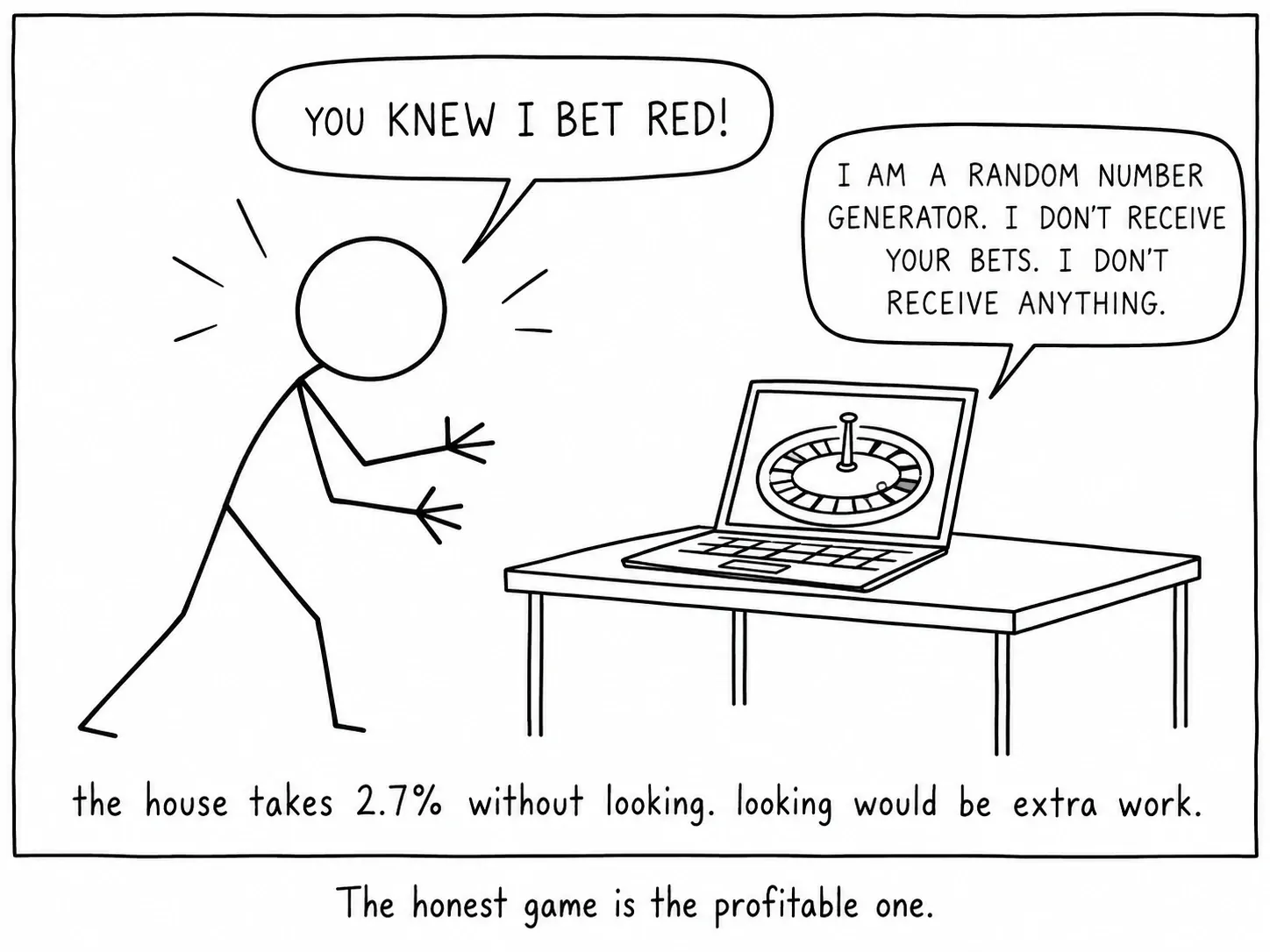
The house edge is not proof that a particular game is fair.
Sources
- UKGC RTS7 — generation of random outcomes
- UKGC RTS17 — live dealer studios