Casino de Monte-Carlo
The building that made the single zero famous and the stories that made the building famous.
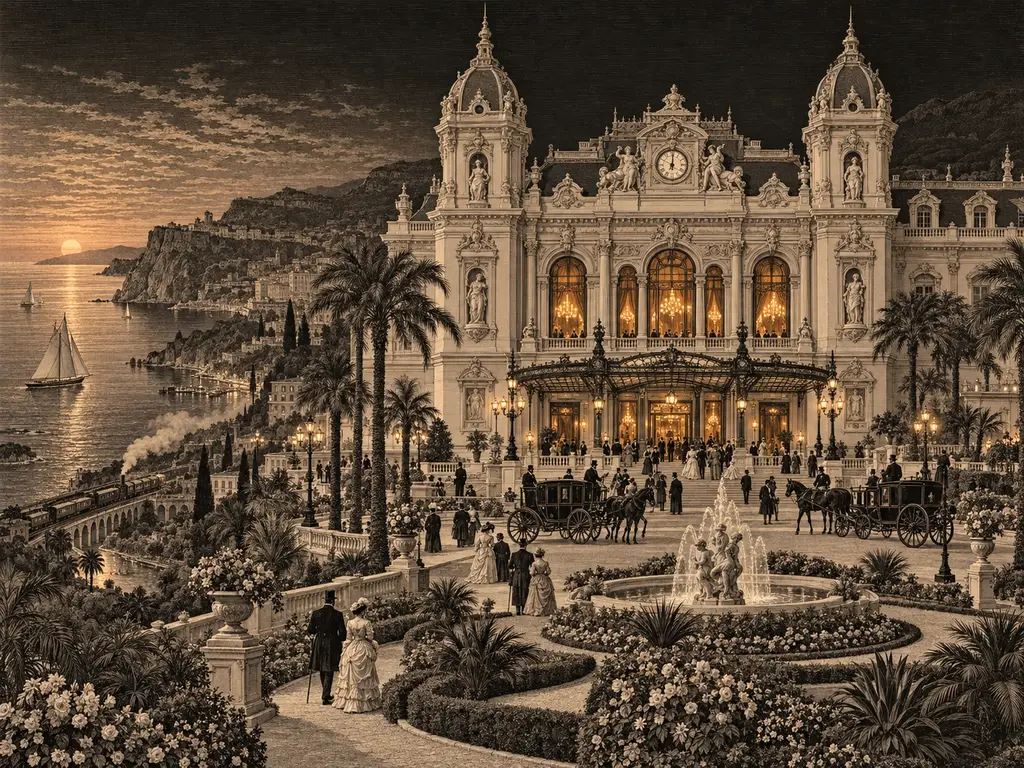
Opened in 1863 and rebuilt by Charles Garnier in 1878, the Casino de Monte-Carlo is the model for every casino resort since. Its roulette tables run single-zero wheels with French rules and have produced the game’s best-known anecdotes.
The building
The first casino was a modest villa. In 1878 Charles Garnier, fresh from the Paris Opéra, added the Salle Garnier and the façade that appears in every photograph: two towers, a terrace facing the sea, and a gaming floor of gilded salons designed to make a player feel that losing here was a kind of belonging. The Salle Europe, with its stained glass and eight chandeliers, has held roulette tables since it opened and still does.
The tables
Single-zerowheelZeroThe single green pocket that no even-money, dozen or column bet covers; the source of the house edge. Also: single zero, 0.Read full → wheels throughout, with French-language layoutsequipmentLayoutThe printed betting grid on the table. Also: table, felt, cloth.Read full →, call betstableCall betA bet announced to the dealer rather than placed by hand, usually a wheel-sector bet such as voisins or tiers. Also “announced bet”.Read full → expected, and the player’s choice of la partageruleLa partageFrench rule: when zero hits, half of an even-money stake is returned. Halves the house edge on those bets to 1.35%.Read full → or en prisonruleEn prisonFrench rule: when zero hits, an even-money bet is held for the next spin instead of lost. Halves the house edge on those bets.Read full → on even-money betsbetEven-money betRed/black, odd/even, high/low. 18 numbers, pays 1:1.Read full → when zero hits. Minimums are higher than most European floors and the dress code is enforced after dark. Private salons with higher limits sit behind the public ones. The equipment is modern; the ritual, including the dealer’s spoken “rien ne va plusFR · procedureRien ne va plus“Nothing goes any more.” The French call for no more bets.Read full →”, is 19th-century.
The arithmetic that built a state
At 2.70% on most bets and 1.35% on even money, the edge was lower than any competitor’s. Volume made up for it: trains from Nice from 1868, hotels on the hill, a season that ran all winter. By 1869 the casino paid for the state and income tax was abolished. The lesson Blanc taught is the one this site repeats: edge × turnovermoneyTurnoverThe total amount wagered over a session or period, counting re-bet winnings. Also: handle, action.Read full → is the whole business, and turnover responds to price.
Visiting
The main salons admit visitors over 18 with ID; locals are still barred from gambling. There is an entrance fee for the gaming rooms and a free area with slot machines. If you go to watch roulette, the Salle Europe in the early evening is the place: a dealer, a long rake, chipsmoneyChipA token representing a fixed amount, placed on the layout to make a bet. Also: check.Read full → announced in French, and a wheel that has not changed its odds since 1863.
Questions
Visitors over 18 with ID, dressed appropriately. Monégasque citizens may not gamble.
Single zero with French rules is the best standard roulette anywhere; many European casinos match it.
Not officially. The casino has never confirmed the table or the date beyond the accepted account.
Comic relief
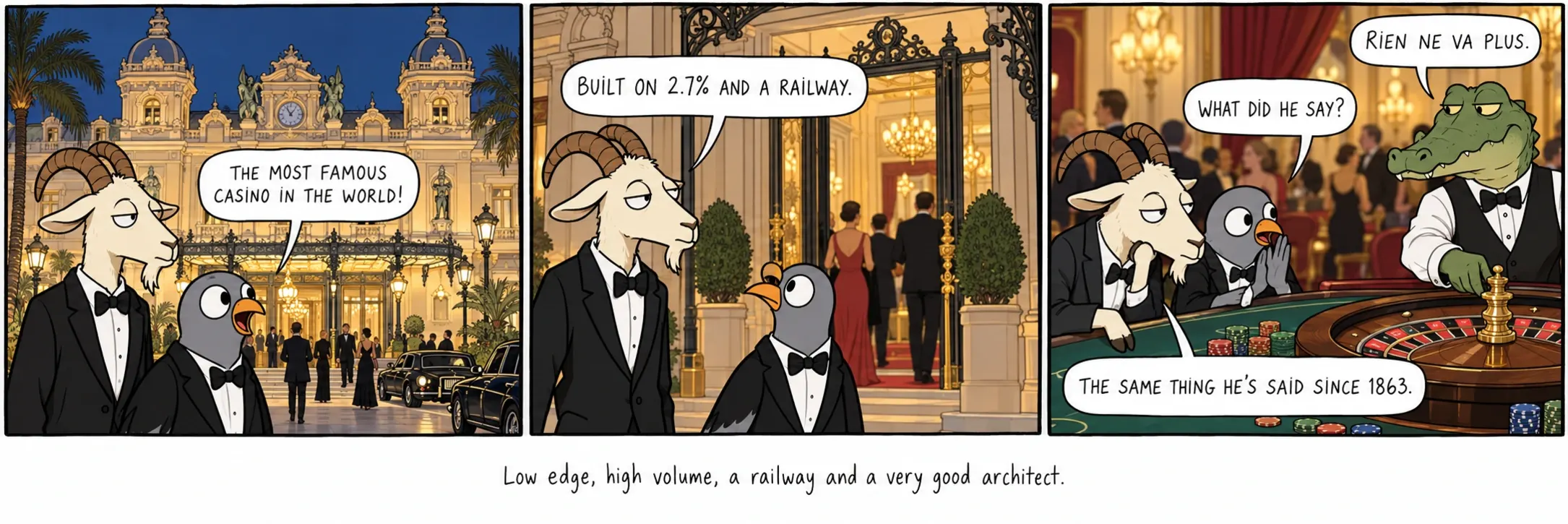
Low edge, high volume, a railway and a very good architect.
Sources
- Schwartz, D. G. Roll the Bones: The History of Gambling.
- Kavanagh, T. M. Dice, Cards, Wheels: A Different History of French Culture.
- Barnhart, R. T. Beating the Wheel.