Cheating at Roulette
The first crooked roulette wheels belonged to the house. Today cheating happens at the layout, often with a dealer’s help, and every licensed table is built to catch it.
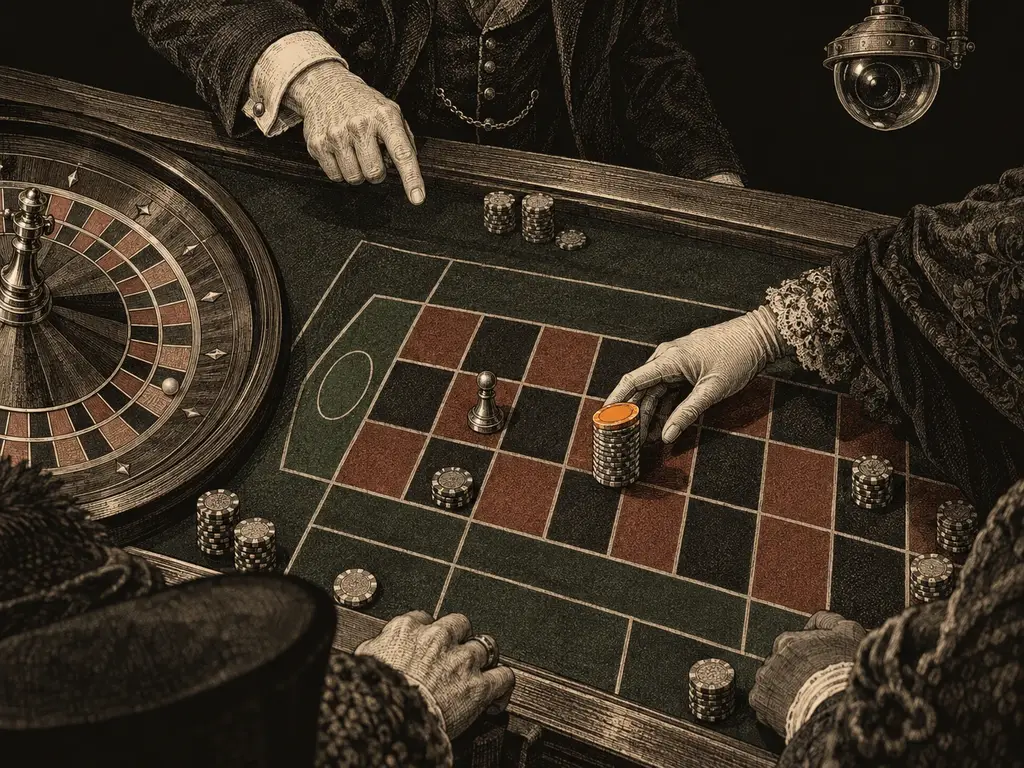
Roulette cheats have attacked four things: the wheel, built to steer the ball; the bet, changed after the result; the dealer, paid to help; and the software, altered to pay. The gaffed wheel was the house’s tool in illegal 19th- and early 20th-century gambling houses; licensed casinos now check every wheel for magnets before a table opens. Late bets, often taken by a corrupt dealer, are what courts see today. Reading a biased wheel or a predictable ball by eye is not cheating; using a device to do it is a crime in Nevada.
Two different things
Advantage play uses information anyone could gather, a biased wheellabBiased wheelA wheel whose physical defects make some pockets more likely than 1/37. Rare, detectable only with thousands of recorded spins.Read full → or a predictable ballequipmentBallThe small ball launched along the track against the rotor. Modern balls are ivorine or Teflon, 18–21 mm.Read full →, and bets on it before betting closes. Cheating changes the game: it adds to a bet after the result is known, takes back a losing bet, or hides how much was bet. The first is usually legal, and the casino’s answer is to fix the wheel or bar the player. The second is fraud. In Nevada, placing or changing a bet once the outcome is known is an offense in its own right. The Ritz players of 2004 were arrested, released, and given their money back when the case was dropped; past-posters are prosecuted.
Four ways to cheat a wheel
A fair spin can be attacked at four points: the wheel itself, the bet once the result is known, the dealer who settles the bets, and, on machines and online, the software that pays them. Who does the cheating has changed over time. In the 19th century it was mostly the house. Today it is mostly players, often with a dealer’s help.
The crooked wheel, 1890 to the 1930s
For its first century in America the dishonest party at a roulette table was usually the house. John Philip Quinn, a reformed gambler, described the devices in 1890. A lever under the wheel was worked through one table leg, made a trifle shorter than the others, so that the dealer leaning on it changed the ball’s course from redbetRedEven-money bet on the 18 red numbers. French: rouge.Read full → to blackbetBlackEven-money bet on the 18 black numbers. French: noir.Read full →. On another wheel half the fretsequipmentFretThe metal divider between two pockets on the wheel.Read full →, the metal dividers between pocketsequipmentPocketOne of the 37 numbered compartments on the rotor. Also: slot, cup.Read full →, were a trifle taller: because the colors alternate, spinning the ball one way or the other favored red or black, and the dealer chose whichever color held less money. A third had a false center in which rods pushed fine needle points up in front of alternate pockets. Quinn reprinted a New York supplier’s catalogue that offered wheels “that can be made to come Red or Black, or High or Low Number, just as the dealer desires.” By 1912 he wrote that electricity was the popular method, with wires run up a table leg from a battery in the cellar, and suggested a pocket compass to find it: the needle swings when the current is on. The Smithsonian’s National Museum of American History holds a 1930s wheel made in Chicago with an electromagnet that the dealer switched on with a button to push the ball away from numbers carrying large bets.
Why a licensed wheel is hard to rig
The gaffed wheel belonged to houses with no regulator. In a licensed casino the controls are written into the rules. New Jersey’s are typical: before a table opens the wheel is checked for magnets and any other device, for level, and for turning freely and evenly; the ball is passed over a magnet or compass, and it must contain no metal at all; every adjustment is logged, and a locked cover goes on the wheel when the table closes. Many modern wheels read the winning number with sensors in the rim and send every result to the casino’s software, so a wheel that favors some numbers shows up in the house’s own statistics. The house also has no reason to take the risk. A fair single-zerowheelZeroThe single green pocket that no even-money, dozen or column bet covers; the source of the house edge. Also: single zero, 0.Read full → wheel keeps 2.70% of everything bet, and a rigged one would cost the license.
Past-posting
The classic roulette scam is past-posting: slipping a chipmoneyChipA token representing a fixed amount, placed on the layout to make a bet. Also: check.Read full → onto, or under, a winning bet after the ball has dropped, then claiming the payoutmoneyPayoutWhat a winning bet returns, quoted as “X to 1” on top of the returned stake.Read full →. It takes a team. A mechanic makes the move while the dealer is busy, a claimer the dealer has never seen collects, and a lookout watches the pit and calls off the play by hand signal. The moment is the payout itself, when the dealer turns to fetch chips for an outside winner and the inside numbers go unwatched for a few seconds.
Richard Marcus
Marcus was a dealer at the Four Queens in Las Vegas in the 1970s when a past-posting crew recruited him. By his own account he worked with it, then led his own team, for about 25 years at roulette, craps and blackjack, and quit around 2000 without ever being convicted. His 2003 memoir describes the roulette version. Two players cover the third dozenbetDozen1–12, 13–24 or 25–36, pays 2:1.Read full →, chip by chip, spin after spin, until it hits; while the dealer pays the dozen, a hand slides a $100 chip under a winning straight-up stack. The claimer has already made one genuine $100 straight-up bet, so the pit remembers him as a player of that size, and the move is worth $3,500. Keeping the layoutequipmentLayoutThe printed betting grid on the table. Also: table, felt, cloth.Read full → busy costs the team only the house edgemathHouse edgeThe share of each stake the casino keeps on average: 2.70% in European roulette.Read full → on its cover bets.
The Savannah
Marcus’s best-known move was not a past-post at all. Before the spin he set a $5 chip on top of a $5,000 chip on an outside betbetOutside betA bet on the boxes surrounding the grid: dozens, columns and even-money bets.Read full →, the big chip pushed back so the dealer saw only a small stack. If the bet won, the dealer found the big chip and paid it: $5,005 on red, $10,010 on a dozen. If it lost, Marcus lifted the stack before the sweep, and if challenged put down two $5 chips palmed in advance; the dealer, who had read the bet as $10, saw nothing wrong. Every winning bet was real and every losing one vanished. Later accounts credit it with about $5 million before casinos stopped paying it.
Inside jobs
Most roulette cheating that reaches a court now involves a dealer. The usual method is the late bet: the dealer lets a partner place or add to a bet after the ball has dropped, or releases the ball early so a bet goes in before an electronic cut-off. The sums are rarely large, and the cases usually come to light through the camera over every table, or through one player who keeps winning at one dealer’s table.
Machines and software
Electronic roulette moves the target from the chips to the code. In the summer of 2007 two IT contractors at a London casino group altered its system so that the terminals at live roulette tables printed winning slips, worth up to £600 each, whatever number had come up. They cashed about £33,000 at four casinos, pleaded guilty to theft and received suspended sentences in 2010. Online, the risk to a player is an unlicensed operator, whose software nobody tests. For licensed games we found no regulator’s finding of a rigged roulette generator. What does reach the courts are malfunctions: in 2021 BetMGM voided a Michigan player’s run from $50 to about $3.3 million on an online roulette game as a software error, and in 2025 the state’s Supreme Court let her lawsuit go ahead. An error the casino refuses to pay is a dispute about a contract, not proof that the game was rigged.
Devices, and where the law draws the line
Predicting the ball is not cheating in itself. Reading a biased wheel, as Joseph Jagger and the García-Pelayo family did, uses information anyone could collect. Spain’s Supreme Court ruled in 2004 that the García-Pelayos had used ingenuity and a computer, not cheating, and that the casino’s remedy was to change its wheels. Carrying the computer to the table is a different matter. Nevada has made it a crime to use or possess any device designed to project the outcome of a game or analyze its probabilities, and has treated it as a felony since 1985. Britain’s Gambling Act 2005 makes cheating an offense and says it can consist of interference with the process of the game; in 2017 the UK Supreme Court held, in Ivey v Genting, that cheating does not have to be dishonest.
Stories every cheating article repeats
Two stories turn up on page after page about roulette cheats, and neither can be traced to a source. Pierre Dugal, a Frenchman said to have rigged wheels in the early 19th century and been betrayed by his wife, appears with no date, no casino and no trial. Monique Laurent, said to have steered a radio-controlled ball from a transmitter hidden in a cigarette packet in the 1970s, appears in versions that disagree on the casino, the amount, “5 million francs” or “$1 million”, and whether she was ever arrested. We found no newspaper, court record or book of the period for either. Two other claims are simply wrong: García-Pelayo’s case was decided in Spain, not by the United States Supreme Court, and Richard Marcus, by his own account and later interviews, was never convicted.
How the casino catches it
Most of a dealer’s routine is protection against the chip moves above. “No more betsprocedureNo more betsThe dealer’s call (or the on-screen prompt) that closes betting. Chips may no longer be placed, moved or removed.Read full →” closes the layout before the ball drops. The dollyequipmentDollyThe marker placed on the winning number on the layout while bets are settled.Read full → marks the winning number, and nothing on the felt may move while it is down. Losing chips are swept before any winner is paid, so a losing bet cannot be taken back during the payout. A dealer who sees a high-value chip on the layout calls it out to the pit, which is why Marcus’s claimer placed his genuine big bet first. Color chipstableColor chipsRoulette-only chips in a color unique to each player at the table, with a value set at buy-in. Also: wheel checks.Read full →, one color per player, make a stranger’s chip stand out, and overhead cameras record every payout for review. The rest of the casino covers the other methods.
What it means for an ordinary player
In a licensed casino the gaffed wheel is history, and the cheats at the table are robbing the casino, not the players beside them. No legal move at the table beats a fair wheel, and nothing a cheat does changes the odds for anyone else. Two habits keep a player clear of suspicion. Leave your chips alone while the dolly is down, even winning ones, because reaching for them then looks exactly like the move the cameras are there to catch. And refuse any dealer who offers to help, because a late bet taken as a favor is the same crime as one bought. Online, play only where the operator’s license can be checked with the regulator. An unlicensed game is the one place a modern player could meet the 1890 wheel.
Questions
No. Changing a bet once the result is known is fraud wherever the game is legal.
In Nevada using such a device has been a felony since 1985. Elsewhere the law varies; see Advantage Play.
He was questioned many times and, by his own account and later interviews, never convicted. He has since advised casinos on game protection.
It has been: the Smithsonian holds a 1930s wheel built for it. Licensed casinos check for magnets before a table opens, and in New Jersey the ball must contain no metal.
Prosecution. Dealers and their partners have been sentenced in the United States, New Zealand, England and Singapore.
Fun with Math
Try these yourself first. Each solution is folded; open it when you are ready.
A past-posting team keeps the layoutequipmentLayoutThe printed betting grid on the table. Also: table, felt, cloth.Read full → busy by covering the third dozenbetDozen1–12, 13–24 or 25–36, pays 2:1.Read full → every spin on an American wheel: 4 chipsmoneyChipA token representing a fixed amount, placed on the layout to make a bet. Also: check.Read full → on each of the numbers 25 to 36 and 20 chips on the dozen box. What does it win when the dozen hits, what does it lose when it misses, and what does the waiting cost?
Show the solution
Answer +136 chips when it hits and −68 when it misses, so on average the team loses 3.58 chips a spin, the ordinary 5.26% of 68. The dozen hits about once every 3.2 spins.
Each spin 68 chips go down. If one of 25 to 36 comes up, the 4 chips on it win 35 to 1 and come back with their stake: 144 chips. The dozen pays 2 to 1 on 20 chips: 60 back. That is 204 for 68 staked, +136. Otherwise all 68 are lost.
Average: (12 × 136 − 26 × 68)/38 = (1,632 − 1,768)/38 = −3.58 chips a spin, which is 5.26% of 68. The dozen comes up 12 times in 38, once every 3.2 spins on average.
So the cover costs the team nothing beyond the house edgemathHouse edgeThe share of each stake the casino keeps on average: 2.70% in European roulette.Read full →, and it buys what the move needs: a reason to sit at the table, and a payoutmoneyPayoutWhat a winning bet returns, quoted as “X to 1” on top of the returned stake.Read full → during which the dealer looks away.
Quinn’s 1890 wheel with taller fretsequipmentFretThe metal divider between two pockets on the wheel.Read full → let the dealer steer the ballequipmentBallThe small ball launched along the track against the rotor. Modern balls are ivorine or Teflon, 18–21 mm.Read full → toward redbetRedEven-money bet on the 18 red numbers. French: rouge.Read full → or blackbetBlackEven-money bet on the 18 black numbers. French: noir.Read full →. Suppose the steering works only once in 18 spins and the rest are fair, on a double-zerowheelZeroThe single green pocket that no even-money, dozen or column bet covers; the source of the house edge. Also: single zero, 0.Read full → wheel, and the dealer always steers against the color you bet. What does a $10 bet on red cost you now? How often would the steering have to work for the house to keep a third of every bet?
Show the solution
Answer Once in 18 spins doubles the house edge, from 5.26% to 10.53%: $1.05 a bet instead of $0.53. To keep a third of every bet, the steering has to work 8 spins in 27, about 30% of the time.
On a fair spin red wins 18 times in 38. A steered spin never wins. If the steering works with probabilitymathProbabilityChance of an outcome, from 0 to 1 or 0% to 100%. One number: 1/37 = 2.70%.Read full → s, red wins with probability (1 − s) × 18/38.
With s = 1/18: (17/18) × (18/38) = 17/38. The bet wins $10 with chance 17/38 and loses $10 with chance 21/38, an average of −$40/38 = −$1.05, which is 10.53% of the stake. The fair wheel’s figure is −$20/38 = −$0.53, or 5.26%.
For a third: the bet is worth 2p − 1 of the stake, where p is the chance of winning, so 2p − 1 = −1/3 gives p = 1/3. Then (1 − s) × 18/38 = 1/3, so 1 − s = 38/54 and s = 16/54 = 8/27, about 29.6%.
This is why a gaffed wheel was worth the risk to a crooked house, and why it could be used sparingly: steering one spin in eighteen, against the biggest bets only, is hard to see from the rail and doubles the take.
steered spinsred winshouse keepsnone18 in 385.26%1 in 1817 in 3810.53%1 in 615 in 3821.05%8 in 271 in 333.33%allnever100%
Comic relief
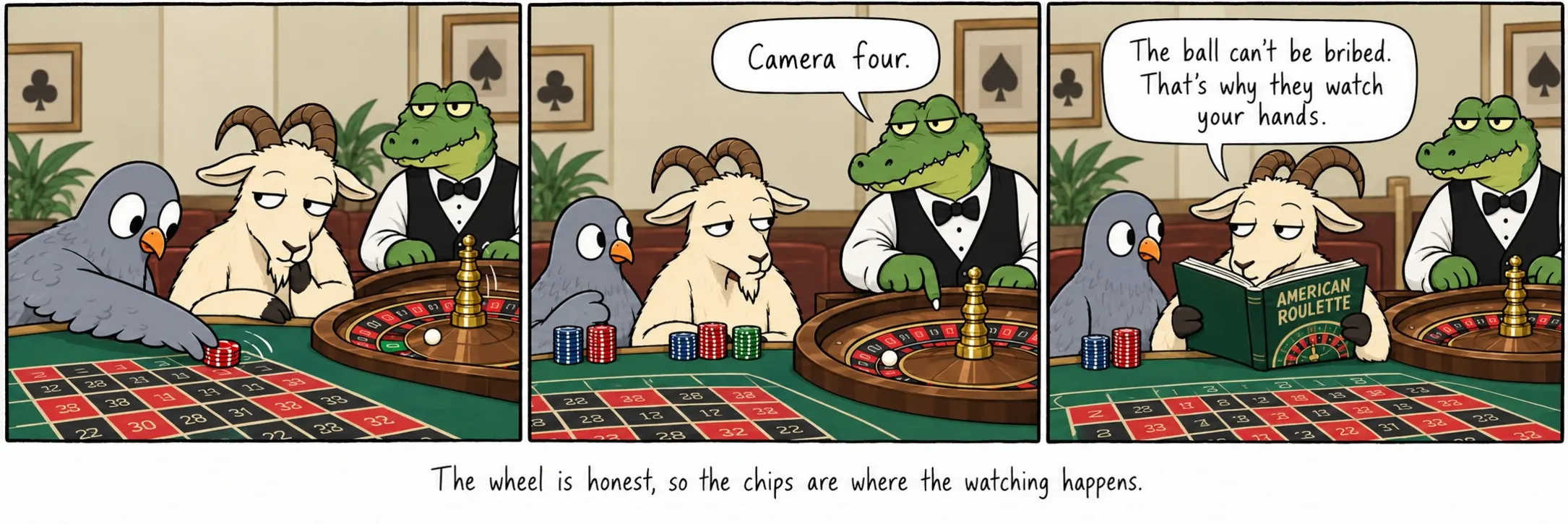
The wheel is honest, so the chips are where the watching happens.
Sources
- Marcus, R. American Roulette: How I Turned the Odds Upside Down.
- CDC Gaming Reports. “Richard Marcus: from the wrong side of the casino tables to the right.”
- Goldman, N. Great Gambling Scams.
- Nevada Revised Statutes, chapter 465.
- Quinn, J. P. Fools of Fortune; or, Gambling and Gamblers.
- Quinn, J. P. Gambling and Gambling Devices.
- Bollman, M. Mathematics of the Big Four Casino Table Games: Blackjack, Baccarat, Craps, & Roulette.
- National Museum of American History. Roulette wheel, H. C. Evans & Co., Chicago, 1930s.
- New Jersey Administrative Code.
- Federal Bureau of Investigation, New Orleans. “Leader of conspiracy to defraud L’Auberge Casino in Lake Charles sentenced in federal court.”
- Department of Internal Affairs, New Zealand. “Hamilton Casino cheats penalised.”
- Blackpool Gazette. “Croupiers jailed for casino scam.”
- The Register. “IT contractors convicted of UK casino hack scam.”
- Marraco, M. “‘Los Pelayos’ vencen al casino en la ruleta y en el Supremo.”
- Gambling Act 2005 (c. 19).
- Ivey v Genting Casinos (UK) Ltd.