2 Up 2 Down Roulette Strategy
2 Up 2 Down keeps an outside stake unchanged until a pair of consecutive results triggers a change. This version adds a unit after two consecutive losses and resets after two consecutive wins.

Use an even-money wager here. Count non-overlapping loss pairs, add one base unit after each pair, and reset to the base after two consecutive wins.
Known rule and limitation
Choose an affordable base stake allowed by the table. This example uses an even-money betbetEven-money betA bet paying a profit equal to the stake, such as red/black, odd/even or high/low.Read full definition → under standard single-zerowheelZeroThe 0 outcome, conventionally shown in green. Ordinary color, parity, high/low, dozen and column bets do not include it.Read full definition → rules. Hold the stake through results until two consecutive losses occur, then add one base unitmoneyUnitA base amount used to express stakes or results.Read full definition →; after two consecutive wins, reset to the base stake. An opposite result breaks a consecutive streak. This article counts non-overlapping loss pairs: L L L L raises the next stake twice, not three times. The two-win rule resets to base rather than subtracting one unit.
Declared example convention
To illustrate only the stated triggers, this table resets the opposite streak counter on each result and counts the current outcome as the first result of its new streak. A completed loss pair then starts a fresh loss count.
| recent result pair | stake before | next stake under example convention |
|---|---|---|
| loss, loss | 1 | 2 |
| win, win at any level | 2 | 1 |
| loss, win | 2 | 2; new streak starts at 1 |
| win, loss | 2 | 2; new streak starts at 1 |
Worked example
Begin with one unit. Two losses make the next wager two units. If a win then follows, that win interrupts the loss streak, so the declared convention retains two units and starts a win count of one. A second consecutive win from that point makes the next bet one unit. The completed wagers might therefore be 1, 1, 2, 2; their arithmetic depends on whether each outcome won or lost, not on the name of the progressionstrategyProgressionA rule that changes stakes over a sequence of bets, often using previous wins or losses.Read full definition →.
Expectation and operational risk
A conditional trigger does not alter independent roulette outcomes. On a single-zero wheel, a one-unit even-money wager has expected result −1/37, and any later two-unit wager has expected result −2/37. A session calculation also needs a horizon, bankrollmoneyBankrollThe amount set aside for play. Bankroll management concerns stakes and limits within that amount.Read full definition → and table-limit response. Two consecutive wins can reset the stake without recovering all earlier losses; the name is not a profit guarantee.
Questions
The stake remains unchanged. The second result starts a new consecutive streak of its own type; it does not complete a pair.
Not necessarily. Resetting selects a future stake; it does not turn losses already recorded into wins.
Comic relief
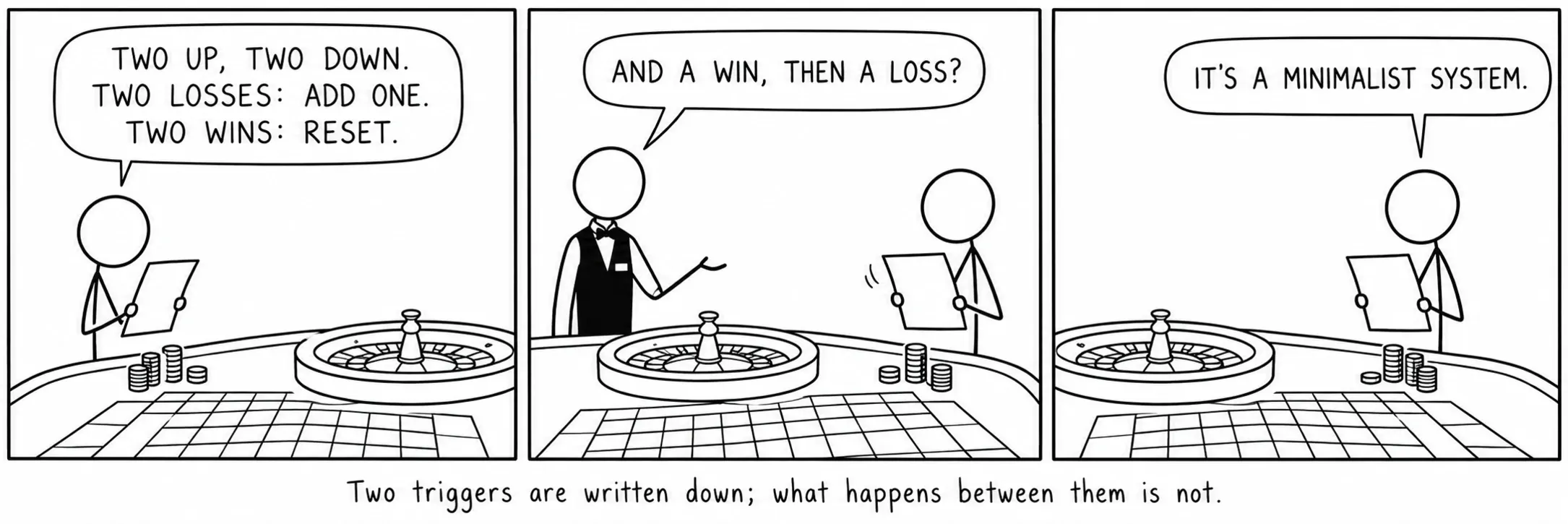
Two consecutive wins reset the stake, not the history of losses.
Sources
- RouletteDoc, Strategy overview
- Roulette77, “2 Up 2 Down” — stated triggers and missing transitions
- Wizard of Odds, Roulette Basics — outside-bet odds and edge
- Wizard of Odds, The Truth about Betting Systems — conditional staking does not change expectation