Sector Analysis
Physical defects affect neighboring pockets together, so test arcs of the wheel, not just single numbers.

Group the 37 pockets into contiguous sectors and compare observed hits with expectation per sector. A real bias usually shows as one or two adjacent sectors running hot across independent samples.
Method
Divide the wheel into contiguous sectorswheelSectorA contiguous arc of pockets on the wheel, as distinct from a group on the layout.Read full →, usually six arcs of six or seven pocketsequipmentPocketOne of the 37 numbered compartments on the rotor. Also: slot, cup.Read full →, following the wheel order rather than the layoutequipmentLayoutThe printed betting grid on the table. Also: table, felt, cloth.Read full →. For each sector of k pockets, expected hits are n·k/37 and the standard deviationmathStandard deviationSquare root of variance; the typical distance of a result from the expected value.Read full → is √(n·p·(1−p)) with p = k/37. Compute z = (observed − expected)/σ for each sector. A sector above +2 is worth a second look; above +3, in two independent samples, is interesting.
Why sectors
Single-pocket tests have 37 chances to throw a false positive and a weak signal in each. Sector tests have six chances and a signal that adds across neighboring pockets. They also match the physics: a tilted rotorequipmentRotorThe spinning part of the wheel that carries the pockets.Read full → makes the ballequipmentBallThe small ball launched along the track against the rotor. Modern balls are ivorine or Teflon, 18–21 mm.Read full → drop preferentially on the low side, which favors an arc; a loose or bent fretequipmentFretThe metal divider between two pockets on the wheel.Read full → changes the bounce for the pockets beside it; a worn ball trackequipmentBall trackThe rim groove the ball runs along before it slows and falls. Also: upper track.Read full → creates a drop zone that favors whichever pockets are beneath it at the drop, which with a slowly varying rotor speed smears across a wide arc. None of these defects favors a single pocket in isolation.
Rolling sectors
Fixed boundaries can split a hot arc between two sectors and dilute it. A complementary approach slides a window of k pockets around the wheel, computing z at each of 37 positions, and looks for the maximum. The maximum of 37 correlated z-scores under fairness is typically around 2.2 to 2.5, so a rolling-window maximum under 2.5 is noise and the threshold for interest is correspondingly higher, around 3.5.
From sector to bet
If a sector is confirmed hot, the natural bet is neighborsbetNeighborsA number and the two pockets on either side of it on the wheel, five straight-up chips.Read full → on its center or a hand-placed set of straight upsbetStraight upA single number, pays 35:1.Read full → across it. The profitability test is the sector hit rate against the payoutmoneyPayoutWhat a winning bet returns, quoted as “X to 1” on top of the returned stake.Read full →: a six-pocket sector must hit more than 6/36 = 16.7% of the time (observed, replicated) for six straight-up chipsmoneyChipA token representing a fixed amount, placed on the layout to make a bet. Also: check.Read full → to break even, against a fair 16.2%. The margin is half a percentage point, which is why confirming it takes tens of thousands of spins.
The analyzer
The Wheel Bias Analyzer on this site accepts a list of spins, computes the chi-square, and shows the wheel as a heat map with sector z-scores, with the partition above as default. It also shuffles your data to show what the same statistics look like under fairness, which is the quickest cure for seeing patterns.
Formula
Questions
Six is standard. Fewer loses resolution; more loses power. Decide in advance.
Merge them and compute z for the combined arc. A real defect often straddles a boundary.
No. Sectors are wheel arcs. DozensbetDozen1–12, 13–24 or 25–36, pays 2:1.Read full → and columnsbetColumnTwelve numbers in one vertical column of the layout, pays 2:1.Read full → are not sectors.
Comic relief
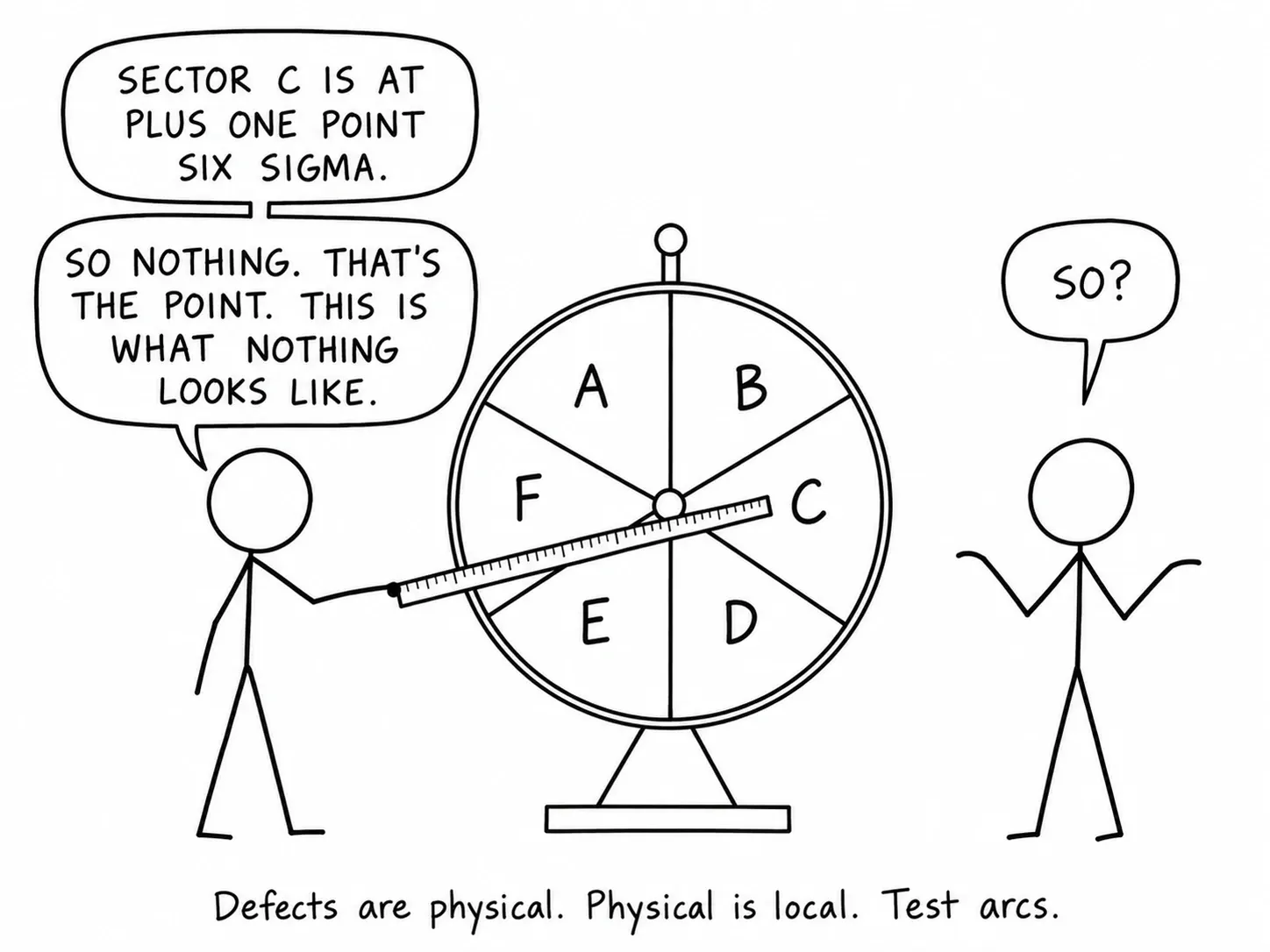
Defects are physical. Physical is local. Test arcs.
Sources
- Barnhart, R. T. Beating the Wheel.
- Pearson, K. “On the criterion that a given system of deviations from the probable…”