Roulette Wheel
Thirty-seven pockets, alternating red and black, arranged so that no part of the rim is “high” or “low”.
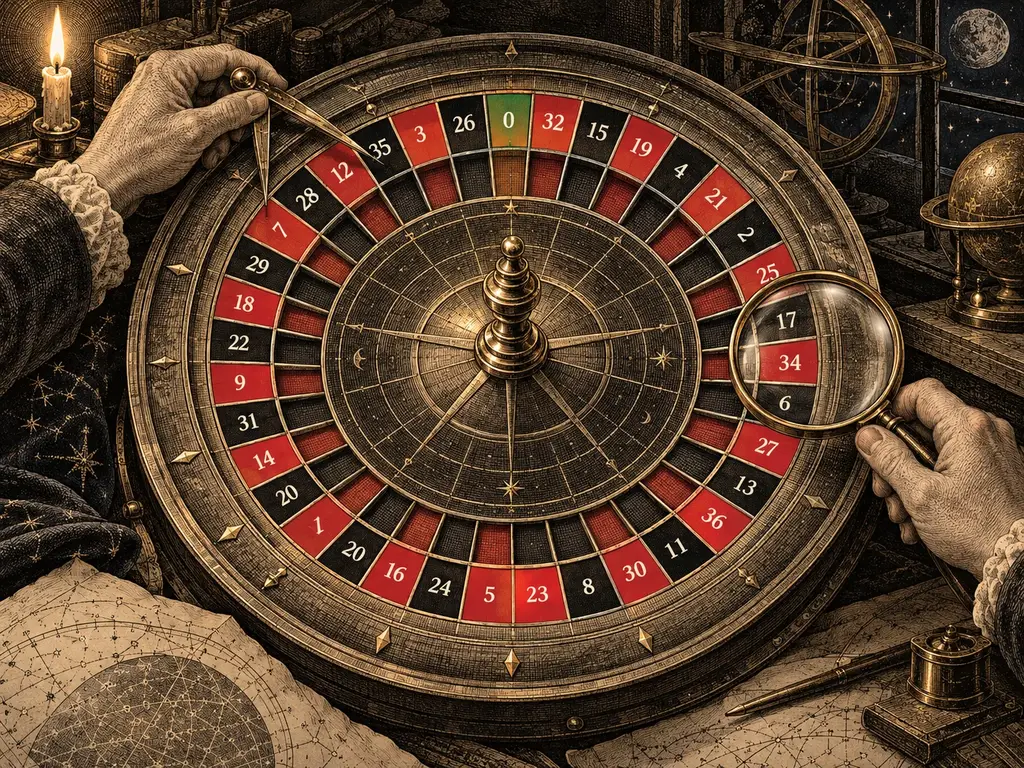
The European wheel carries 0 to 36 in a fixed order that spreads colors, parities and magnitudes evenly around the rim.
Point at a sector or tap it to see its numbers.
Parts of the wheel
A professional wheel is a bowlequipmentBowlThe fixed outer part of the wheel: the wooden or composite rim that holds the ball track and apron, inside which the rotor spins.Read full → about 80 cm across set into the table. The outer rim carries the ball trackequipmentBall trackThe rim groove the ball runs along before it slows and falls. Also: upper track.Read full →, a shallow groove the ballequipmentBallThe small ball launched along the track against the rotor. Modern balls are ivorine or Teflon, 18–21 mm.Read full → runs along. Below the track the bowl slopes inward across the apronequipmentApronThe sloped area between the ball track and the pockets, where the deflectors sit.Read full →, which carries eight metal deflectorsequipmentDeflectorOne of the metal obstacles on the apron that scatter the falling ball. Also: canoe, diamond, pin.Read full →, four vertical and four horizontal, called canoes or diamonds. At the center sits the rotorequipmentRotorThe spinning part of the wheel that carries the pockets.Read full →: the spinning disc that holds the 37 numbered pocketsequipmentPocketOne of the 37 numbered compartments on the rotor. Also: slot, cup.Read full →, separated by metal dividers called fretsequipmentFretThe metal divider between two pockets on the wheel.Read full →. A turret in the middle gives the dealer something to grip when spinning it.
The ball is launched against the direction of the rotor, so the two move in opposite directions. It circles the track ten to twenty times, slows, drops across the apron, usually strikes a deflector, bounces across the frets and settles.
The number sequence
The European order, clockwise from zerowheelZeroThe single green pocket that no even-money, dozen or column bet covers; the source of the house edge. Also: single zero, 0.Read full →: 0 32 15 19 4 21 2 25 17 34 6 27 13 36 11 30 8 23 10 5 24 16 33 1 20 14 31 9 22 18 29 7 28 12 35 3 26. It looks random and is not. RedbetRedEven-money bet on the 18 red numbers. French: rouge.Read full → and blackbetBlackEven-money bet on the 18 black numbers. French: noir.Read full → alternate strictly. High and low numbers alternate as far as 37 pockets allow. Odd and even are mixed so that no stretch of the rim favors either. Consecutive numbers never sit side by side.
- Colors alternate all the way round: red, black, red, black, with zero green.
- Each pair of pockets at the same distance to the left and right of zero is either both high or both low.
- No two consecutive numbers touch: 32 sits between 0 and 15, and 33 is sixteen pockets away. That is not a coincidence of the design, it is the design.
Why the order matters
Table neighborsbetNeighborsA number and the two pockets on either side of it on the wheel, five straight-up chips.Read full → are not wheel neighbors. 17 sits between 25 and 34 on the rim and nowhere near 16 and 18. A cornerbetCornerFour numbers sharing a corner on the layout, pays 8:1.Read full → bet on 16-17-19-20 therefore covers four pockets scattered around the wheel, while “17 and the neighbors” covers a single arc of five. SectorwheelSectorA contiguous arc of pockets on the wheel, as distinct from a group on the layout.Read full → bets (voisins du zéroFR · sectorVoisins du zéro“Neighbors of zero”: the seventeen numbers from 22 to 25 on the wheel, bet with nine chips.Read full →, tiers du cylindreFR · sectorTiers du cylindre“Third of the wheel”: the twelve numbers opposite zero, 27 to 33 on the wheel, bet with six splits.Read full →, orphelinsFR · sectorOrphelins“Orphans”: the eight numbers left over by voisins and tiers: 17, 34, 6 and 1, 20, 14, 31, 9.Read full →) are defined by wheel position, and a wheel-bias player cares about arcs, not about layoutequipmentLayoutThe printed betting grid on the table. Also: table, felt, cloth.Read full → groups. On the layout the pattern of a bet tells you its payoutmoneyPayoutWhat a winning bet returns, quoted as “X to 1” on top of the returned stake.Read full →; on the wheel it tells you nothing about the odds and everything about the physics.
Fair by design
Manufacturers balance rotors with small weights, like a car wheel, to tolerances of fractions of a gram. Pockets are milled from a single piece so that no pocket can be deeper than its neighbors. Frets are low and sometimes curved so that the ball cannot settle predictably. Casinos level the bowl with a spirit level and rotate rotors between bowls so that any defect that does appear cannot be tied to one table. All of this exists because of the players on the famous-players page: bias is real, has been exploited, and is now engineered out.
The American wheel, briefly
The American wheel has 38 pockets with 0 and 00 opposite each other and a different sequence: 0 28 9 26 30 11 7 20 32 17 5 22 34 15 3 24 36 13 1 00 27 10 25 29 12 8 19 31 18 6 21 33 16 4 23 35 14 2. Consecutive numbers sit directly across from one another. Call betstableCall betA bet announced to the dealer rather than placed by hand, usually a wheel-sector bet such as voisins or tiers. Also “announced bet”.Read full → like voisins do not exist on it because the sectors they describe do not. Everything else about the equipment is the same.
Reading a wheel from a video
On a live stream you can see the rotor direction, estimate its speed by timing the zero pocket past a fixed point, and count ball revolutions. None of that changes your odds; all of it is good practice for the Lab pages, which explain what it would take to turn those observations into an edge and why studios make sure you cannot.
Questions
Dealers alternate or follow house rules; the ball always goes the other way. Direction has no effect on the odds.
So that it belongs to neither color bet. Early wheels used other colors; green became standard in the 19th century.
A few grams. Modern balls are ivorine or Teflon, 18 to 21 mm across. Lighter balls bounce more.
Live-dealer wheels are real and filmed. RNG tables draw the number in software and animate a wheel for show.
Comic relief
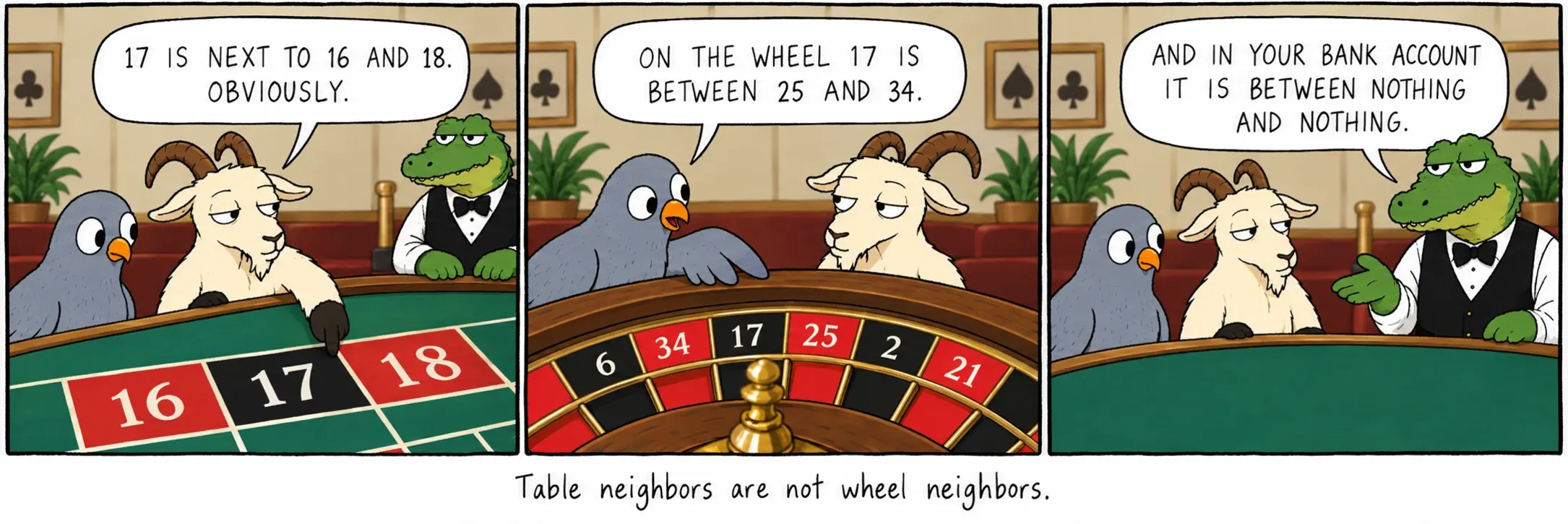
Table neighbors are not wheel neighbors.
Sources
- Ethier, S. N. The Doctrine of Chances: Probabilistic Aspects of Gambling.
- Small, M. & Tse, C. K. “Predicting the outcome of roulette.”
- Barnhart, R. T. Beating the Wheel.