Roulette Bankroll Management
Roulette bankroll management means deciding the budget, the stake and the stop rule before the first spin.

Bankroll management does not change the odds. A budget, stake limit and stop rule can help restrict spending and duration when followed. They do not guarantee a long session or a profit.
Three numbers before you sit down
Decide the amount you can afford to spend, the stake per spin and when to stop. Keep essential expenses and borrowed money out of the budget. A loss limit needs to account for the next stake: do not place a bet that could take you beyond it. No stake size guarantees the session length you want.
Sizing the stake
Budget divided by stake gives the number of consecutive full-stake losses the budget can absorb. Wins can extend the session, but the resulting duration varies widely. The table shows a specific fixed-stake model. A rule such as “1% of budget” does not make every bet type or session length equally affordable.
| budget | fixed stake | units available | median time to bankruptcy | bankrupt by 100 spins |
|---|---|---|---|---|
| $500 | $5 | 100 | 3134 spins | <0.001% |
| $500 | $10 | 50 | 1364 spins | <0.001% |
| $500 | $25 | 20 | 394 spins | 7.69% |
| $500 | $50 | 10 | 136 spins | 41.09% |
Expected cost
For fully funded fixed-stake bets, expected lossmathExpected lossThe probability-weighted average net loss under a stated model. With a constant edge, it equals edge times expected total stakes.Read full definition → equals stake × number of spins × house edgemathHouse edgeThe casino’s expected net gain expressed as a fraction of the stake, under specified probabilities and payouts.Read full definition →. At an illustrative 50 spins per hour, $10 bets cost $13.51 per hour in expectation under standard single-zerowheelZeroThe 0 outcome, conventionally shown in green. Ordinary color, parity, high/low, dozen and column bets do not include it.Read full definition → rules, or $6.76 with eligible la partageruleLa partageA rule returning half of a qualifying even-money stake when zero lands. On a fair single-zero wheel it gives an edge of 1/74, about 1.35%.Read full definition →. At 100 spins per hour those values double. These are average costs, not maximum losses; actual pace and rules matter.
Drawdown
A bankrollmoneyBankrollThe amount set aside for play. Bankroll management concerns stakes and limits within that amount.Read full definition → can fall substantially before recovering, or fail to recover at all. For a fixed horizon of independent equal redbetRedAn even-money wager on the 18 red numbers. French: rouge.Read full definition → bets, standard deviationmathStandard deviationThe square root of variance: a measure of dispersion in the same units as the result.Read full definition → grows with the square root of the number of spins; this is not a bound on the worst drawdownmoneyDrawdownA fall from a bankroll peak to a later value. Maximum drawdown is the largest such fall in the record.Read full definition →. The chart illustrates possible paths under its settings, not a promise of a typical loss range.
- p10 −$440
- p25 −$280
- median −$140
- p75 +$20
- p90 +$160

Responsible play
Use deposit or session limits where available. Never increase the budget during a session: the money you “need to win back” is already gone and the next spin does not know about it. If stopping feels difficult, take a break and consider support. The responsible gambling page lists help services, and the footer links to that page.
- Decide the budget before you log in or sit down.
- Do not play with money needed for anything else, and never with borrowed money.
- Take breaks. With the same stake and rules, placing fewer bets reduces expected loss.
- A loss is not a reason to continue or to expect a recovery.
Questions
No. Limits can restrict spending and duration when followed; they do not improve the next bet’s odds.
No stake guarantees a whole evening. Choose an affordable budget and a time limit; fewer bets and smaller stakes reduce turnovermoneyTurnoverThe sum of amounts wagered over a session or period, including money wagered again after a return. Also called handle or action.Read full definition → under the same rules.
Increasing stakes increases the money at risk. It does not improve the odds, and it can increase expected loss by raising turnover. Winnings are your money too.
Comic relief
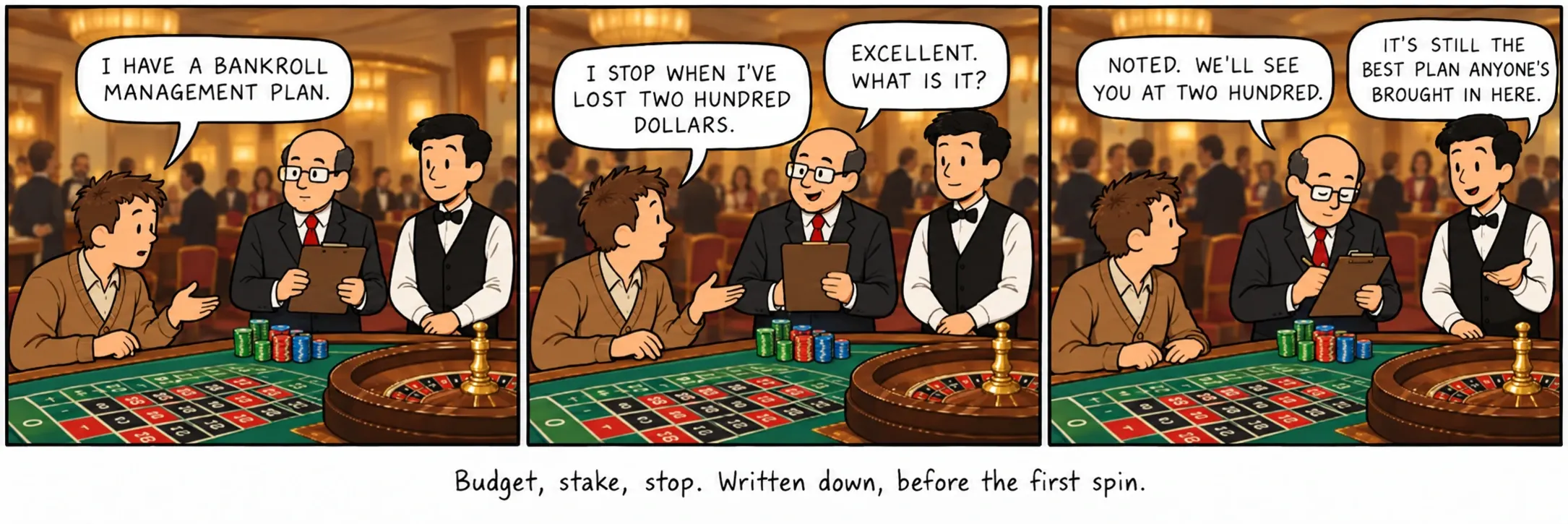
Set an affordable budget before playing. Stop before the next stake could take you beyond your loss limit.
Sources
- RouletteDoc. Roulette strategies overview.
- Roulette77. Roulette strategies overview.
- Ethier, S. N. The Doctrine of Chances: Probabilistic Aspects of Gambling.
- Feller, W. An Introduction to Probability Theory and Its Applications, Vol. 1.