Fibonacci Roulette Strategy
In the Fibonacci roulette strategy, stakes follow 1, 1, 2, 3, 5, 8, 13… Move forward one step after a loss, back two after a win.
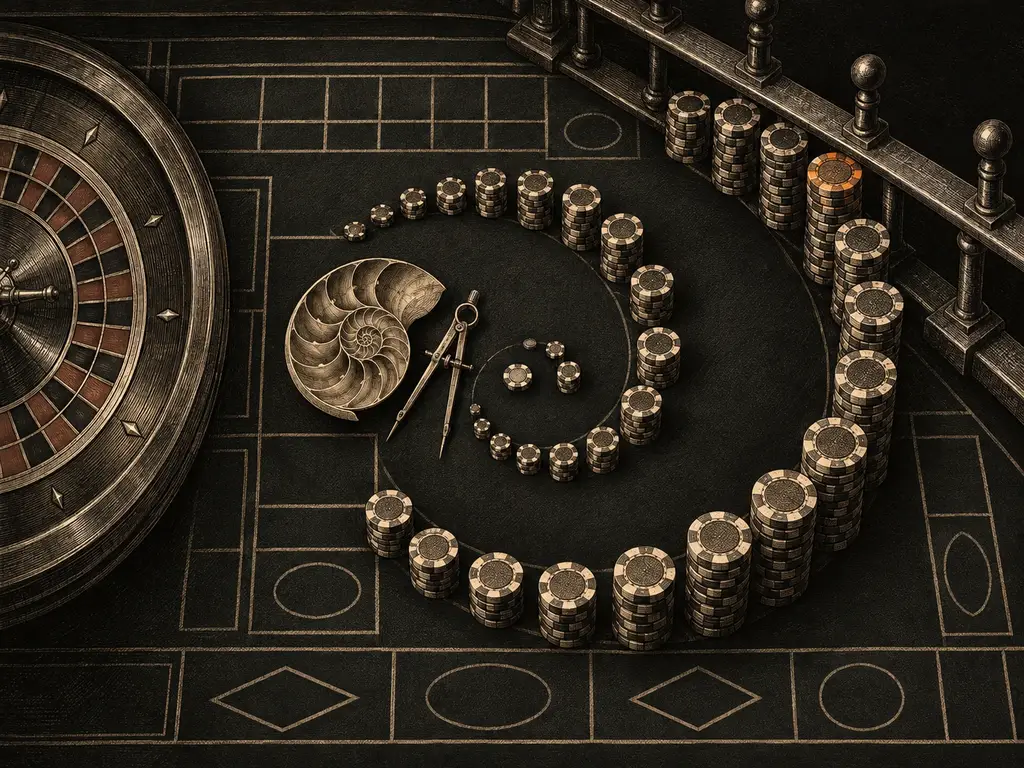
It does not beat the wheel; no staking plan does. Its stakes grow more slowly than doubling during consecutive losses, but accumulated losses can still be large. Under standard single-zerowheelZeroThe 0 outcome, conventionally shown in green. Ordinary color, parity, high/low, dozen and column bets do not include it.Read full definition → rules, expected loss remains 1/37 of expected turnover for a bounded session.
How the sequence is built
Start with 1 and 1. Each following number is the sum of the two before it.
So after 8 and 13 comes 21.
Use each number as the side length of a square. The squares fit together: each new side length is the sum of the previous two. Quarter circles drawn across the squares join to form a spiral.
Walk the sequence
A loss moves one step to the right. A win moves two steps back, stopping at the first step.
Stakes and results are in units of the base bet.
How does the Fibonacci roulette system work?
Write out the FibonaccistrategyFibonacciA staking progression using 1, 1, 2, 3, 5, 8, 13 and so on, commonly moving forward after a loss and back two places after a win.Read full definition → numbers: 1, 1, 2, 3, 5, 8, 13, 21, 34, 55, 89, 144. Each one is the sum of the two before it. Start at the first and bet that many unitsmoneyUnitA base amount used to express stakes or results.Read full definition →. Lose, and you move one step right. Win, and you move two steps left, or back to the start if there is no room. That is the whole system. The table shows what each step costs: a run of losses cut off by the table limittableTable limitA permitted minimum or maximum stake, applied per bet, bet category or total wager according to the table.Read full definition → or your bankrollmoneyBankrollThe amount set aside for play. Bankroll management concerns stakes and limits within that amount.Read full definition → loses the sum of everything staked so far.
| step | stake (units) | cumulative risk | net after a win |
|---|---|---|---|
| 1 | 1 | 1 | +1 |
| 2 | 1 | 2 | 0 |
| 3 | 2 | 4 | 0 |
| 4 | 3 | 7 | −1 |
| 5 | 5 | 12 | −2 |
| 6 | 8 | 20 | −4 |
| 7 | 13 | 33 | −7 |
| 8 | 21 | 54 | −12 |
| 9 | 34 | 88 | −20 |
| 10 | 55 | 143 | −33 |
| 11 | 89 | 232 | −54 |
| 12 | 144 | 376 | −88 |
What does a session look like?
Take a $10 base and eight spins: L L W L L L W W. The stakes run 10, 10, 20 (win, back two, to step 1), 10, 10, 20, 30 (win, back two, to step 2), 10 (win, back to the start). Lost: 10 + 10 + 10 + 10 + 20 = 60. Won: 20 + 30 + 10 = 60. Five losses, three wins, and you are level. That is the appeal of the system. The cost is on the same line: it took $120 of bets to get there, and every dollar staked carries the house edgemathHouse edgeThe casino’s expected net gain expressed as a fraction of the stake, under specified probabilities and payouts.Read full definition →.
Why step back two, and not one?
After consecutive losses along the sequence, the next Fibonacci number equals the sum of the previous two. A five-unit win can therefore recover preceding losses of two and three units. That identity motivates moving back two places, but the current sequence index does not by itself determine the session balance: earlier wins at the base and the exact path also matter.
With almost as many wins as losses, two steps for one sounds like a bargain, and the index can move back toward the start. The catch is that the steps get taller as you climb. Ten wins on the first step earn 10 units. Three losses at steps 6, 7 and 8 cost 8 + 13 + 21 = 42.
- p10 −$500
- p25 −$500
- median −$500
- p75 +$250
- p90 +$920
Does the Fibonacci system work?
It does not produce a positive expected return; individual sessions can still finish ahead. The calculation is the same as for every system: each bet loses 1/37 of its stake on average, so a bounded session has expected lossmathExpected lossThe probability-weighted average net loss under a stated model. With a constant edge, it equals edge times expected total stakes.Read full definition → equal to 1/37 of expected turnovermoneyTurnoverThe sum of amounts wagered over a session or period, including money wagered again after a return. Also called handle or action.Read full definition →. Using the Fibonacci sequence in roulette does not change that, because the wheel pays the same odds whatever the size of the chipmoneyChipA token used to place a wager, with a printed or assigned value. Also called a check in some casino terminology.Read full definition →. For the same funded number of spins, stakes never below the flat-bet base imply at least as much turnover. Comparisons with other progressionsstrategyProgressionA rule that changes stakes over a sequence of bets, often using previous wins or losses.Read full definition → require specified bankrolls, limits and reset rules.
Is it safer than Martingale?
It is slower, which is not the same thing. Fibonacci stakes grow by about 1.6× per step instead of 2×, so a $10 start permits nine Fibonacci losses before the next $550 bet exceeds a $500 maximum. MartingalestrategyMartingaleA progression that doubles after each loss and usually returns to the base stake after a win.Read full definition → permits six losses before a $640 bet is refused. The corresponding probabilities for one uninterrupted cycle are (19/37)⁹ ≈ 0.248% and (19/37)⁶ ≈ 1.834%. They are not whole-session failure probabilities. Funds can run out before either limit is reached.
| Martingale | Fibonacci | |
|---|---|---|
| stake growth per loss | ×2 | ×1.62 |
| losses allowed before next bet is refused | 6 | 9 |
| p(that run from cycle start) | 1.834% | 0.248% |
| total lost in that run | $630 | $880 |
| next required stake | $640 | $550 |
Where do the numbers come from?
From a puzzle about rabbits. Leonardo of Pisa, later nicknamed Fibonacci, set it in his Liber Abaci of 1202: start with one breeding pair, let newborn pairs begin breeding in their second month, and count the pairs as each breeding pair produces a new pair every month. The answer runs 1, 2, 3, 5, 8, 13. He was not the first to find the rule. Indian scholars of verse rhythm had written it down earlier: Singh (1985) traces it to Virahanka, between 600 and 800, and then to Gopala and Hemachandra.
These examples concern counting rabbits or poetic meters, not a roulette staking rule. They do not establish who first applied the sequence to betting. The recurrence determines the prescribed stakes; the roulette probabilities and payoutsmoneyPayoutThe amount paid on a winning wager. Check whether the quoted figure is net profit or total return including the stake.Read full definition → determine each stake’s expected return.

How much is lost after a run of losses?
Two identities make the table above easy to check. After n losses in a row the total lost is the (n + 2)th Fibonacci number minus 1, which gives 1, 2, 4, 7, 12, 20 and so on, and the next stake is the (n + 1)th Fibonacci number. Bollman (2021) proves the same result by induction for a sequence that starts 1, 2, 3, which shifts each number one place. At a 500-unit limit from a 1-unit start, Martingale cannot place its 10th bet, 512 units. Fibonacci can place its 14th, 377 units, but not its 15th, 610.
| Martingale | Fibonacci | |
|---|---|---|
| largest bet under 500 | 256 (9th bet) | 377 (14th bet) |
| losses in a row that break it | 9 | 14 |
| units lost by then | 511 | 986 |
| chance on red, from a given spin | 0.25% | 0.0089% |
What changes on a dozen or a column?
On a dozenbetDozenA bet on 1–12, 13–24 or 25–36, ordinarily paying 2 to 1.Read full definition → or a columnbetColumnTwelve numbers in one vertical layout column, ordinarily paying 2 to 1.Read full definition →, which pays 2 to 1, the step back is not needed. A win at stake F pays 2F, which is always more than everything lost before it, so every win ends the sequence ahead. The price is that a dozen wins only 12 times in 37, so long losing runs are far more common: fourteen dozen losses in a row happen about once in 242 tries, against about once in 11,000 for redbetRedAn even-money wager on the 18 red numbers. French: rouge.Read full definition →.
| bet | lost before | stake | net after a win |
|---|---|---|---|
| 1 | 0 | 1 | +2 |
| 2 | 1 | 1 | +1 |
| 3 | 2 | 2 | +2 |
| 4 | 4 | 3 | +2 |
| 5 | 7 | 5 | +3 |
| 6 | 12 | 8 | +4 |
| 7 | 20 | 13 | +6 |
| 8 | 33 | 21 | +9 |
| 9 | 54 | 34 | +14 |
| 10 | 88 | 55 | +22 |
What if you stop only after two wins in a row?
Another variant moves one step forward after every spin, win or lose, and stops only after two wins in a row. For the particular path of n consecutive losses followed immediately by two wins, the profit is the (n + 1)th Fibonacci number plus 1: a result for that path only. If isolated wins occurred earlier, the result differs. Larger late stakes also require a larger bankroll and table limit. An early pair of wins always comes at small stakes; a late one can need a large bet at exactly the moment the session has gone worst.
| losses before the two wins | stake on the last win | profit |
|---|---|---|
| 0 | 1 | +2 |
| 1 | 2 | +2 |
| 2 | 3 | +3 |
| 3 | 5 | +4 |
| 4 | 8 | +6 |
| 5 | 13 | +9 |
| 6 | 21 | +14 |
| 7 | 34 | +22 |
Simulator · Fibonacci
2,000 sessions of even-money bets from a $1,000 bankroll.
Base bet $10 · table limit $500 · up to 100 spins per session
Losing-streak probabilities
On a fair single-zero wheel without special zero rules, an even-money bet loses with probability 19/37 per spin. Each row is the chance that a given run of spins all lose, and what a Fibonacci player, who moves one step along the sequence after every loss, has lost by then.
| losses in a row | chance | about 1 in | lost so far | next bet |
|---|---|---|---|---|
| 1 | 51.4% | 2 | $1 | $1 |
| 2 | 26.4% | 4 | $2 | $2 |
| 3 | 13.5% | 7 | $4 | $3 |
| 4 | 7.0% | 14 | $7 | $5 |
| 5 | 3.6% | 28 | $12 | $8 |
| 6 | 1.8% | 55 | $20 | $13 |
| 7 | 0.94% | 106 | $33 | $21 |
| 8 | 0.48% | 207 | $54 | $34 |
| 9 | 0.25% | 403 | $88 | $55 |
| 10 | 0.13% | 784 | $143 | $89 |
| 11 | 0.065% | 1527 | $232 | $144 |
| 12 | 0.034% | 2974 | $376 | $233 |
| 13 | 0.017% | 5792 | $609 | $377 |
| 14 | 0.0089% | 11279 | $986 | $610 |
| 15 | 0.0046% | 21965 | $1,596 | $987 |
The chance is 19/37 multiplied by itself once per loss, counted from one given spin. A longer session offers more possible starting positions, so its chance of containing a run can be higher. Overlapping windows are not independent. The stakes assume enough bankroll and no table limit.
Questions
Yes: forward after a win, back after a loss. It behaves like a slower ParolistrategyParoliA positive progression that raises stakes after wins. A common version uses 1, 2 and 4 units, resetting after a loss or three wins.Read full definition →.
Fun with Math
Try these yourself first. Each solution is folded; open it when you are ready.
Play the variant that moves one step along the sequence after every spin, win or lose, and stops after two wins in a row: stakes 1, 1, 2, 3, 5, 8 and so on. The first fourteen results are W L W L L L W L L L W L L W. Where do you stand, and what is the next bet?
Show the solution
Answer Down 22 unitsmoneyUnitA base amount used to express stakes or results.Read full definition →. The next bet is 610 units, and a win would end the session 588 up.
The stakes are the first fourteen FibonaccistrategyFibonacciA staking progression using 1, 1, 2, 3, 5, 8, 13 and so on, commonly moving forward after a loss and back two places after a win.Read full definition → numbers: 1, 1, 2, 3, 5, 8, 13, 21, 34, 55, 89, 144, 233 and 377. Add the wins and subtract the losses: +1 −1 +2 −3 −5 −8 +13 −21 −34 −55 +89 −144 −233 +377 = −22.
The last result was a win, so one more win ends it. The next stake is 610: a win leaves +588, a loss leaves −632 and a next stake of 987.
If it can continue until two consecutive wins, this variant ends ahead. A finite bankrollmoneyBankrollThe amount set aside for play. Bankroll management concerns stakes and limits within that amount.Read full definition → or table limittableTable limitA permitted minimum or maximum stake, applied per bet, bet category or total wager according to the table.Read full definition → may prevent that ending; here the next required bet is 610 units. Under the usual rules, two steps back after a win, the same fourteen results leave you just 1 unit down with a next bet of 2. A different starting sequence defines a different variant. The usual rules lose less here because each win pulls the stakes back down.
spin stake result running total 1 1 W +1 2 1 L 0 3 2 W +2 4 3 L −1 5 5 L −6 6 8 L −14 7 13 W −1 8 21 L −22 9 34 L −56 10 55 L −111 11 89 W −22 12 144 L −166 13 233 L −399 14 377 W −22 In the same variant, why do n losses followed by two wins always leave a profit of the (n + 1)th Fibonacci number plus 1?
Show the solution
Answer The n losses add up to the (n + 2)th Fibonacci number minus 1, and the two wins are the next two numbers, which together beat that by the (n + 1)th number plus 1.
Write F₁, F₂, F₃ … for 1, 1, 2, 3, 5 … Each number is the sum of the two before it.
The losses: F₁ + F₂ + … + Fₙ. Add 1 to that sum, written as F₂, and it collapses: F₂ + F₁ = F₃, then F₃ + F₂ = F₄, and so on, until the whole sum is Fₙ₊₂. So the losses total Fₙ₊₂ − 1.
The wins are the next two stakes, Fₙ₊₁ and Fₙ₊₂. Profit: Fₙ₊₁ + Fₙ₊₂ − (Fₙ₊₂ − 1) = Fₙ₊₁ + 1. With four losses, that is F₅ + 1 = 6 units. This is a payoff identity for a completed path, not a guarantee that the necessary stakes are affordable.
Comic relief
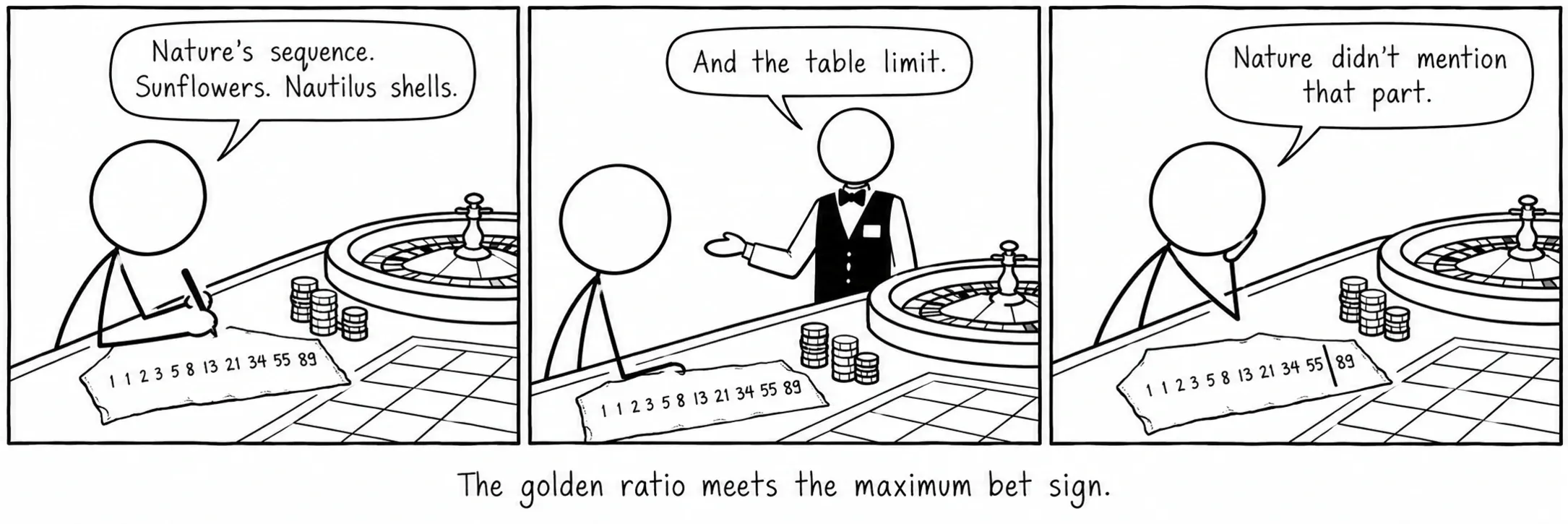
The golden ratio meets the maximum bet sign.
Sources
- RouletteDoc. Strategy description and examples.
- Roulette77. Strategy description and examples.
- Ethier, S. N. The Doctrine of Chances: Probabilistic Aspects of Gambling.
- Epstein, R. A. The Theory of Gambling and Statistical Logic, 2nd ed.
- Bollman, M. Mathematics of the Big Four Casino Table Games: Blackjack, Baccarat, Craps, & Roulette.
- Sigler, L. E. Fibonacci’s Liber Abaci: A Translation into Modern English of Leonardo Pisano’s Book of Calculation.
- Singh, P. The so-called Fibonacci numbers in ancient and medieval India.