Odds
Ten questions on probabilitymathProbabilityChance of an outcome, from 0 to 1 or 0% to 100%. One number: 1/37 = 2.70%.Read full →, payouts and expectation, drawn from a pool of fifteen. Answer, score, and get the page that explains each one you missed.
Test what you know before you bet it. Ten multiple-choice questions, shuffled each time. Score 8 or more and you know more than the pamphlets; under 5 and the Learn section is a good evening.
Scoring
10: you could write this site.
8–9: you understand roulette better than almost everyone at the table.
5–7: solid; the Mathematics section will fill the gaps.
Under 5: start with How to Play and Roulette PayoutsmoneyPayoutWhat a winning bet returns, quoted as “X to 1” on top of the returned stake.Read full →, then come back.
The questions most often missed are the “at least one hit in 37 spins” one (people say “100%” or “about 50%”) and the two-dozensbetDozen1–12, 13–24 or 25–36, pays 2:1.Read full → one (people say “two thirds” and forget zerowheelZeroThe single green pocket that no even-money, dozen or column bet covers; the source of the house edge. Also: single zero, 0.Read full →).
The follow-up quiz
The history quiz on the next page covers Pascal, Blanc, Jagger and the 26 blacksbetBlackEven-money bet on the 18 black numbers. French: noir.Read full →. It is easier and more fun, and it will not save you money.
Questions
Because 37 chances at 1 in 37 feels like certainty. It is 63.7%, and one number in three is absent after 37 spins.
The cornerbetCornerFour numbers sharing a corner on the layout, pays 8:1.Read full →-edge and odd-one-out questions together: every standard bet has the same edge, except the American five-number bet.
Comic relief
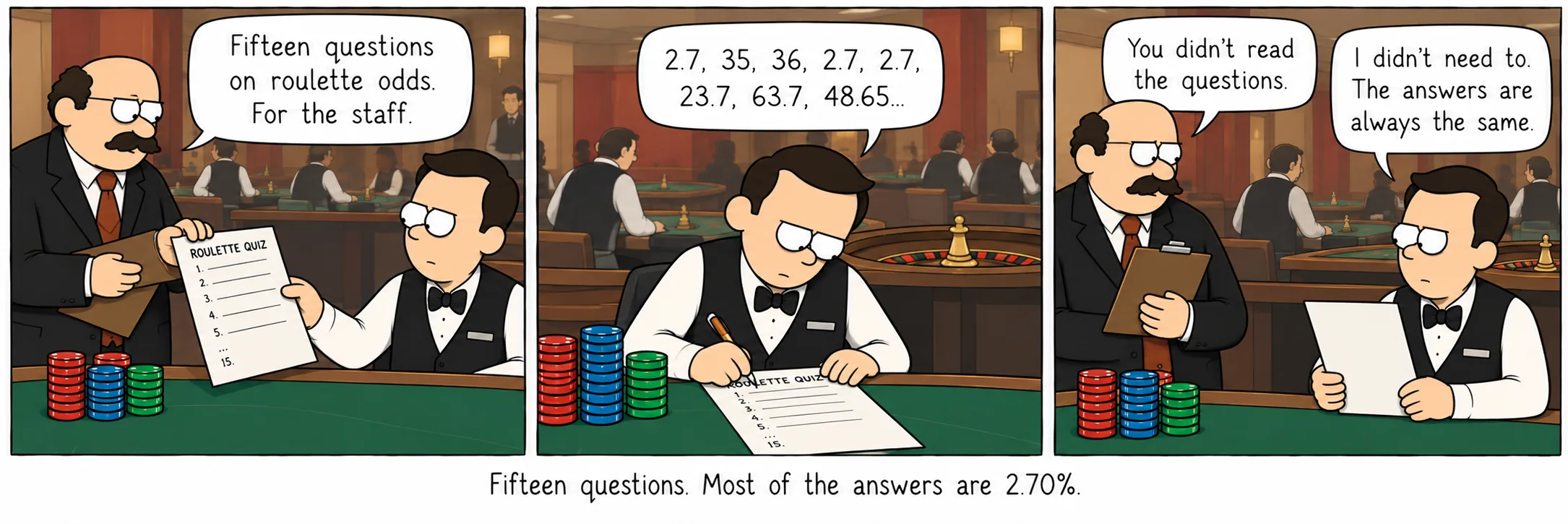
Fifteen questions. Most of the answers are 2.70%.
Sources
- Ethier, S. N. The Doctrine of Chances: Probabilistic Aspects of Gambling.