Session Length and Cost
How long a bankroll lasts at a given stake, and what the hours cost. The numbers most players never compute and most should.
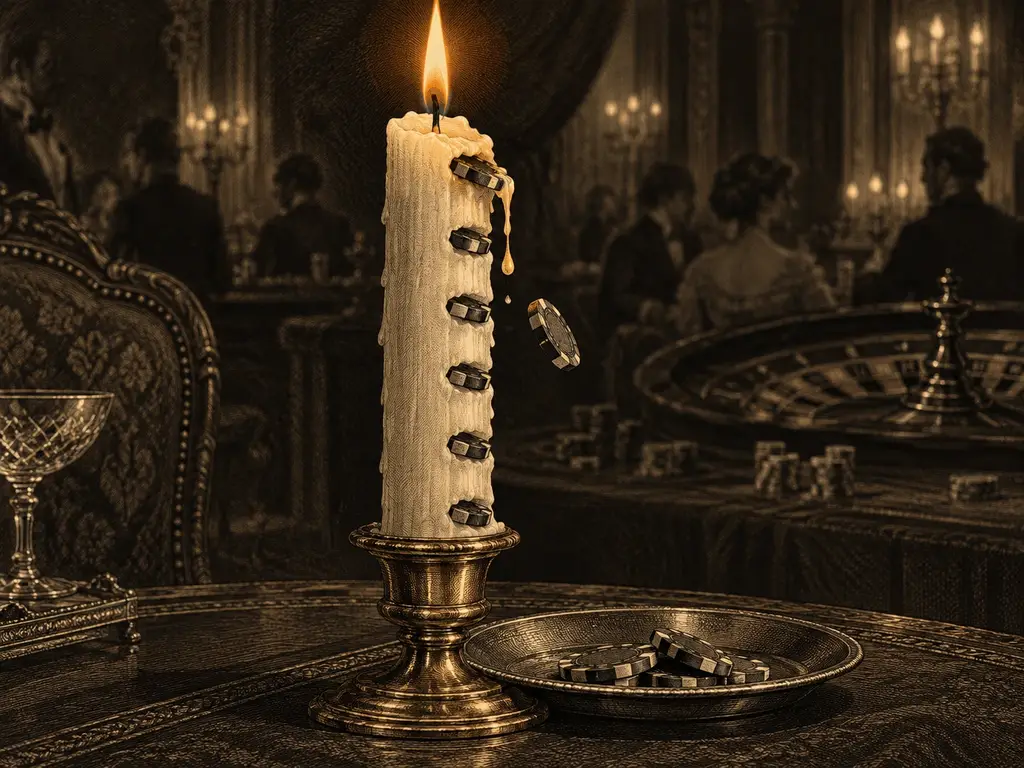
Flat even-money betting lasts, on average, 37 spins for every stake in the bankroll, though half of all sessions end sooner than that; the expected cost per hour is stake × spins per hour / 37. Together they let you price an evening before it starts.
How long a bankroll lasts
With bankrollmoneyBankrollThe total amount set aside for play. Bankroll management is deciding how much of it to risk per bet and per session.Read full → B and flat even-money stake s, the bankroll drifts down by s/37 a spin on average and swings by about s a spin either way. The drift alone sets the average: the bankroll lasts 37 × B/s spins, since that is how long it takes to lose B at s/37 a spin. The swings make the lengths uneven. Some sessions die early on a bad run, a few last far longer, and the median, the length half of all sessions fail to reach, sits below the average. A $500 bankroll at $10 (B/s = 50) lasts 1,850 spins on average and 1,364 at the median, about 27 hours at a live table. At $50 (B/s = 10) the median is 136 spins, under three hours.
What the hours cost
Expected lossmathExpected lossExpected value times total amount wagered; the average amount lost over a session or a period.Read full → per hour = stake × spins per hour / 37. The two numbers you control are the stake and the pace. A $10 bettor at 50 spins an hour pays $13.51 an hour on a European table, $6.76 on a French table, $27 on a speed table. Decide what an hour of roulette is worth to you, and the stake follows.
Putting them together
A player with $500 who wants a four-hour evening at a 50-spin live table (200 spins) and does not want to bust should stake no more than about $25 (B/s = 20, median ruin 394 spins). The expected cost of the evening is 200 × $25 / 37 = $135. If $135 is too much, the stake drops and the evening gets safer and cheaper together: at $10, expected cost $54 and ruin before 200 spins is rare.
- p10 −$500
- p25 −$500
- median −$500
- p75 −$50
- p90 +$350
Straight-up sessions
For straight upsbetStraight upA single number, pays 35:1.Read full → the stake must be smaller for the same session length: σ per unitmoneyUnitThe base stake a system or a player works in. Progressions are described in units so they apply at any table.Read full → is 5.84 against about 1 for redbetRedEven-money bet on the 18 red numbers. French: rouge.Read full →, so the bankroll has to cover long dry spells. A median of 200 spins needs B/s of about 13 on red and about 56 on a single number, roughly four times as many stakes. A $500 bankroll lasting 200 spins of straight ups at the median needs a stake near $9. Players who bet $25 straight ups from $500 are buying a short, loud evening: twenty misses in a row end it, and that happens more often than not.
The honest price list
Roulette costs stake × spins / 37. Everything else, the system, the lucky number, the hedge, decides the shape of the evening and not its price. A player who computes the price first and chooses a stake they are happy to pay has done the only piece of strategy that works.
Formula
Questions
Not an exact one. For a small bankroll the swings dominate and the median grows roughly like (B/s)², as for a fair coin. For a large one the edge dominates and the median approaches the average, 37 × B/s. At about 20 stakes the (B/s)² rule happens to match the exact median, 394 spins; below that it runs short and above it runs long.
It caps the worst case and shortens the session, which reduces expected loss in proportion to the spins not played.
Halves the cost per hour on even-money betsbetEven-money betRed/black, odd/even, high/low. 18 numbers, pays 1:1.Read full → and doubles the average ruin time, to 74 × B/s spins.
Fun with Math
Try these yourself first. Each solution is folded; open it when you are ready.
You bet $500 on redbetRedEven-money bet on the 18 red numbers. French: rouge.Read full →, $10 at a time, on a European wheel, with no stop rule. On average, how many spins does the bankrollmoneyBankrollThe total amount set aside for play. Bankroll management is deciding how much of it to risk per bet and per session.Read full → last?
Show the solution
Answer 1,850 spins: 37 spins for each of the 50 stakes.
Each spin costs, on average, 1/37 of the stake: $10/37, about 27 cents. The bankroll holds 50 stakes, and losing 50 stakes at 1/37 of a stake a spin takes 50 × 37 = 1,850 spins.
The swings do not change this average, because a session can only end at zero and every spin before that costs the same 27 cents on average. They change the spread: half of all sessions are over by spin 1,364, and about one in twenty runs past 5,000, which pulls the average up.
Epstein (2013) gives the general rule: against a house that never runs out of money, a bankroll of z stakes lasts z divided by the edge per spin. On an American wheel, where even money loses 1/19 of the stake a spin, the same $500 lasts 950 spins on average.
Comic relief
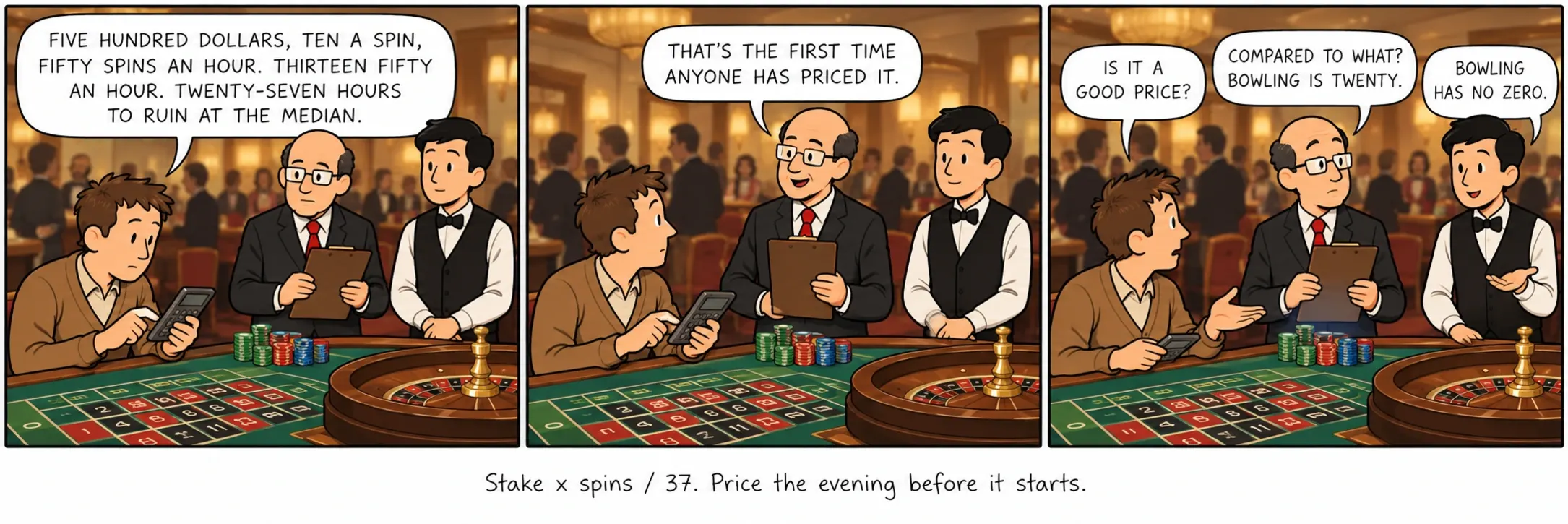
Stake × spins / 37. Price the evening before it starts.
Sources
- Feller, W. An Introduction to Probability Theory and Its Applications, Vol. 1.
- Ethier, S. N. The Doctrine of Chances: Probabilistic Aspects of Gambling.
- Epstein, R. A. The Theory of Gambling and Statistical Logic, 2nd ed.