Kelly Criterion and Roulette
The Kelly criterion tells a bettor with an edge how much to stake. For roulette it gives a clear answer: nothing.

Kelly stake = edge / odds. With a negative edge the formula returns a negative fraction, which means do not bet. The criterion is still useful for understanding why bias players sized bets the way they did, and why everyone else should size by budget.
The criterion
John Kelly (1956) asked how a gambler with a known edge should size bets to maximize long-run growth of the bankrollmoneyBankrollThe total amount set aside for play. Bankroll management is deciding how much of it to risk per bet and per session.Read full →. The answer, for a bet paying b to 1 with win probabilitymathProbabilityChance of an outcome, from 0 to 1 or 0% to 100%. One number: 1/37 = 2.70%.Read full → p and loss probability q = 1 − p, is to stake the fraction f* = (bp − q) / b of the bankroll. Positive f* means bet that fraction; zero or negative means do not bet. Kelly worked at Bell Labs, and his paper, “A new interpretation of information rate”, set the problem in Claude Shannon’s theory of information: a gambler who gets tips over a noisy line, at fair odds, can grow the bankroll at best at the rate the line carries information. In 1961 Leo Breiman proved that Kelly betting, in the long run, ends ahead of any essentially different strategy and reaches a set goal in about the shortest time.
Applied to roulette
For redbetRedEven-money bet on the 18 red numbers. French: rouge.Read full →: b = 1, p = 18/37, q = 19/37; f* = (18/37 − 19/37)/1 = −1/37. For a straight upbetStraight upA single number, pays 35:1.Read full →: b = 35, p = 1/37, q = 36/37; f* = (35/37 − 36/37)/35 = −1/1295. Every standard bet gives a negative Kelly fraction, because every bet has a negative edge, and the growth-optimal stake is zero. Kelly is a formal way of saying what the house-edge page says: there is no size at which a negative-expectation bet grows a bankroll.
Where Kelly did apply
Bias players had an edge and a sizing problem. Jagger, the García-Pelayos and the Eudaemons all had to decide how much to bet on their measured advantage, and under-betting wastes the edge while over-betting risks ruin before the edge shows. For a pocketequipmentPocketOne of the 37 numbered compartments on the rotor. Also: slot, cup.Read full → hitting 1 in 30, Kelly says 0.57% of bankroll per spin on that number: with $10,000, about $57 a spin, for a typical growth of about 0.054% per spin, or ×1.7 over 1,000 spins. The average gain is twice that, 0.11% a spin, but Kelly aims at the typical bankroll, not the average one, which a few lucky runs inflate. Half-Kelly is the usual practical choice because the edge estimate is uncertain.
Typical and average
The gap between the typical bankroll and the average one is wide. Take a pocket that hits 1 time in 25, an edge of 44%, the figure Thorp gives for his device. Kelly stakes 1.26% of the bankroll on it. After 1,000 spins the typical bankroll has grown about 11.5 times, while the average, pulled up by a few very lucky runs, has grown about 249 times. Betting more than Kelly raises the average and lowers the typical result: at twice the Kelly stake the typical bankroll only doubles, and by two and a half times the Kelly stake it shrinks, although every bet still carries a 44% edge. Betting less costs little: half the stake keeps about three quarters of the growth.
When the edge is a guess
Kelly assumes the edge is known. At the table it is estimated, and the estimate is usually too high. Epstein’s example, built on Thorp’s 44%, is a number that hit 49 times in 1,225 spins of a double-zerowheelZeroThe single green pocket that no even-money, dozen or column bet covers; the source of the house edge. Also: single zero, 0.Read full → wheel: 1 time in 25, a 44% edge, a Kelly stake of 1.26%. But a fair double-zero wheel has 38 numbers, and the busiest of them reaches 49 or more in 1,225 spins about one time in nine. The busiest number in any record is also the one luck has helped most, so even a truly biased pocket looks better in the record than it is: the winner’s curse. If that pocket is in fact unbiased, the Kelly stake is simply a bet that loses 5.26% on average. The usual answers are to bet a fraction of Kelly and to keep counting until the edge survives a fresh record (see How to Detect Wheel Bias).
People with an edge
Knowing the edge is not the same as using it well. Haghani and Dewey (2016) gave 61 people $25 each to bet for half an hour on a coin they were told came up heads 60% of the time, with winnings capped at $250 (players learned of the cap only on reaching it). Kelly says bet 20% of the bankroll on heads every time, and the authors estimate that steady bets of 10–20% would reach the cap about 95% of the time. Only 21% of the players got there. 28% went broke, 18 of the 61 bet everything on a single flip, about a third finished below the $25 they started with, and the average payoutmoneyPayoutWhat a winning bet returns, quoted as “X to 1” on top of the returned stake.Read full → was $91. Only five of the 61 had heard of the Kelly criterion. With an edge, the size of the bets decides whether you keep it; without one, as at a fair wheel, no size helps.
What to use instead
Without an edge, sizing is a budget question, not a growth question: stake = what you are willing to spend per spin, derived from the hourly budget and the table’s pace (bankroll management page). Kelly’s contribution to the ordinary player is the clarity of its answer: zero. Everything you stake above zero is the price of playing, chosen by you, not optimized by any formula.
A note on fractional Kelly and “money management”
Systems sold as “Kelly for roulette” that recommend a fixed percentage of bankroll per bet are flat bettingstrategyFlat bettingWagering the same amount every spin. The baseline every progression is compared against.Read full → with a shrinking stake. They lose 2.70% of turnovermoneyTurnoverThe total amount wagered over a session or period, counting re-bet winnings. Also: handle, action.Read full → and, because the stake shrinks as you lose, they make ruin slow rather than unlikely. It is a reasonable way to make a budget last; it is not Kelly, which would say to stop.
Formula
Questions
Only with a measured edge from a biased wheellabBiased wheelA wheel whose physical defects make some pockets more likely than 1/37. Rare, detectable only with thousands of recorded spins.Read full → or a timing device. Not on a fair wheel.
Because the edge estimate has error, and over-betting is costlier than under-betting. Half-Kelly gives three quarters of the growth at a quarter of the variancemathVarianceA measure of how widely results spread around the expected value. High for straight up, low for even-money bets.Read full →.
No. Kelly optimizes growth given an edge. Bankroll management controls spending given none.
Fun with Math
Try these yourself first. Each solution is folded; open it when you are ready.
Thorp and Shannon’s prediction device gave about a 44% edge. On a single predicted number, Kelly says to bet 1.26% of the bankrollmoneyBankrollThe total amount set aside for play. Bankroll management is deciding how much of it to risk per bet and per session.Read full →. What if the same 44% edge came on one bet spread over five neighboring numbers?
Show the solution
Answer Kelly then says 7.1% of the bankroll, and the bankroll grows almost six times as fast: about 1.25 million-fold over 1,000 bets, against about 11.5-fold.
A straight upbetStraight upA single number, pays 35:1.Read full → with a 44% edge wins with chance 0.04, since 36 × 0.04 = 1.44. Kelly’s stake is the edge divided by the odds: 0.44/35 = 1.26%. The typical growth per bet is 0.04 × ln(1 + 35 × 0.0126) + 0.96 × ln(1 − 0.0126) ≈ 0.00244, so 1,000 bets multiply the bankroll by about e^2.44 ≈ 11.5.
Spread one stake over five numbers and the bet wins with chance 0.20 and pays 36/5 for 1, that is 6.2 to 1: still a 44% edge, since 0.2 × 7.2 = 1.44. Kelly’s stake becomes 0.44/6.2 = 7.10%, and the growth per bet 0.01404, about 5.75 times as much. Over 1,000 bets that is e^14.04, about 1.25 million.
The edge is the same; the swings are smaller. A bet that wins one time in five can carry a larger share of the bankroll without risking ruin, and Kelly’s growth rewards that. Thorp (1984) uses the example to show why prediction players bet sectorswheelSectorA contiguous arc of pockets on the wheel, as distinct from a group on the layout.Read full →. In practice five neighborsbetNeighborsA number and the two pockets on either side of it on the wheel, five straight-up chips.Read full → carry a slightly lower edge than the single best number (see Advantage Play).
A player has found two neighboring pocketsequipmentPocketOne of the 37 numbered compartments on the rotor. Also: slot, cup.Read full → that each hit 1 time in 25 instead of 1 in 37. Should they bet the splitbetSplitTwo adjacent numbers, pays 17:1.Read full → between them at 17 to 1, or each number straight up? How much does Kelly say, and how fast does the bankroll grow compared with one such pocket?
Show the solution
Answer It makes no difference: 2.59% of the bankroll on the split, or 1.29% on each number. The typical bankroll grows about 155 times in 1,000 spins, against 11.5 times with one pocket.
The split wins with probabilitymathProbabilityChance of an outcome, from 0 to 1 or 0% to 100%. One number: 1/37 = 2.70%.Read full → 2/25 = 0.08 and pays 17 to 1, so it returns 18 × 0.08 = 1.44 per unitmoneyUnitThe base stake a system or a player works in. Progressions are described in units so they apply at any table.Read full → staked: an edge of 44%, the same as one biased pocket. Kelly’s stake is the edge divided by the odds: 0.44/17 = 2.59%.
Two straight-up bets of 1.29% each give exactly the same results. When either number comes up, one chipmoneyChipA token representing a fixed amount, placed on the layout to make a bet. Also: check.Read full → wins 35 to 1 and the other is lost, a net of 34 × 1.29% = 44% of the bankroll, as the split pays; when neither does, both are lost.
The growth per spin is 0.00505, against 0.00244 for one pocket, so over 1,000 spins the typical bankroll grows e^5.046 ≈ 155 times rather than e^2.44 ≈ 11.5 times. Two good numbers are worth far more than twice one, which is why bias players bet groups of numbers. Thorp (1984) works the same comparison.
Comic relief
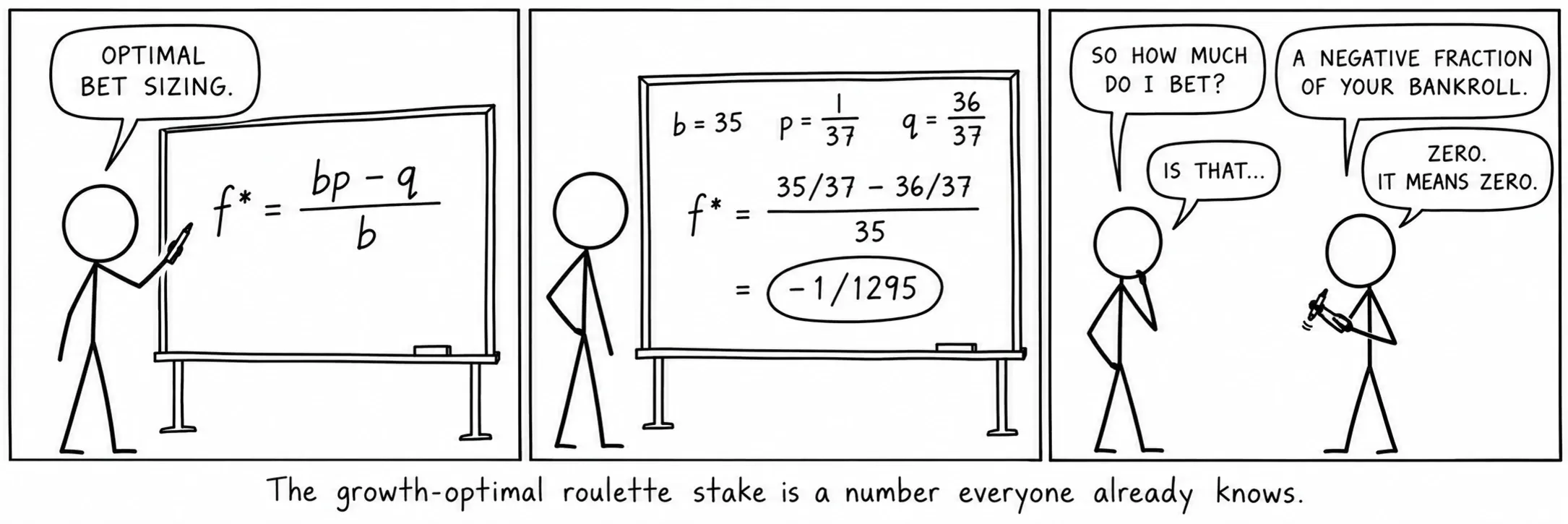
The growth-optimal roulette stake is a number everyone already knows.
Sources
- Kelly, J. L. “A new interpretation of information rate.”
- Breiman, L. “Optimal gambling systems for favorable games.”
- Thorp, E. O. “Optimal gambling systems for favorable games.”
- Thorp, E. O. The Mathematics of Gambling.
- Epstein, R. A. The Theory of Gambling and Statistical Logic, 2nd ed.
- Taylor, D. G. Games, Gambling, and Probability: An Introduction to Mathematics, 2nd ed.
- Ethier, S. N. The Doctrine of Chances: Probabilistic Aspects of Gambling.
- Haghani, V. & Dewey, R. “Rational decision-making under uncertainty: observed betting patterns on a biased coin.”