Roulette Dealer Procedure
What the dealer does, in order, and why each step is there.

A typical round opens betting, spins the wheel and ballequipmentBallThe small ball that settles in a numbered pocket to determine a physical roulette result.Read full definition →, closes bets, confirms the result and settles wagers. Exact timing and payment order follow the house rules.
Roulette dealer rules: the sequence
The checklist below describes a typical floor round, not a universal operating manual. Follow the dealer’s signals and the published rules. Online rounds replace physical chipmoneyChipA token used to place a wager, with a printed or assigned value. Also called a check in some casino terminology.Read full definition → handling with software settlement.
Finish settlement and reopen betting.
Set or maintain the rotor’s motion.
Launch the ball against the rotor’s direction.
Announce and signal that bets are closed.
Wait for the ball to settle and announce the result.
Mark the winning number.
Remove losing bets.
Pay winning bets under the house procedure.
Check settlement and prepare the next round.
Spin and launch
Launch position, minimum revolutions, direction changes and invalid-spin rules belong to the specific game’s procedures. Do not assume every casino requires the last winning pocketequipmentPocketA compartment on the rotor in which the ball can settle. The number of pockets depends on the wheel.Read full definition → as the launch point or the same rotorequipmentRotorThe rotating part of a physical roulette wheel, carrying the numbered pockets.Read full definition → speed.
Closing bets
The dealer’s signal closes betting at a floor table. Online, follow the interface and accepted-bet confirmation. Neither format gives a player permission to add or move a bet after the deadline.
Settling
The winning number is marked while wagers are settled. Removing losing chips and paying winners in a defined sequence helps make the result clear. Exact payment order and chip-counting methods can differ; wait until the dealer reopens the layoutequipmentLayoutThe marked betting surface, whether printed on a table or displayed on a screen.Read full definition → before placing the next bet.

Dealer signatures
A dealer may have a recognizable rhythm, but a habit alone does not demonstrate a usable prediction. Claims about a dealer’s influence need controlled evidence. Staff rotations and break schedules vary; they are not proof that the casino has identified such an effect.
Questions
That is the conventional roulette procedure. It does not, by itself, prove that outcomes are uniform.
The dealer must follow the table’s procedures rather than a player’s requested outcome.
It depends on the venue and shift schedule; there is no universal 20-to-40-minute rule.
Comic relief
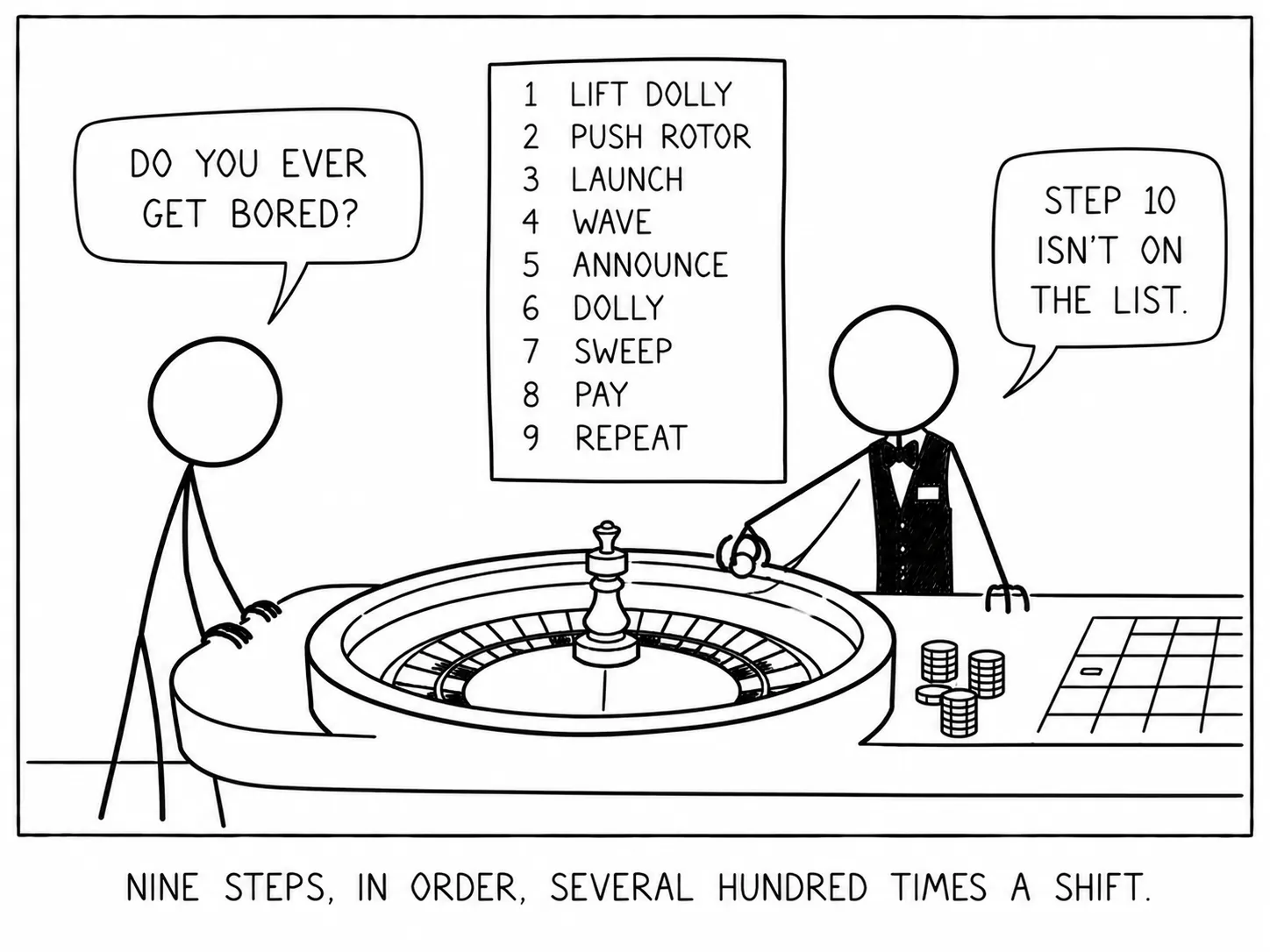
An illustrative round, not a universal operating manual.
Sources
- Gambling Commission, RTS 17: live dealer studios
- Gambling Commission, RTS 7: random outcomes
- Gambling Commission, RTS 10: interrupted gambling