Walkthrough: A Labouchère Line
Write 1-2-3-4, bet the ends, cross them off on a win, add the loss to the end. The cancellation system through one line that clears and one that runs away.
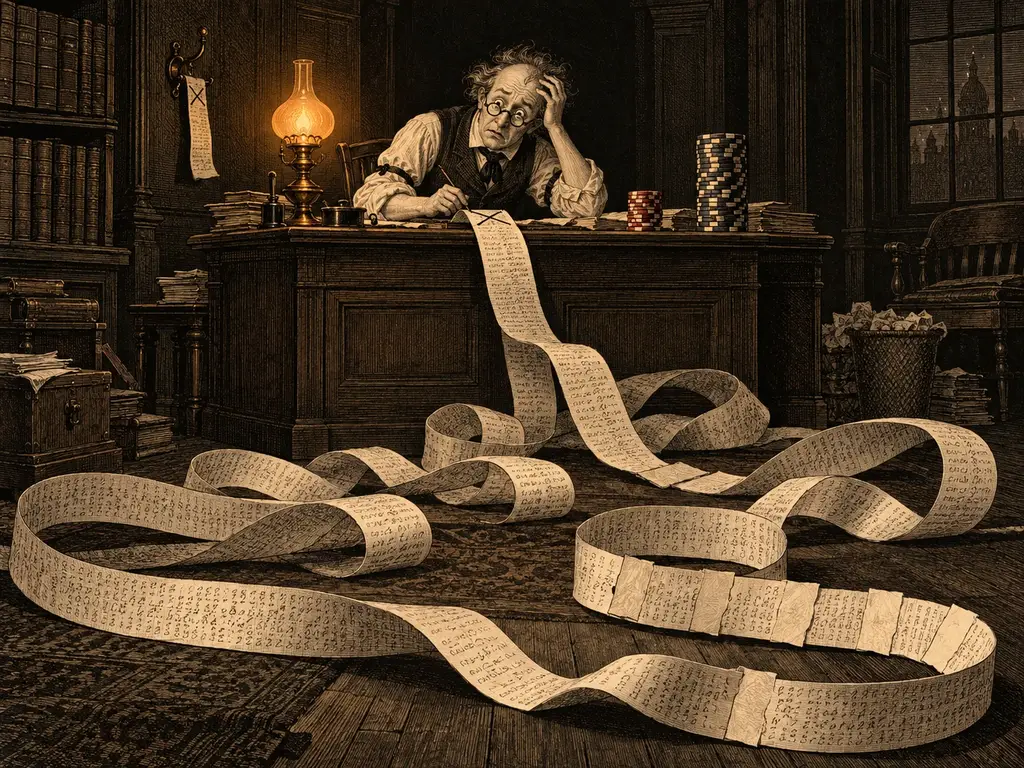
A simulated Labouchère session at $5 a unit, target $50 per line. The first line cleared in 14 spins for exactly $50. The second ran to a 19-number line and a $115 stake before we abandoned it $385 down. Usually works, and then does not.
Walk the system
The stake is the first number plus the last. A win crosses both off. A loss writes the stake at the end.
Stakes and results are in units of the base bet.
The plan
Write 1 2 3 4 on a card. Each spin, stake the sum of the two end numbers, on redbetRedEven-money bet on the 18 red numbers. French: rouge.Read full →. A win crosses both numbers off; a loss adds the stake to the right-hand end. The line clears when nothing is left, which nets the original total, 10 unitsmoneyUnitThe base stake a system or a player works in. Progressions are described in units so they apply at any table.Read full →, $50. A line needs only one win for every two losses to clear, because each win removes two numbers and each loss adds one. Red wins 48.65% of spins, which is more than the one-in-three required, so most lines clear.
Line 1, spins 1–14
1 2 3 4 → stake 5 (1+4): L, line 1 2 3 4 5. Stake 6: W, line 2 3 4. Stake 6: L, line 2 3 4 6. Stake 8: W, line 3 4. Stake 7: L, line 3 4 7. Stake 10: W, line 4. Stake 4: L, line 4 4. Stake 8: W, cleared. Eight spins described; the full line took fourteen with six wins and eight losses. Net +$50, exactly the target, with the stake never above $12. It works like a small machine.
Line 2, spins 15–70
1 2 3 4 again. Nine losses in the first twelve spins. Each loss appends a number that is the sum of two others, so the line grows at both length and size: after twelve spins it read 1 2 3 4 5 6 8 9 11 13 15 17 and the stake was $90. Wins cross off the big end numbers, which helps, but the line kept lengthening. By spin 70 it had 19 numbers, the stake was $115 against a $200 limit, and the cycle stood at −$385. We stopped. The line would have cleared for +$50 eventually, if “eventually” arrived before the limit and the bankrollmoneyBankrollThe total amount set aside for play. Bankroll management is deciding how much of it to risk per bet and per session.Read full → did not.
- p10 −$500
- p25 −$500
- median −$500
- p75 −$500
- p90 +$1,360
The accounts
Total wagered about $2,400 over 70 spins against $350 flat. Expected lossmathExpected lossExpected value times total amount wagered; the average amount lost over a session or a period.Read full → on $2,400 is $65; actual −$335, two standard deviationsmathStandard deviationSquare root of variance; the typical distance of a result from the expected value.Read full → and change below. A runaway LabouchèrestrategyLabouchèreCancellation system: write a line of numbers, bet the sum of the two ends, cross them off after a win, add the lost stake after a loss.Read full → line is the heaviest turnovermoneyTurnoverThe total amount wagered over a session or period, counting re-bet winnings. Also: handle, action.Read full → of any common system, because each loss raises the stake by the amount of the loss and the line has no ceiling but the table’s.
What the session shows
Labouchère has the rare property that it usually works, which is why it was a conversation piece at Victorian dinners and why it still sells. The cleared lines are small and frequent; the runaway line is large and rare, and its size is open-ended. The expected loss per dollar is −2.70% in both halves, and the system’s only effect is to decide which half you are in on a given night.
Questions
Yes: a line of 1 2 3 4 5 6 8 9 can be split into two lines with the same total, which lowers the stake and doubles the number of lines to clear. It changes the shape, not the price.
A line of 1 1 is a two-unit target with a $10 stake; it clears quickly and runs away just as readily. The length only sets the target.
Yes, under a dozen names. Henry Labouchère popularized it in the 1870s; he did not invent it.
Comic relief
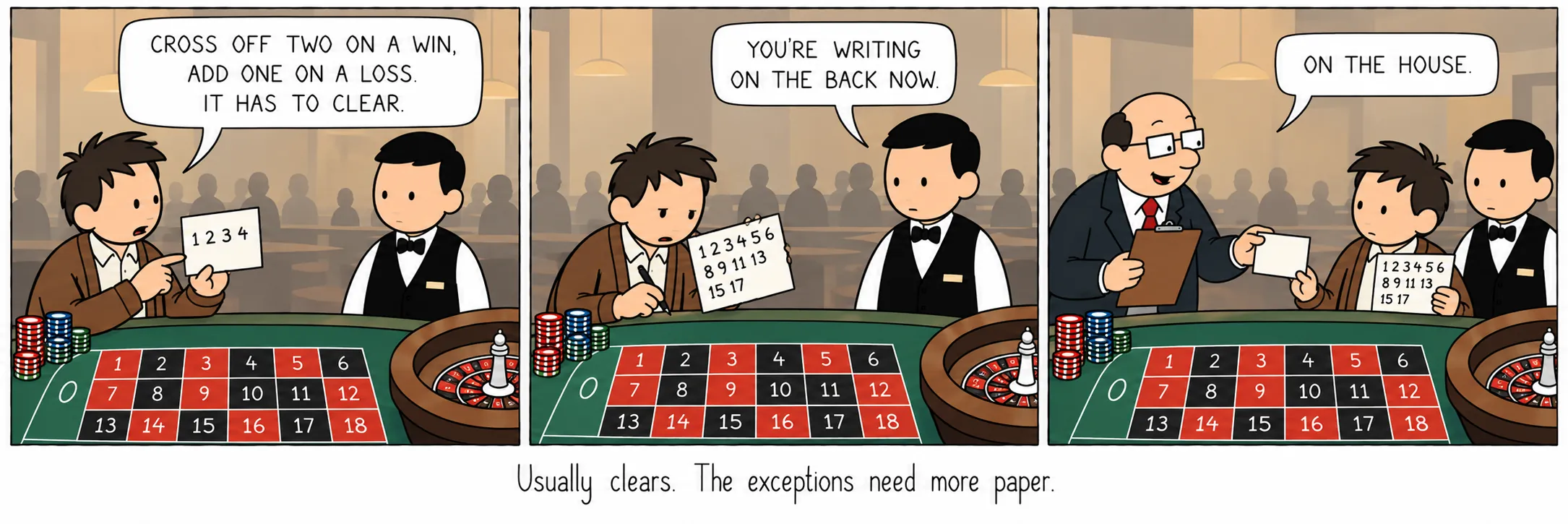
Usually clears. The exceptions need more paper.
Sources
- Ethier, S. N. The Doctrine of Chances: Probabilistic Aspects of Gambling.
- Schwartz, D. G. Roll the Bones: The History of Gambling.