Speed and Auto Roulette
Faster rounds increase turnovermoneyTurnoverThe sum of amounts wagered over a session or period, including money wagered again after a return. Also called handle or action.Read full definition →. The wheel and payout rules still determine the edge.
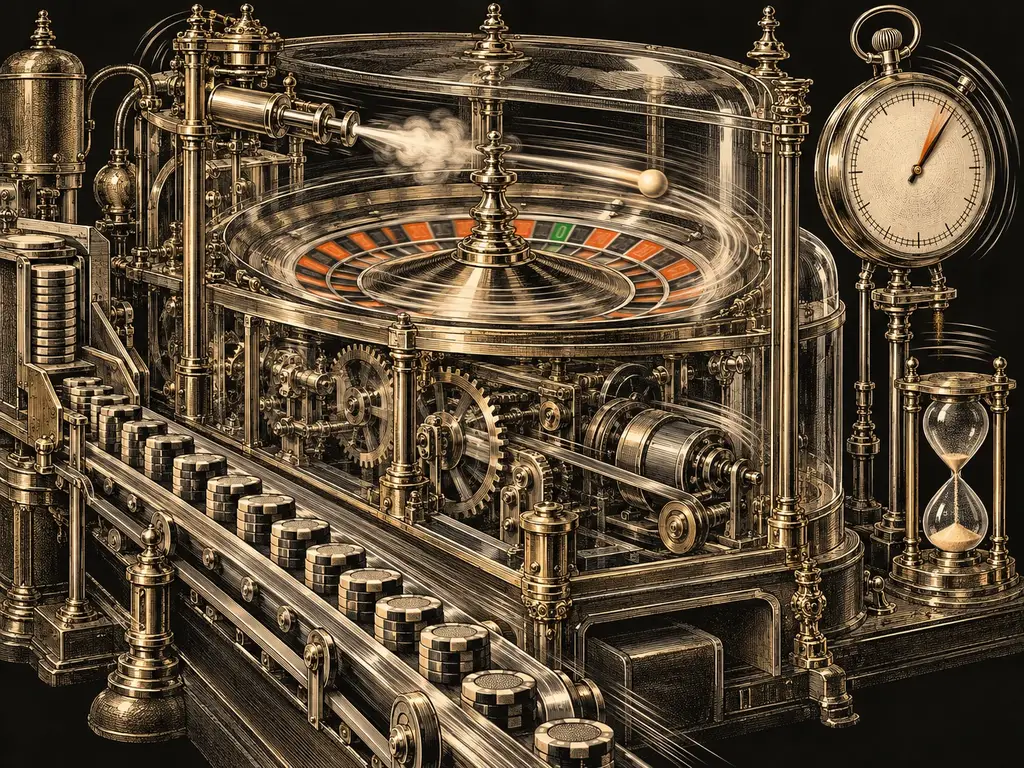
Speed roulette shortens the round; auto roulette uses an automated wheel. Neither label guarantees single-zero rules. At an unchanged stake and house edge, twice as many wagers means twice the expected loss.
Live speed roulette
Evolution describes its Speed Roulette as a live-dealer game with 25 seconds from spin to spin, with betting during the spin. That would allow 144 rounds in an uninterrupted hour; actual play can include pauses. Other providers and tables may use different timings. Speed alone does not change the payoutmoneyPayoutThe amount paid on a winning wager. Check whether the quoted figure is net profit or total return including the stake.Read full definition → of a bet.
Auto roulette
Evolution’s Auto Roulette uses a filmed automated physical wheel without a live dealer. The provider lists 60–80 games an hour, and about 2,500 a day for Speed Auto, roughly 104 an hour averaged across a day. It offers European, French and American versions. An RNG game instead generates its outcome in software; a wheel animation does not make it a physical-wheel game.
| pace example | wagers per hour | expected loss at $10 |
|---|---|---|
| illustrative slower pace | 50 | $13.51 |
| Evolution Auto published range | 60–80 | $16.22–$21.62 |
| illustrative faster pace | 100 | $27.03 |
| 25-second rounds, uninterrupted | 144 | $38.92 |
Expected loss per hour
stake × spins per hour / 37. At $10 per wager: about $13.51 for 50 wagers, $27.03 for 100 and $54.05 for 200. These are illustrative paces, not measured averages for every floor, live or RNG game. Expected lossmathExpected lossThe probability-weighted average net loss under a stated model. With a constant edge, it equals edge times expected total stakes.Read full definition → is an average, not the maximum a session can lose.
Cost per hour
For a standard single-zerowheelZeroThe 0 outcome, conventionally shown in green. Ordinary color, parity, high/low, dozen and column bets do not include it.Read full definition → bet on every round, expected loss = stake × number of rounds / 37. At $10 per bet, 100 rounds gives about $27.03 expected loss and 50 gives about $13.51. In this example, halving the stake while doubling the number of wagers leaves expected loss unchanged. Actual results can differ widely.
Who it suits
Faster play offers more betting opportunities. It also makes it easier to wager more than intended. With a changing stake, add up every wager rather than treating the opening chipmoneyChipA token used to place a wager, with a printed or assigned value. Also called a check in some casino terminology.Read full definition → as the session cost; a progressionstrategyProgressionA rule that changes stakes over a sequence of bets, often using previous wins or losses.Read full definition → can reach a bankrollmoneyBankrollThe amount set aside for play. Bankroll management concerns stakes and limits within that amount.Read full definition → or table limittableTable limitA permitted minimum or maximum stake, applied per bet, bet category or total wager according to the table.Read full definition → at either pace.
Pace as a budget tool
At the same stake and edge, making half as many wagers halves expected loss. You can reduce the number of wagers by taking breaks or skipping rounds. This changes the amount exposed to the house edgemathHouse edgeThe casino’s expected net gain expressed as a fraction of the stake, under specified probabilities and payouts.Read full definition →, not the probabilities of the rounds you play, and does not set a limit on actual loss.
Pace and systems
Progressions are often sold with a speed roulette strategy attached: play fast “to get through the losing runs”. Playing fast gets you through everything faster, including your bankroll, and increases the number of attempts per hour at the losing run that breaks the system. The risk depends on the progression, its limits and the number of wagers, not a universal multiplier attached to the word speed.
Measuring it
Count rounds over a timed interval to estimate the pace. Multiplying a ten-minute count by six gives an hourly estimate only if that pace continues. Note pauses and skipped rounds, and distinguish the table’s rounds from the wagers you actually make.
Questions
A fast format alone is not evidence of manipulated outcomes. Compare the published round timing with observed play; speed does not establish fairness either.
Evolution Auto Roulette uses an automated physical wheel. Other automated products may use RNG outcomes, so check the game’s own description.
Yes. Skipping a round avoids placing a wager on it. The expected loss avoided depends on the stake and rules; 2.70% applies to standard single-zero bets, not every speed game.
Speed alone does not change the odds. Two games have the same probabilities and payouts only when their underlying rules match; check the wheel and zero rules.
Whichever produces less total wagering at the same edge. A player can take an RNG game slowly or skip live rounds; the labels alone do not decide hourly cost.
It depends on round time, shift length and breaks. Estimate from the actual time spent dealing and the observed pace rather than assuming a fixed total.
Comic relief
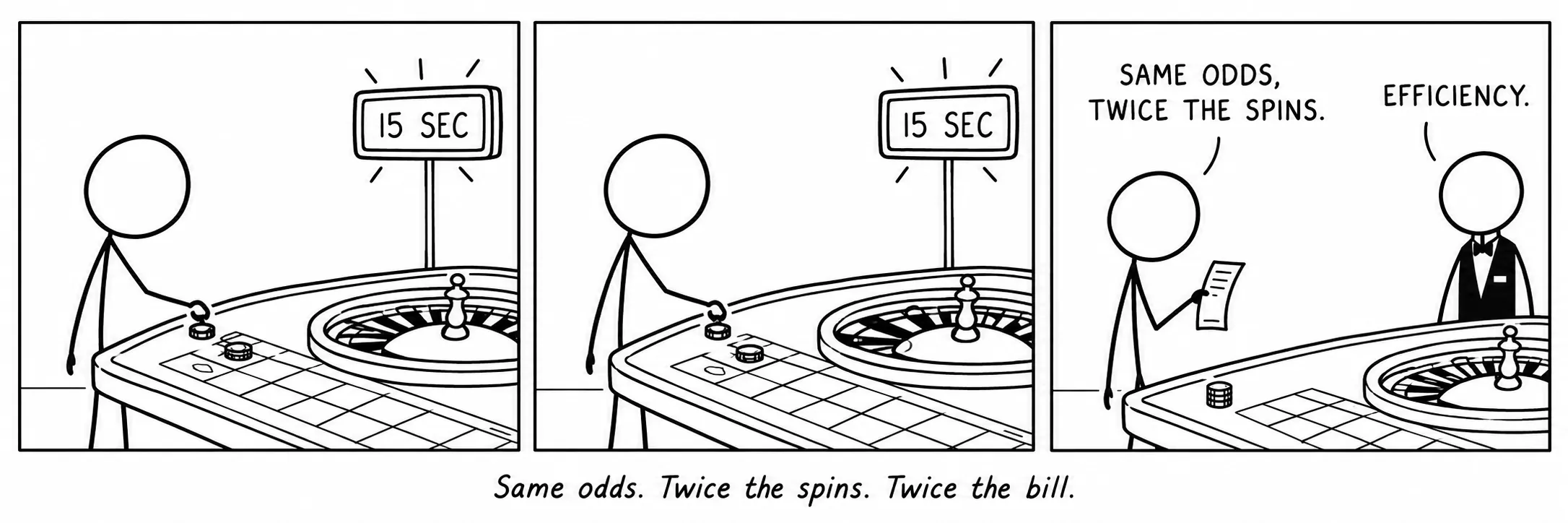
At the same stake and edge, twice the wagers means twice the expected loss.
Sources
- Evolution, Speed Roulette — published 25-second rounds
- Evolution, Auto Roulette — physical wheel, rates and available rule variants
- UK Gambling Commission. Remote gambling and software technical standards.