Walkthrough: A Fibonacci Climb
Stakes of 1, 1, 2, 3, 5, 8, 13 on blackbetBlackEven-money bet on the 18 black numbers. French: noir.Read full →, stepping back two after a win. A slower Martingale, and how its cliff arrives.
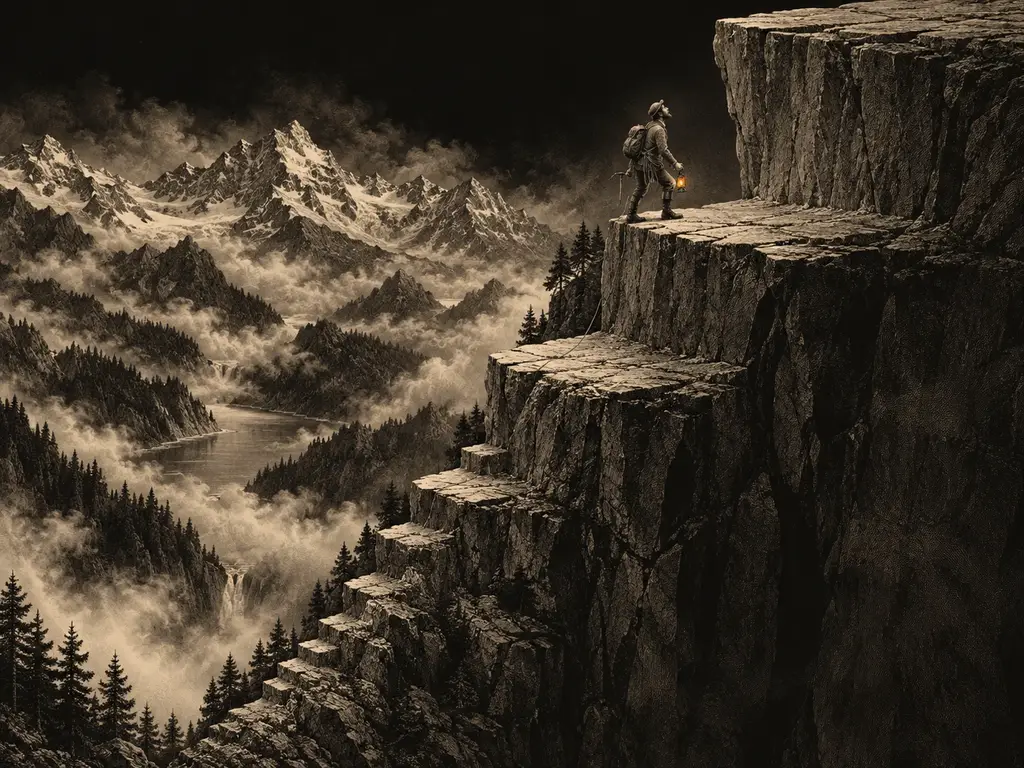
A simulated 90-spin Fibonacci session at $5 a unit. Twenty cycles cleared for $5 each, one bad run to the ninth term ($170 stake) that left the session down $340. Gentler than doubling until it is not.
Walk the sequence
A loss moves one step to the right. A win moves two steps back.
Stakes and results are in units of the base bet.
The plan
Stake the first FibonaccistrategyFibonacciProgression that follows the sequence 1, 1, 2, 3, 5, 8, 13…: one step forward after a loss, two steps back after a win.Read full → number, $5. After a loss, move one step right in the sequence. After a win, move two steps left. A cycle is cleared when we are back at the start and one unitmoneyUnitThe base stake a system or a player works in. Progressions are described in units so they apply at any table.Read full → up. Compared with MartingalestrategyMartingaleProgression that doubles the bet after each loss. See the Strategy section for what it does and does not do.Read full → the stake grows by ×1.6 instead of ×2, so the cliff is further away and the climb back is slower: a win does not end the cycle, it only steps back.
Spins 1–40
Eleven cycles cleared, the longest reaching the fifth term ($25). Each cleared cycle nets exactly $5; the bookkeeping is pleasant and the stakes stayed small. Net +$55. It feels like a Martingale with the panic removed.
Spins 41–70
Five more cycles clear by spin 60 (+$25). Then the cycle that does not clear. L L L L L L L W L L: stakes 5, 5, 10, 15, 25, 40, 65 (seven losses, −$165), a win at $105 (+$105, step back two to $40), then two losses at $40 and $65. We are now at the eighth term, $105, with −$165 in the cycle, and the next loss would send us to $170 against a $200 table limittableTable limitMinimum and maximum bet allowed. The maximum is what stops doubling progressions.Read full →. Net for the stretch −$140.
- p10 −$500
- p25 −$500
- median −$500
- p75 +$390
- p90 +$480
Spins 71–90
L L: $105 and then $170 lost, and the cycle stands at −$440. The next stake would be $275, over the limit, so at spin 72 we abandon the cycle and restart at $5. That is the cliff. The remaining eighteen spins clear four more cycles. Final −$340; the bankrollmoneyBankrollThe total amount set aside for play. Bankroll management is deciding how much of it to risk per bet and per session.Read full →’s low point was −$360.
The accounts
Total wagered about $1,200 against $450 flat. Expected lossmathExpected lossExpected value times total amount wagered; the average amount lost over a session or a period.Read full → on $1,200 is $32; actual −$340 is about one and a half standard deviationsmathStandard deviationSquare root of variance; the typical distance of a result from the expected value.Read full → below, a bad session, and the kind of session Fibonacci produces nearly one time in five at this length. The cleared cycles paid $5 each; the bad cycle cost eighty-eight of them.
What the session shows
Fibonacci spreads the Martingale’s cliff over several spins and pushes it further out, which makes it both safer and more deceptive: the sequence of stakes looks reasonable right up to the one that is not. The expected loss per dollar is unchanged; the extra turnovermoneyTurnoverThe total amount wagered over a session or period, counting re-bet winnings. Also: handle, action.Read full → from the climb is where the money goes.
Questions
Because a win at term n recovers the losses at terms n−1 and n−2, which sum to it. The sequence is built for the rule.
The maximum stake is lower for the same number of losses, so yes, in the sense of a later cliff. The expectation is identical.
The twelfth at a $5 unit: 5, 5, 10, 15, 25, 40, 65, 105, 170, 275, 445, then 720.
Comic relief
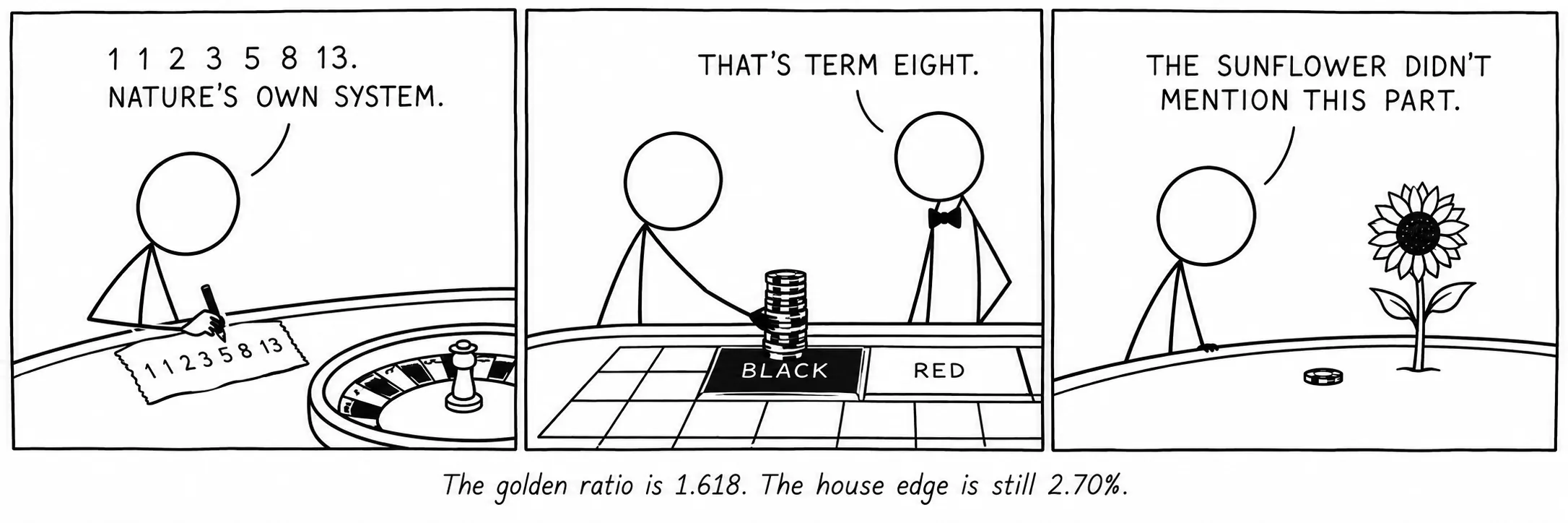
The golden ratio is 1.618. The house edge is still 2.70%.
Sources
- Ethier, S. N. The Doctrine of Chances: Probabilistic Aspects of Gambling.