Roulette Spread Betting and Hedging
Betting against yourself to “cover” outcomes feels safe. Under standard single-zero rules, expected loss is 1/37 of the total stake.
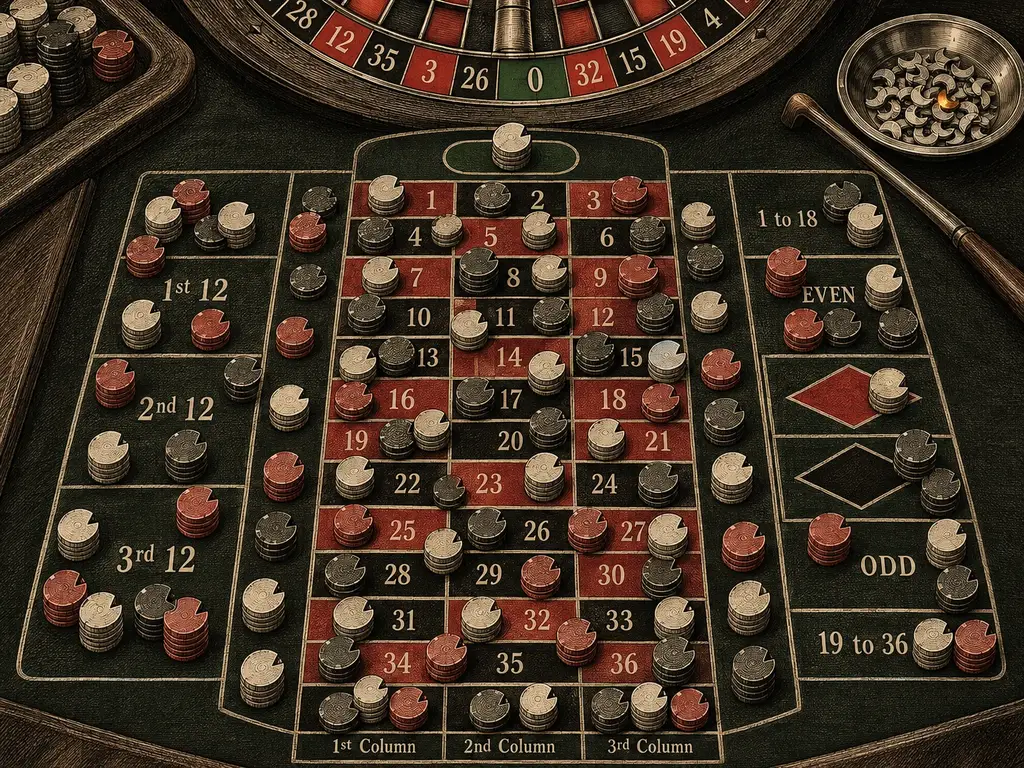
Combining bets changes their net outcomes. Adding chips increases expected loss under the same rules; redistributing a fixed total stake preserves expected loss but can change variancemathVarianceThe expected squared distance of a result from its expected value. It measures dispersion in squared units.Read full definition → and profit probability.
The idea behind a roulette hedging strategy
A chipmoneyChipA token used to place a wager, with a printed or assigned value. Also called a check in some casino terminology.Read full definition → on redbetRedAn even-money wager on the 18 red numbers. French: rouge.Read full definition → and a chip on columnbetColumnTwelve numbers in one vertical layout column, ordinarily paying 2 to 1.Read full definition → 3 cover 22 distinct numbers, but coverage is not the same as a net profit: some winning chips merely offset losing ones. The stake sizes and overlap determine the full distribution. Adding a bet can increase absolute swings even if it feels like protection.
The arithmetic
Expected valuesmathExpected valueThe sum of each possible net result multiplied by its probability. It can be positive, zero or negative.Read full definition → add. Red is −1/37 of its stake; the column chip is −1/37 of its stake; together they are −1/37 of the total. Profit probabilitymathProbabilityA measure of how likely an event is, from zero to one. Percentages express the same scale from 0% to 100%.Read full definition → need not increase: $10 on red plus $5 on column 3 still profits on only the 18 red numbers. The Bet Builder tool enumerates all 37 outcomes for any set of chips and shows the distribution and the expected return for the chosen total stake.
| combination | stake | p(net win) | best case | worst case | EV |
|---|---|---|---|---|---|
| $10 red | $10 | 48.6% | +$10 | −$10 | −$0.27 |
| $10 red + $5 column 3 | $15 | 48.6% | +$20 (red in col 3) | −$15 | −$0.41 |
| $10 on two dozens + $1 zero | $21 | 67.6% | +$15 (zero) | −$21 | −$0.57 |
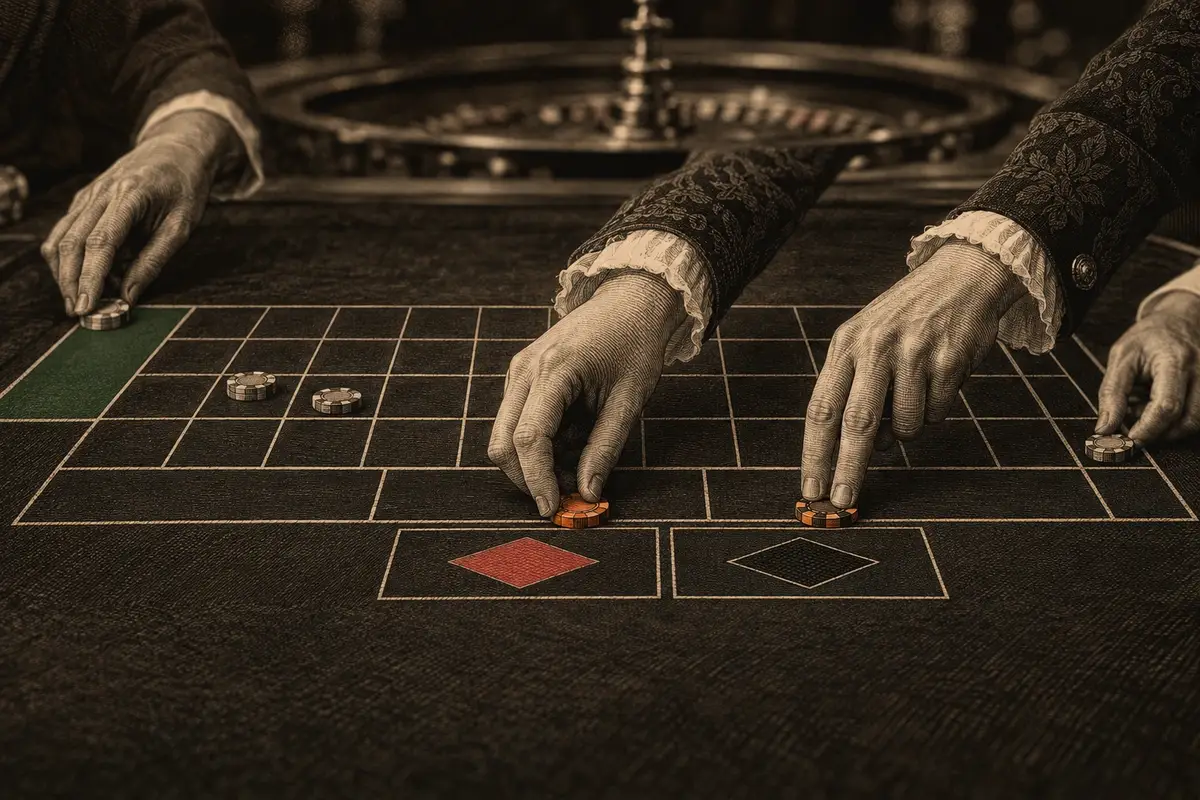
| $10 red + $10 black | $20 | 0% | $0 | −$20 (zero) | −$0.54 |
| $10 × 3 dozens + $1 zero | $31 | 2.7% (zero) | +$5 | −$1 | −$0.84 |
Red plus black
Equal stakes on red and blackbetBlackAn even-money bet on the 18 black numbers. French: noir.Read full definition → break even on every nonzero result and lose both stakes on zerowheelZeroThe 0 outcome, conventionally shown in green. Ordinary color, parity, high/low, dozen and column bets do not include it.Read full definition →. Under standard single-zero rules the net-profit probability is zero and the edge is 1/37 of the total. Covering all numbers can also guarantee a loss: 12 unitsmoneyUnitA base amount used to express stakes or results.Read full definition → on each dozenbetDozenA bet on 1–12, 13–24 or 25–36, ordinarily paying 2 to 1.Read full definition → and 1 on zero stakes 37 and returns 36 whichever pocketequipmentPocketA compartment on the rotor in which the ball can settle. The number of pockets depends on the wheel.Read full definition → wins.
An overlapping spread: black plus column 3
Consider one unit on black and one on the third column, which holds eight red numbers and only four black ones (6, 15, 24, 33). On a standard double-zero wheel, 38 such spins have expected lossmathExpected lossThe probability-weighted average net loss under a stated model. With a constant edge, it equals edge times expected total stakes.Read full definition → 4 units, not a guaranteed result. Count the outcomes on a European wheel. A black number in the third column wins both bets, +3; a red one wins the column and loses black, +1; any other black wins black and loses the column, 0; the other ten reds and the zero lose both, −2. Using the expected counts over 37 independent spinsmathIndependent spinsSpins for which learning an earlier outcome does not change the probabilities assigned to a later one.Read full definition → gives 12 + 8 + 0 − 22 = −2 units on 74 staked, 2.70%, as for every combination. The chance of a win or break-evenmathBreak-evenA result with no net gain or loss, or a threshold at which expected profit is zero. Specify which meaning applies.Read full definition → result is 26/37. Changing the stakes to 3 on black and 2 on the column changes the outcomes and total expected loss, while preserving the standard single-zero edge per unit.
| ball lands in | numbers | black, 1 unit | column 3, 1 unit | net |
|---|---|---|---|---|
| black in column 3 | 4 | +1 | +2 | +3 |
| red in column 3 | 8 | −1 | +2 | +1 |
| other black | 14 | +1 | −1 | 0 |
| other red, or 0 | 11 | −1 | −1 | −2 |
Hedging a progression
Adding or moving bets changes which outcomes recover previous losses, and can change both the probability and size of an unfinished-cycle loss. It does not make the previous loss part of the next spin’s odds. Under standard single-zero rules, extra turnovermoneyTurnoverThe sum of amounts wagered over a session or period, including money wagered again after a return. Also called handle or action.Read full definition → adds expected cost.
When the pattern costs more: a dealer’s sector system
On a double-zero wheel one cover costs more than the rest. Consider a spread aimed at two arcs of the standard American wheel: the eight pockets 2, 0, 28, 9, 26, 30, 11, 7 and, opposite them, 1, 00, 27, 10, 25, 29, 12, 8. On that wheel the two arcs happen to fall into layoutequipmentLayoutThe marked betting surface, whether printed on a table or displayed on a screen.Read full definition → blocks, so three chips cover them: one on the five-number bet (0, 00, 1, 2, 3), one on the six linebetSix lineA bet on six numbers in two adjacent layout rows, ordinarily paying 5 to 1.Read full definition → 7–12 and one on the six line 25–30. That is 17 numbers, the two arcs plus 3, for three chips. The catch is the first chip. The layout has no bet on 0, 00, 1 and 2 alone, and the five-number bet is the one American bet priced at 7.89% instead of 5.26%. It pulls the whole pattern to −7/38 of a unit on 3 units staked, 6.14%. For standard double-zero payoutsmoneyPayoutThe amount paid on a winning wager. Check whether the quoted figure is net profit or total return including the stake.Read full definition → without a special zero rule, these other constituent bets have a 5.26% edge; this one costs more because it includes it.
| ball lands in | numbers | net, 3 chips | probability |
|---|---|---|---|
| a six line | 12 | +3 | 31.58% |
| the five-number bet | 5 | +4 | 13.16% |
| anywhere else | 21 | −3 | 55.26% |
| expected value | −0.184 units | 6.14% of the stake |
Can Roulette Dealers Hit Numbers? The MythAmerican Roulette Wheel and Rules
When covering is reasonable
A spread can be chosen for a particular outcome distribution. Check the net return on every pocket, including zero, and compare equal total stakes. A high hit rate does not guarantee a long session or low losses. Special zero rules or nonstandard payouts can also change the blended edge.
Questions
La partageruleLa partageA rule returning half of a qualifying even-money stake when zero lands. On a fair single-zero wheel it gives an edge of 1/74, about 1.35%.Read full definition → gives eligible single-zero even-money betsbetEven-money betA bet paying a profit equal to the stake, such as red/black, odd/even or high/low.Read full definition → a 1/74 edge. Mixing them with ordinary 1/37 bets produces a stake-weighted edge between those values. Check actual rules, not just the table name.
Sometimes. It depends on the stakes and overlap, and on whether you compare equal total stakes or add more money. Coverage alone is not a variance measure.
Where accepted, both bets remain subject to the house rules and edge. Equal stakes break even on nonzero results and lose on zero under standard single-zero rules.
Comic relief
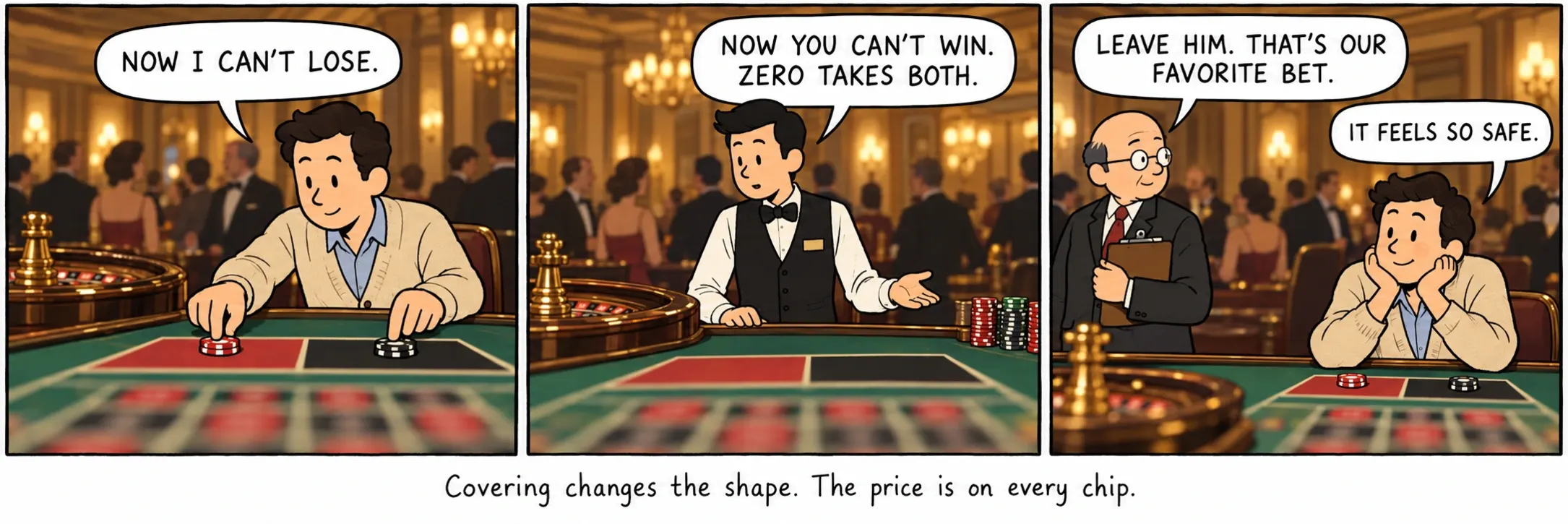
Equal stakes on red and black break even on nonzero results and lose both stakes on zero under standard single-zero rules.
Sources
- RouletteDoc. Roulette strategies overview.
- Roulette77. Roulette strategies overview.
- Ethier, S. N. The Doctrine of Chances: Probabilistic Aspects of Gambling.
- Bollman, M. Mathematics of the Big Four Casino Table Games: Blackjack, Baccarat, Craps, & Roulette.
- Bollman, M. Basic Gambling Mathematics: The Numbers Behind the Neon, 2nd ed.
- Epstein, R. A. The Theory of Gambling and Statistical Logic, 2nd ed.
- Scarne, J. Scarne’s Complete Guide to Gambling.