Las Vegas Roulette Wheels
Las Vegas offers several roulette games. Compare the zeros, payouts and minimum stake: each changes what a session can cost.

Double-zero roulette is widespread in Las Vegas, but single-zero, triple-zero and special-payout games are also available. A lower house edge means a lower expected loss per dollar wagered. It does not necessarily mean a lower cost per spin if you must bet more.
Several games in one city
The Vegas Advantage survey, last updated 15 May 2026, records double-zerowheelZeroThe 0 outcome, conventionally shown in green. Ordinary color, parity, high/low, dozen and column bets do not include it.Read full definition → roulette at most of the Las Vegas casinos it surveyed. It also lists single-zero and triple-zero games, plus versions with special payoutsmoneyPayoutThe amount paid on a winning wager. Check whether the quoted figure is net profit or total return including the stake.Read full definition →. This is a dated survey, not a guarantee of what a casino will offer on your visit.
With standard payouts and no special zero rule, the house edgemathHouse edgeThe casino’s expected net gain expressed as a fraction of the stake, under specified probabilities and payouts.Read full definition → is 1/37 on single zero, 2/38 on double zerovariantDouble zeroThe 00 pocket on a conventional 38-pocket wheel. With ordinary payouts, the fair-wheel edge is 2/38, about 5.26%.Read full definition → and 3/39 on triple zero. There are exceptions: the five-number double-zero bet pays 6 to 1 and has a 3/38 edge, about 7.89%. Count the pocketsequipmentPocketA compartment on the rotor in which the ball can settle. The number of pockets depends on the wheel.Read full definition → and read the payout rules before comparing tables.
Minimum stake versus house edge
A $100 ordinary single-zero wager has an expected lossmathExpected lossThe probability-weighted average net loss under a stated model. With a constant edge, it equals edge times expected total stakes.Read full definition → of about $2.70. A $25 ordinary double-zero wager has an expected loss of about $1.32. The first has better odds per dollar, but a higher expected cost per spin. Neither figure predicts the result of one bet.
The following examples use the same $25 wager to isolate the effect of the rules. They are calculations, not advertised casino minimums.
| rules | house edge | expected loss on $25 | expected loss per $1 |
|---|---|---|---|
| single zero, ordinary payouts | 2.70% | $0.68 | 2.7¢ |
| double zero, ordinary payouts | 5.26% | $1.32 | 5.3¢ |
| triple zero, ordinary payouts | 7.69% | $1.92 | 7.7¢ |
| single zero, even-money bet with half back on zero | 1.35% | $0.34 | 1.4¢ |
Triple-zero roulette
Adding a third zero without increasing the ordinary payouts raises the edge to 3/39, or about 7.69%. It is a cost of the rules, not a penalty that appears only after a losing streak.
A lower minimum can still reduce the amount at risk on each spin. For example, a hypothetical $5 triple-zero bet has an expected loss of about 38¢, compared with 53¢ for a $10 double-zero bet. That comparison does not make triple zero better per dollar or guarantee either minimum is available.
Computers and casino rules
Edward Thorp’s account describes testing a wearable roulette computer with Claude Shannon in Las Vegas in 1961. It belongs to the history of physical prediction, not evidence that an ordinary staking system beats an independent wheel.
Nevada added its device provision in 1985. Today NRS 465.075 prohibits using, possessing with intent to use, or assisting another with specified advantage devices or software in the games it covers, subject to approved-game and Commission exceptions. Mere possession is not an accurate summary of the wording.
Electronic roulette
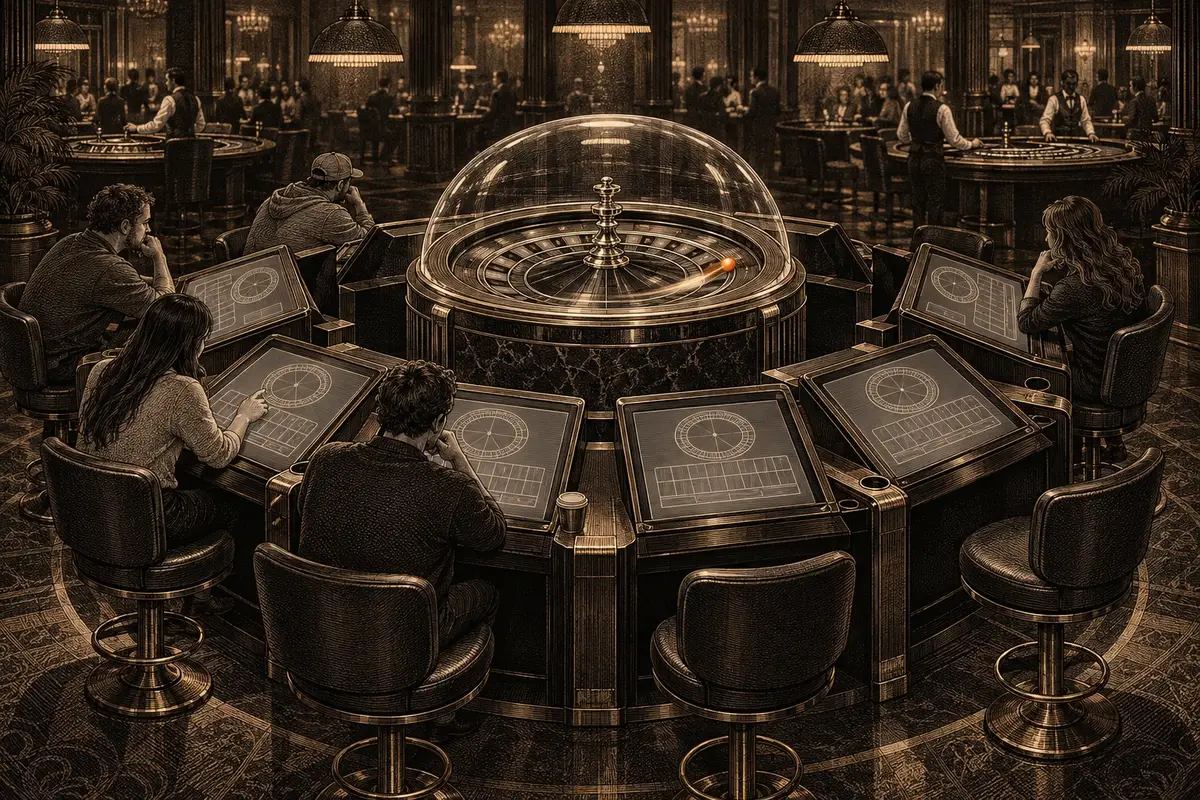
A terminal is a way to place bets, not a guarantee of a particular wheel or payout table. Electronic games may use a physical wheel or a random-number generator. Some configurations reduce straight-up or splitbetSplitA wager on two numbers sharing an allowed layout boundary, ordinarily paying 17 to 1.Read full definition → payouts, so counting the zeros alone is not enough.
Check whether the displayed return includes your stake. A total return of 35 times the wager is a profit of 34 to 1, which is lower than the usual straight-up profit of 35 to 1. On a fair single-zero game, that reduced return gives a 2/37 edge, about 5.41%.
Promotions and a zero-free wheel
John L. Smith’s account of Bob Stupak, excerpted in The Intelligent Gambler in May 1997, reproduces advertising for Vegas World’s “Polish Roulette” with no zeros. The excerpt establishes the promotion’s wording, but does not supply a complete paytable or stake-limit schedule.
The arithmetic of a genuinely zero-free game is straightforward. If the 36 numbered outcomes are equally likely and the standard payouts apply, the ordinary bets have zero expected loss before any fee. That does not turn a MartingalestrategyMartingaleA progression that doubles after each loss and usually returns to the base stake after a win.Read full definition → into guaranteed income. On independent fair redbetRedAn even-money wager on the 18 red numbers. French: rouge.Read full definition →-or-blackbetBlackAn even-money bet on the 18 black numbers. French: noir.Read full definition → bets, a $1–$2–$4 sequence stopped at the first win or third loss earns $1 with probabilitymathProbabilityA measure of how likely an event is, from zero to one. Percentages express the same scale from 0% to 100%.Read full definition → 7/8 and loses $7 with probability 1/8. Its expected profit is zero. Those are model assumptions, not a reconstruction of every rule Vegas World used.
Questions
The cited May 2026 survey lists single-zero games on the Strip, downtown and off the Strip. Availability and minimums can change; check the actual table.
The survey lists single-zero games with this rule, which it labels European roulettevariantEuropean rouletteUsually single-zero roulette: 37 pockets. Ordinary standard-payout bets have a fair-wheel edge of 1/37, about 2.70%.Read full definition →. With equally likely pockets, that makes the edge 1/74, about 1.35%, on the qualifying even-money betsbetEven-money betA bet paying a profit equal to the stake, such as red/black, odd/even or high/low.Read full definition →. Do not assume every single-zero table uses it.
Check the number of pockets, the payouts for your bets, any half-back rule, the minimum stake and any fee. Compare the expected cost at the amount you would actually wager, not just the percentage edge.
Comic relief
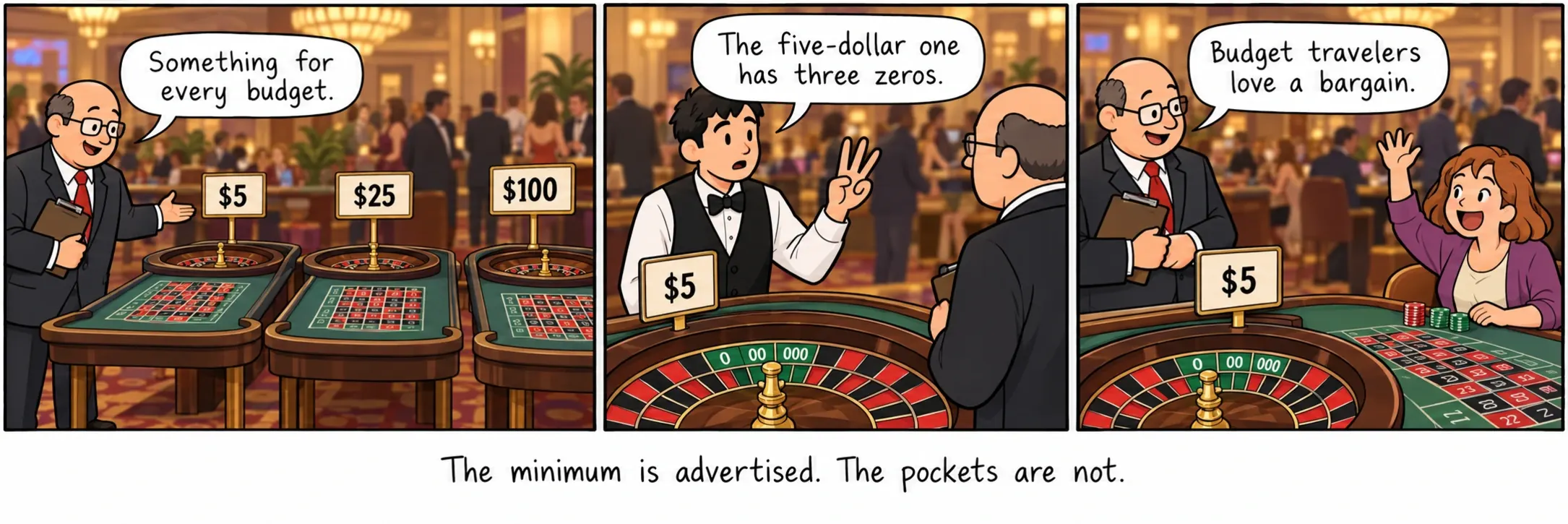
Compare the rules as well as the minimum stake.
Sources
- Vegas Advantage, Las Vegas roulette survey, last updated 15 May 2026
- Edward O. Thorp, The Invention of the First Wearable Computer
- Nevada Revised Statutes 465.075, advantage devices and software
- John L. Smith, No-Limit excerpt, The Intelligent Gambler 7, May 1997, page 3
- Washington State Gambling Commission, Interblock Roulette Game and Special Bet Description, version 1.2.1