Guess the Edge
Estimate the house edge of a bet or spread, then compare your answer with the calculation.
Six rounds are drawn from fourteen examples. A guess within 0.1 percentage points earns 3 points, within 0.5 earns 2, and within 1 earns 1. The maximum is 18.
Round 1 of 6
Scoring
16–18: very close estimates.
11–15: a strong result; review the missed calculations.
6–10: useful practice; compare the different rule sets.
0–5: start with House EdgemathHouse edgeThe casino’s expected net gain expressed as a fraction of the stake, under specified probabilities and payouts.Read full definition → and Bet Builder, then try again.
Distances are percentage points: 3.0% is 0.3 percentage points from 2.7%.
How the reveal works
Multiply each component stake by its expected lossmathExpected lossThe probability-weighted average net loss under a stated model. With a constant edge, it equals edge times expected total stakes.Read full definition → per unitmoneyUnitA base amount used to express stakes or results.Read full definition →, add those losses, and divide by the total stake. Standard single-zerowheelZeroThe 0 outcome, conventionally shown in green. Ordinary color, parity, high/low, dozen and column bets do not include it.Read full definition → bets have edge 1/37; ordinary double-zero bets 2/38; French even-money betsbetEven-money betA bet paying a profit equal to the stake, such as red/black, odd/even or high/low.Read full definition → with la partageruleLa partageA rule returning half of a qualifying even-money stake when zero lands. On a fair single-zero wheel it gives an edge of 1/74, about 1.35%.Read full definition → 0.5/37. The American five-number bet is 3/38. This game’s mini model uses thirteen pocketsequipmentPocketA compartment on the rotor in which the ball can settle. The number of pockets depends on the wheel.Read full definition → and even-money bets covering six of them, for edge 1/13.
Overlapping bets
For expected valuemathExpected valueThe sum of each possible net result multiplied by its probability. It can be positive, zero or negative.Read full definition →, component bets add even when their outcomes overlap. That does not make them independent, and the same simple addition cannot be used for their variancesmathVarianceThe expected squared distance of a result from its expected value. It measures dispersion in squared units.Read full definition →. A $1 straight-up bet on every single-zero number stakes $37 and returns $36 every spin: a certain $1 loss.
Questions
Even-money stakes with la partage have half the standard single-zero edge. Weight each component’s edge by its stake; the blended result depends on the proportions.
No. Under the same standard single-zero rules, adding ordinary bets keeps the edge per dollar at 1/37 while increasing the total stake. Expected loss in dollars therefore grows.
Comic relief
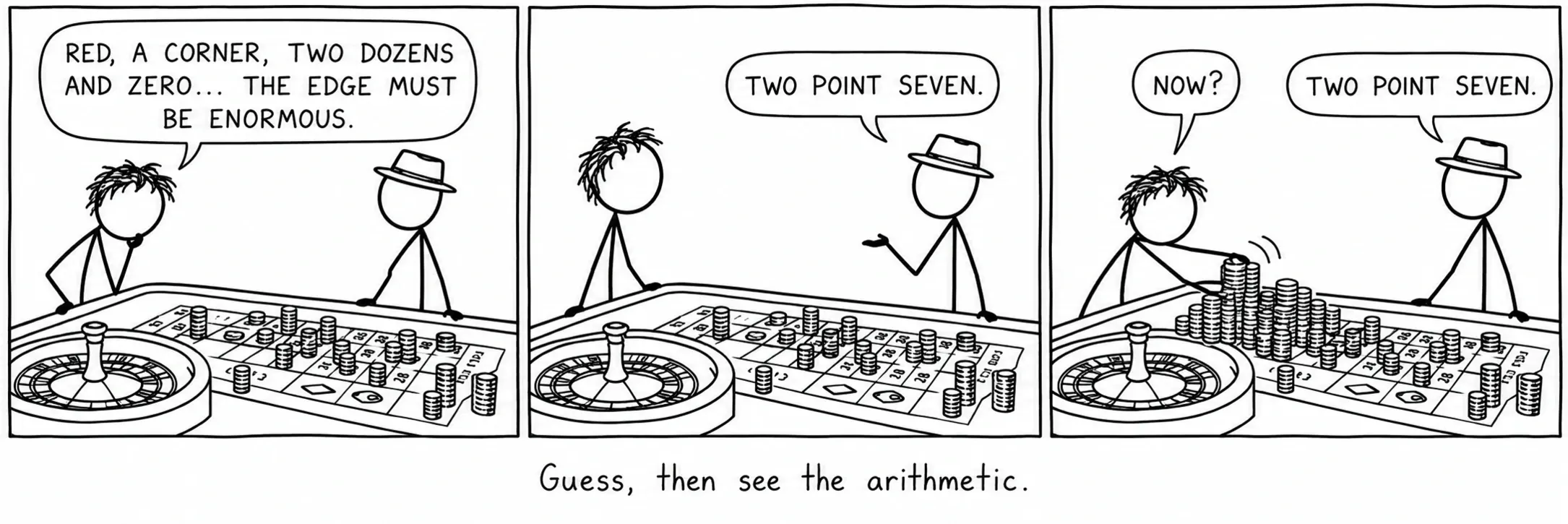
Estimate the edge, then check the component stakes and rules.
Sources
- Ethier, S. N. The Doctrine of Chances: Probabilistic Aspects of Gambling.