Labouchère Roulette Strategy
The Labouchère roulette strategy works from a line of numbers. Bet the sum of the ends. Cross them off after a win, add the lost bet after a loss.
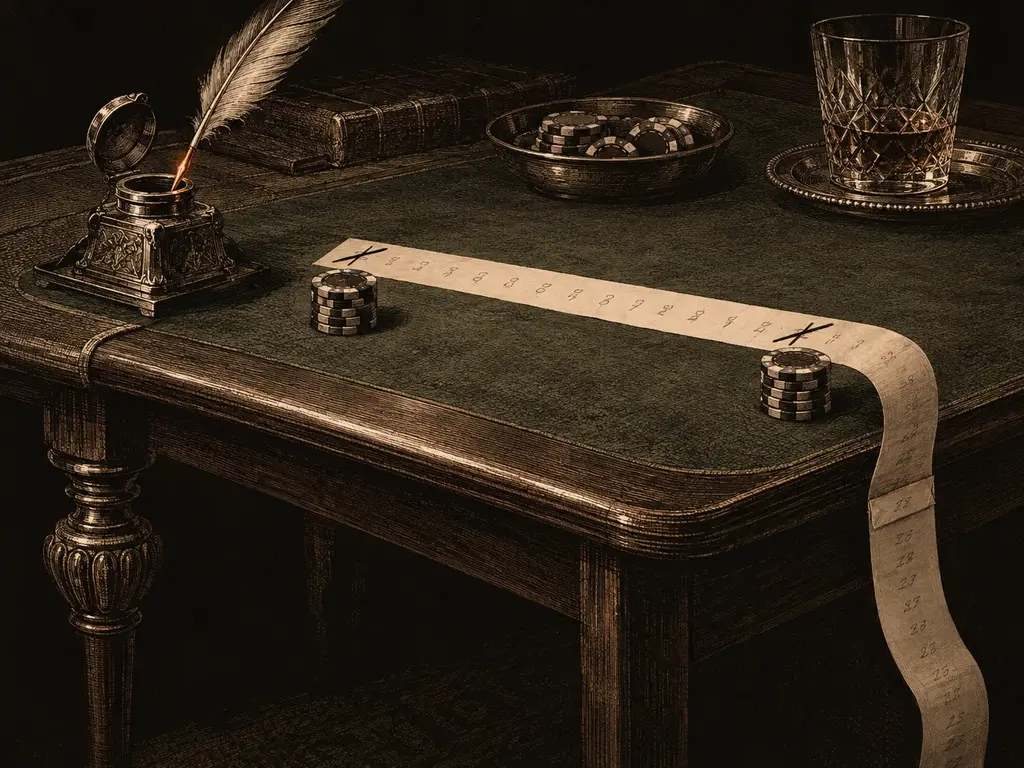
It does not beat the wheel. Completing the line wins its total. The line grows in losing stretches, and the stakes with it. For a bounded session of standard single-zero bets, expected loss is 2.70% of expected turnover.
Walk the system
Bet the first plus last number, or the only number if one remains. A win removes those entries; a loss appends the stake.
Stakes and results are in units of the base bet.
How the Labouchère roulette system works on paper
Decide how much you want to win, say 10 unitsmoneyUnitA base amount used to express stakes or results.Read full definition →, and write it as a line of numbers that add up to it: 1 2 3 4. With two or more numbers, each bet is the first number plus the last; with one number, bet that number once. Initially: 1 + 4 = 5. Win, and cross off both ends; the line is now 2 3. Lose, and write the stake at the end: 1 2 3 4 5. Keep going until the line is empty, which means you have won 10 units, or until you cannot afford the next bet. It works like a to-do list on which every job done removes two items and every job failed adds a bigger one at the bottom.
| line | bet | result | new line | running total |
|---|---|---|---|---|
| 1 2 3 4 | 5 | lose | 1 2 3 4 5 | −5 |
| 1 2 3 4 5 | 6 | win | 2 3 4 | +1 |
| 2 3 4 | 6 | lose | 2 3 4 6 | −5 |
| 2 3 4 6 | 8 | win | 3 4 | +3 |
| 3 4 | 7 | win | (empty) | +10 |
Why does the line usually clear?
With at least two numbers left, a win removes two entries and a loss adds one. At a standard single-zerowheelZeroThe 0 outcome, conventionally shown in green. Ordinary color, parity, high/low, dozen and column bets do not include it.Read full definition → even-money win probabilitymathProbabilityA measure of how likely an event is, from zero to one. Percentages express the same scale from 0% to 100%.Read full definition → of 18/37, the expected change in this line length is −17/37 per bet. This tendency does not guarantee that a player can afford to finish: the values on the line and the required stakes can grow even while its length shrinks.
- p10 −$500
- p25 −$500
- median −$500
- p75 −$500
- p90 −$500
Does the Labouchère system work?
It does not remove the house edgemathHouse edgeThe casino’s expected net gain expressed as a fraction of the stake, under specified probabilities and payouts.Read full definition →. Starting from 1 2 3 4, eight consecutive losses cost 5 + 6 + … + 12 = 68 units and leave a next stake of 13 units. At $10 per unit that is $680 lost and a proposed $130 bet. The probability of those eight losses from a specified starting spin is (19/37)⁸ ≈ 0.48%. A session offers overlapping opportunities for runs, so this is not the probability for a whole session. Completing an unclipped line recovers its accumulated losses and earns the initial target; stopping before completion may leave a loss.
How much money does a short line need behind it?
A target of 6 units does not mean 6 units of funding will suffice. Starting from 1 2 3, consecutive losses require stakes 4, 5, 6 and so on. The examples below show the funds needed to absorb a specified losing run and place the next bet. Other paths have different requirements; no finite bankrollmoneyBankrollThe amount set aside for play. Bankroll management concerns stakes and limits within that amount.Read full definition → guarantees completion.
| consecutive losses | loss so far | next stake | initial funds needed |
|---|---|---|---|
| 1 | 4 | 5 | 9 |
| 2 | 9 | 6 | 15 |
| 5 | 30 | 9 | 39 |
| 10 | 85 | 14 | 99 |
Are there other versions?
Reverse LabouchèrestrategyLabouchèreA cancellation progression: bet the sum of the two end numbers, remove them after a win, and append the stake after a loss. With one number left, bet that number.Read full definition → appends the stake after a win and crosses off the ends after a loss. Splitting a target across shorter lines changes the sequence of stakes, but it does not impose a maximum stake or remove the edge. A one-number line is not flat bettingstrategyFlat bettingUsing the same stake on each bet or spin, as specified by the strategy.Read full definition →: starting with 6, a loss produces 6 6, and the next stake is 12.
Did the reverse Labouchère beat the casino at Nice?
A reported winning trip cannot establish that a system has a positive expected return. In the reverse version, a win appends the stake and a loss removes the ends; with one entry, stake and remove that entry once. Under ordinary full-win/full-loss rules, clearing the line loses its original sum. A line that grows can require increasingly large stakes. A rule to stop at a table maximum changes session outcomes, but not the expected cost per unit wagered. La partageruleLa partageA rule returning half of a qualifying even-money stake when zero lands. On a fair single-zero wheel it gives an edge of 1/74, about 1.35%.Read full definition → reduces the edge on eligible bets to 1/74; its half-loss outcome also requires an explicit rule for updating the line.
What does the name tell us?
Labouchère is also called the cancellation system: its defining feature is the line of numbers and the rule for crossing them off. The name is not evidence of an advantage. For any bounded session of independent standard single-zero bets, expected lossmathExpected lossThe probability-weighted average net loss under a stated model. With a constant edge, it equals edge times expected total stakes.Read full definition → is expected turnovermoneyTurnoverThe sum of amounts wagered over a session or period, including money wagered again after a return. Also called handle or action.Read full definition → divided by 37.
Simulator · Labouchère
2,000 sessions of even-money bets from a $1,000 bankroll.
Base bet $10 · table limit $500 · up to 100 spins per session
Losing-streak probabilities
On a fair single-zero wheel without special zero rules, an even-money bet loses with probability 19/37 per spin. Each row is the chance that a given run of spins all lose, and what a Labouchère player, who starts with the line 1 2 3 4 and writes every lost stake at its end, has lost by then.
| losses in a row | chance | about 1 in | lost so far | next bet |
|---|---|---|---|---|
| 1 | 51.4% | 2 | $5 | $6 |
| 2 | 26.4% | 4 | $11 | $7 |
| 3 | 13.5% | 7 | $18 | $8 |
| 4 | 7.0% | 14 | $26 | $9 |
| 5 | 3.6% | 28 | $35 | $10 |
| 6 | 1.8% | 55 | $45 | $11 |
| 7 | 0.94% | 106 | $56 | $12 |
| 8 | 0.48% | 207 | $68 | $13 |
| 9 | 0.25% | 403 | $81 | $14 |
| 10 | 0.13% | 784 | $95 | $15 |
| 11 | 0.065% | 1527 | $110 | $16 |
| 12 | 0.034% | 2974 | $126 | $17 |
| 13 | 0.017% | 5792 | $143 | $18 |
| 14 | 0.0089% | 11279 | $161 | $19 |
| 15 | 0.0046% | 21965 | $180 | $20 |
The chance is 19/37 multiplied by itself once per loss, counted from one given spin. A longer session offers more possible starting positions, so its chance of containing a run can be higher. Overlapping windows are not independent. The stakes assume enough bankroll and no table limit.
Questions
Their stake paths differ. Risk depends on the starting line, bankroll, limits and stopping rule; neither removes the house edge.
Smaller numbers reduce initial stakes, but neither a short line nor a small target caps later stakes or completion time.
Yes. Your result is simply the running total at that moment.
Fun with Math
Try these yourself first. Each solution is folded; open it when you are ready.
Start the standard LabouchèrestrategyLabouchèreA cancellation progression: bet the sum of the two end numbers, remove them after a win, and append the stake after a loss. With one number left, bet that number.Read full definition → with 1 2 3 4 5, a target of 15, and lose the first four bets. What is the line, how much are you down, and what is the next bet?
Show the solution
Answer The line is 1 2 3 4 5 6 7 8 9, you are 30 unitsmoneyUnitA base amount used to express stakes or results.Read full definition → down, and the next bet is 10.
The bets are 1 + 5 = 6, then 1 + 6 = 7, 1 + 7 = 8 and 1 + 8 = 9. Each loss is written at the end of the line. Lost so far: 6 + 7 + 8 + 9 = 30.
The line now sums to 45: the target of 15 plus the 30 lost. Clearing it still wins exactly 15. Each win crosses off two numbers, so it takes at least five more wins, starting with a 10-unit bet, and every loss on the way makes the line longer again.
Consider a cancellation-system variant starting with 1 1 1 1 1 2 2 2 2 2, a target of 15. After a loss, add one unit to each of the last entries, working leftward, until the lost stake is distributed. Lose the first three bets. What line, loss and next stake result?
Show the solution
Answer The line is 1 1 1 1 1 3 4 5 5 5, you are 12 units down, and the next bet is 6, exactly as in standard Labouchère.
First bet: 1 + 2 = 3. It loses, and 1 unit goes on each of the last three numbers: 1 1 1 1 1 2 2 3 3 3.
Second bet: 1 + 3 = 4. It loses: 1 1 1 1 1 2 3 4 4 4.
Third bet: 1 + 4 = 5. It loses: 1 1 1 1 1 3 4 5 5 5. Lost: 3 + 4 + 5 = 12, and the line sums to 27.
Standard Labouchère from the same start would have the line 1 1 1 1 1 2 2 2 2 2 3 4 5, also summing to 27, with the same next bet of 6. The line stays ten numbers long, which looks reassuring, but the stakes rise just the same.
A single Labouchère line starts at 1 2 3 4. Suppose it reaches completion after exactly 12 losses in that same line. How many wins did completion require? What if it completes after exactly 13 losses?
Show the solution
Answer Eight wins with 12 losses, or nine wins with 13 losses. A completed line gains its original total of 10 units.
The initial line has four entries. Each loss appends one entry. Each non-final win removes two; a final win removes either one or two.
With 12 losses there are 16 entries to remove, so eight wins are required. With 13 losses there are 17, so nine wins are required, the last removing one entry. In general the count is ceil((4 + L)/2) for L losses before that line completes.
This conditions on the losses belonging to one completed line. Reordering a longer list can make the line finish earlier, so later results would belong to a new line or never be played. The order also affects stakes and whether a bankrollmoneyBankrollThe amount set aside for play. Bankroll management concerns stakes and limits within that amount.Read full definition → or table limittableTable limitA permitted minimum or maximum stake, applied per bet, bet category or total wager according to the table.Read full definition → prevents completion.
Comic relief
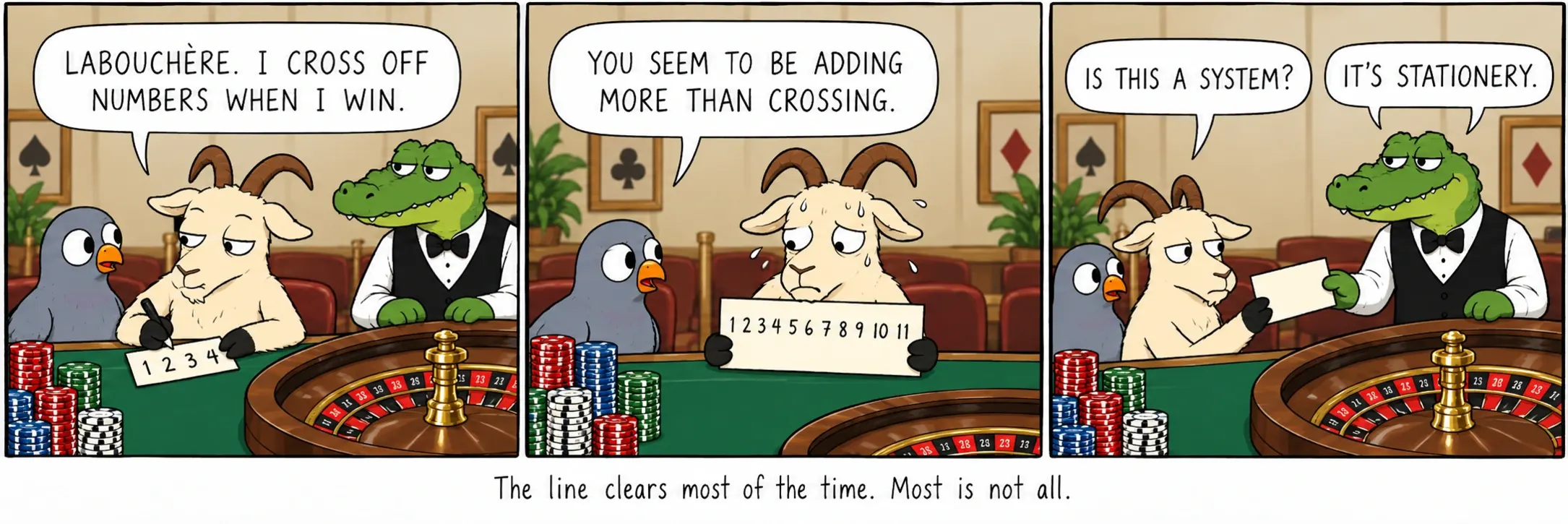
A target is not a guarantee that the line can be completed.
Sources
- RouletteDoc. Strategy description and examples.
- Roulette77. Strategy description and examples.
- Roulette77. Reverse Labouchere description.
- Ethier, S. N. The Doctrine of Chances: Probabilistic Aspects of Gambling.
- Epstein, R. A. The Theory of Gambling and Statistical Logic, 2nd ed.
- Wykes, A. The Complete Illustrated Guide to Gambling.
- Leigh, N. Thirteen Against the Bank.
- Goldman, N. Great Gambling Scams.