Roulette Dozens Strategy and Columns
A roulette dozens strategy bets two dozens or two columns at once, covering 24 of 37 numbers.

Win 64.9% of spins for a net of +1 unit; lose 2 units the other 35.1%. Expected valuemathExpected valueThe sum of each possible net result multiplied by its probability. It can be positive, zero or negative.Read full definition →: −2.70% of the two units staked.
The arithmetic of the two-dozen roulette strategy
One unitmoneyUnitA base amount used to express stakes or results.Read full definition → on each of two dozensbetDozenA bet on 1–12, 13–24 or 25–36, ordinarily paying 2 to 1.Read full definition →. A hit in either pays 2 and loses the other: +1. A miss (the third dozen or zerowheelZeroThe 0 outcome, conventionally shown in green. Ordinary color, parity, high/low, dozen and column bets do not include it.Read full definition →) loses both: −2. (24 × 1 − 13 × 2)/37 = (24 − 26)/37 = −2/37 per two units staked = −1/37 per unit. Under standard single-zero rules, the same 1/37 edge as individual dozen bets, with a different shape: nearly two wins in three, each worth half a losing spin.
| outcome | probability | result (2 units staked) |
|---|---|---|
| covered dozen | 64.86% | +1 |
| third dozen | 32.43% | −2 |
| zero | 2.70% | −2 |
| expected per spin | −0.054 |
Why it feels like winning
The 24/37 profit probabilitymathProbabilityA measure of how likely an event is, from zero to one. Percentages express the same scale from 0% to 100%.Read full definition → is higher than redbetRedAn even-money wager on the 18 red numbers. French: rouge.Read full definition →’s 18/37, but higher hit rates are possible with other combinations. Each win adds one unit and each loss removes two; losses can cluster. The mean slope is −2.70% of turnovermoneyTurnoverThe sum of amounts wagered over a session or period, including money wagered again after a return. Also called handle or action.Read full definition →, and because you stake two units per spin, turnover is doubled relative to a single dozen.
- p10 −$500
- p25 −$500
- median −$287
- p75 −$40
- p90 +$110
Progressions on dozens
Doubling the stake after a loss does not recover on a 2 to 1 bet the way it does on even money. Suppose you lose 2 units (one on each dozen), double to 2 and 2, and win: you collect 4 and lose 2 on the other dozen, net +2, which only covers the previous loss with nothing over. To net +1 after each loss you must more than double, and the standard dozens progressionstrategyProgressionA rule that changes stakes over a sequence of bets, often using previous wins or losses.Read full definition → is to triple: 1, 3, 9, 27, 81. With a $500 maximum per dozen and a $5 initial stake on each dozen, five losing stakes can be placed; the next proposed $1,215 per dozen is refused; (13/37)⁵ ≈ 0.5% per attempt, with many attempts per session.
| step | stake per dozen | total staked so far | p(reaching this step) |
|---|---|---|---|
| 1 | 1 | 2 | 100% |
| 2 | 3 | 8 | 35.1% |
| 3 | 9 | 26 | 12.3% |
| 4 | 27 | 80 | 4.3% |
| 5 | 81 | 242 | 1.5% |
| 6 | 243 | 728 | 0.5% |
Rotation and “sleeping” dozens
Many sold systems rotate which dozen to leave out, usually the one that hit most recently or the one that has not hit for a while. Under the independent uniform model, choosing the omitted dozen from past results does not change the next spin’s outcome distribution. The systems are equivalent to each other and to picking the uncovered dozen at random.

Roulette column strategy
Two columnsbetColumnTwelve numbers in one vertical layout column, ordinarily paying 2 to 1.Read full definition → also cover 24 numbers and have the same outcome distribution as two dozens. A dozen plus a column is different: their overlap covers four numbers, so 20 distinct numbers are covered. With one unit on each, the net outcomes are +4 on four numbers, +1 on sixteen and −2 on seventeen. The Bet Builder tool gives the exact distribution for any mix.
A slower doubling
Consider this progression for a single column: bet 1 unit, bet 1 again after a loss, and double only after two losses in a row, so the stakes run 1, 1, 2, 2, 4, 4, 8, 8 . The stake doubles every two consecutive losses rather than every loss, and the price is that a win no longer always covers the losses: a win on the second bet of a pair can leave you level or behind. Ten consecutive misses cost 62 units and have probability about 1.98% from a specified starting spin, since a column misses 25 times in 37. Every unit staked still costs 2.70%.
Questions
At the same total stake, two dozens have a higher profit probability and smaller variancemathVarianceThe expected squared distance of a result from its expected value. It measures dispersion in squared units.Read full definition → than red: they win half the stake on 24/37 outcomes and lose the stake on 13/37. Both have the same expected lossmathExpected lossThe probability-weighted average net loss under a stated model. With a constant edge, it equals edge times expected total stakes.Read full definition → under standard single-zero rules.
Add a chipmoneyChipA token used to place a wager, with a printed or assigned value. Also called a check in some casino terminology.Read full definition → on zero and you cover 25 numbers; zero then pays 35 − 2 = +33 instead of −2. The expected value becomes −3/37 per three units: unchanged per unit.
Fun with Math
Try these yourself first. Each solution is folded; open it when you are ready.
Consider columnbetColumnTwelve numbers in one vertical layout column, ordinarily paying 2 to 1.Read full definition → stakes of 1, 1, 2, 2, 4, 4, 8 and 8 unitsmoneyUnitA base amount used to express stakes or results.Read full definition →, stopping at the first win. The column pays 2:1. What is the net result if the first win occurs at each of the eight positions?
Show the solution
Answer A win on bet 1, 3, 5 or 7 leaves you 2 units up. A win on bet 2, 4, 6 or 8 leaves you +1, 0, −2 and −6 units: short of the usual +2, and behind from bet 6 on.
A win at stake s pays 2s; subtract everything lost before it.
Bet 1 (stake 1): +2. Bet 2 (stake 1, 1 lost before): 2 − 1 = +1. Bet 3 (stake 2, 2 lost): 4 − 2 = +2. Bet 4 (stake 2, 4 lost): 4 − 4 = 0. Bet 5 (stake 4, 6 lost): 8 − 6 = +2. Bet 6 (stake 4, 10 lost): 8 − 10 = −2. Bet 7 (stake 8, 14 lost): 16 − 14 = +2. Bet 8 (stake 8, 22 lost): 16 − 22 = −6.
The first stake of each pair always nets +2; the second nets +1, 0, −2, −6, −14 and so on, worse each time. That is the price of the slower climb. On independent uniform single-zerowheelZeroThe 0 outcome, conventionally shown in green. Ordinary color, parity, high/low, dozen and column bets do not include it.Read full definition → spins a column misses with probabilitymathProbabilityA measure of how likely an event is, from zero to one. Percentages express the same scale from 0% to 100%.Read full definition → 25/37. If this pattern continues to ten bets with stakes 16 and 16, ten consecutive misses lose 62 units with probability (25/37)¹⁰, about 1.98%, per fresh attempt with sufficient funds.
Comic relief
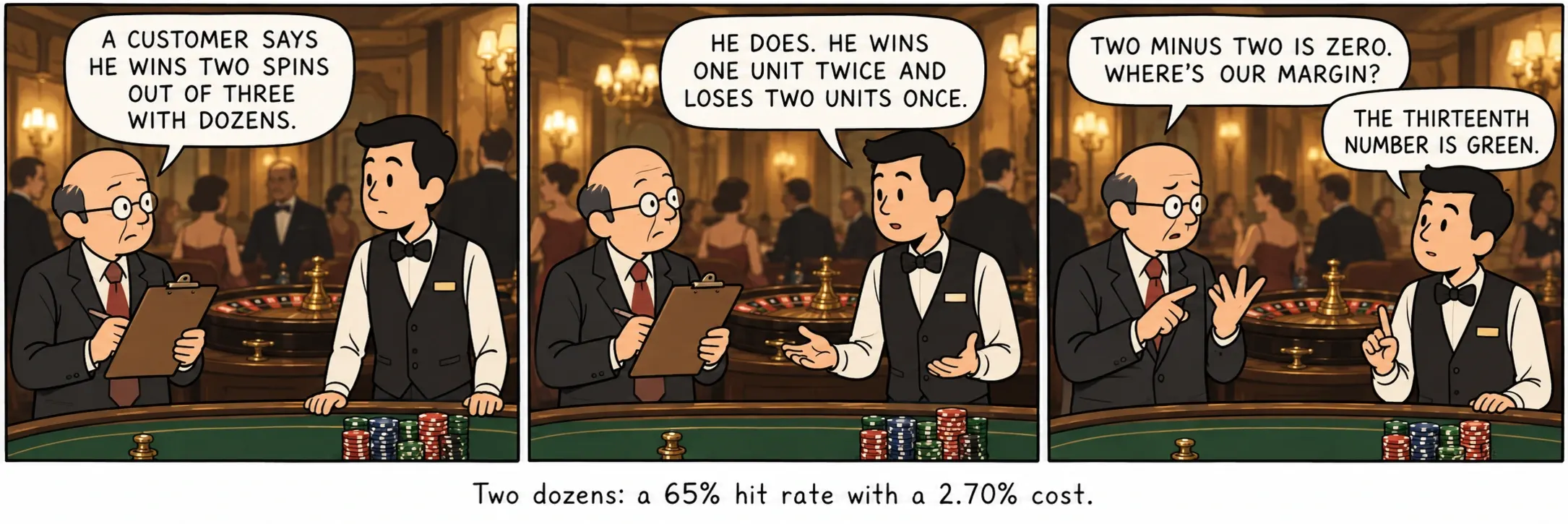
On a fair single-zero wheel with standard payouts, two one-unit dozen bets net +1 on 24 pockets and −2 on 13. Expected loss: 2/37 units per spin.
Sources
- RouletteDoc. Roulette strategies overview.
- Roulette77. Roulette strategies overview.
- Ethier, S. N. The Doctrine of Chances: Probabilistic Aspects of Gambling.
- Bollman, M. Basic Gambling Mathematics: The Numbers Behind the Neon, 2nd ed.