Bonus-Round Wheels
Wheels that pay extra when a bonus lights up: random Bonus numbers on a four-zero wheel, a wide pocket that hands out free spins, a second wheel of multipliers. The bonus is real, and so is the bill for it.

A bonus changes the return; its value depends on how often it occurs and what it pays. Fast Action Roulette pays for its Bonus numbers with four zeros, and its straight upbetStraight upA wager on one number, ordinarily paying a profit of 35 to 1.Read full definition → costs 6.65%. Double Bonus Spin adds a wide Bonus pocket that gives free spins and, by our calculation, makes its standard bets cheaper than a plain American wheel. The bonus bets in the historical examples below cost 13% to 25%. The Deal or No Deal example cannot be priced from the cited description because its bonus-trigger frequencies are missing.
Paying for a bonus
Bonus games need a complete return calculation. Count ordinary payoutsmoneyPayoutThe amount paid on a winning wager. Check whether the quoted figure is net profit or total return including the stake.Read full definition →, bonus payouts and any extra stakes; the number of zeroswheelZeroThe 0 outcome, conventionally shown in green. Ordinary color, parity, high/low, dozen and column bets do not include it.Read full definition → alone is not enough.
Fast Action Roulette
Bollman (2021) describes a 2020 version of Fast Action Roulette at Marina Bay Sands. Its wheel has 40 pocketsequipmentPocketA compartment on the rotor in which the ball can settle. The number of pockets depends on the wheel.Read full definition →: 1 to 36, 0, 00, an S and the casino’s logo. Without bonuses, a straight-up payout of 35 to 1 on 40 equally likely pockets would give the house a 10% edge. On every spin, 10 of the 40 spaces on the layoutequipmentLayoutThe marked betting surface, whether printed on a table or displayed on a screen.Read full definition → light up at random as Bonus spaces. That version has ten rows of four and the four bets listed below. These calculations apply to the historical rule set described here. Do not apply them to a different bonus bet or a later pay tablemoneyPay tableThe list of payouts for specified bets or outcomes. Probabilities and charges are also needed to calculate the house edge.Read full definition → without checking its rules.
How the single number gets to 6.65%
A number is unlit with probabilitymathProbabilityA measure of how likely an event is, from zero to one. Percentages express the same scale from 0% to 100%.Read full definition → 3/4. It is lit with probability 1/4, including the roughly 1-in-435 chance that its whole row is lit. The three payouts average about 36.3 to 1 on a hit, against fair odds of 39 to 1. That gives a 6.65% edge.
Designing a split
The game offers no splitbetSplitA wager on two numbers sharing an allowed layout boundary, ordinarily paying 17 to 1.Read full definition →. Bollman asks what a split should pay if it used the same Bonus idea: 17 to 1 normally, more if one or both of its numbers are Bonus. For two given spaces, neither is Bonus 29 times in 52, one is 20 times in 52 and both are 3 times in 52. Keeping the edge between the American 5.26% and the triple-zero 7.69% leaves a narrow choice. The simplest design leaves the one-Bonus case alone and pays 30 to 1 when both are Bonus: 6.25%.
Double Bonus Spin
In Bollman’s description, IGT’s Double Bonus Spin keeps the American wheel and adds a yellow Bonus pocket one and a half pockets wide, so the wheel counts 39.5 pocket widths. Without free spins that extra width would simply belong to the house: 3.5 house pockets’ worth out of 39.5, an edge of 8.86% on ordinary non-basketbetBasketA name used for bets covering zero and nearby layout numbers. The covered numbers and payout depend on the game.Read full definition → bets. When the ballequipmentBallThe small ball that settles in a numbered pocket to determine a physical roulette result.Read full definition → lands in the Bonus pocket, every bet on the layout stays up for two free spins, shown as one ball on two rings. You lose your chipmoneyChipA token used to place a wager, with a printed or assigned value. Also called a check in some casino terminology.Read full definition → only if both free spins miss, and win once or twice if one or both hit. That makes this the rare wheel where the cost depends on how many numbers a bet covers: the free spins are worth most to a bet on few numbers.
The yellow bets
The cost of Double Bonus Spin sits in its yellow bets, which you place on the Bonus pocket itself. A straight yellow bet pays 12 to 1 if the ball lands in the Bonus pocket and then multiplies its prize by 10 if one free spin hits it again, by 100 if both do. Split and trio versions add 00, or 0 and 00, at 6 to 1 and 4 to 1, but a ball in 0 or 00 pays without starting the bonus round.
A second wheel of multipliers
Vegas Advantage documented Bonus Wheel Roulette at Palazzo in August 2025 and reported its removal the following September. Four gem pockets replace the zeros. Separate gem bets use a second wheel with prizes up to 500×. Standard payouts on numbers 1 to 36 give a 10% edge on a fair 40-pocket wheel. The report quotes 9.25% for gem bets, but its payout explanation is inconsistent: the listed multipliers give that edge only if they include the returned stake. If the stake is returned separately, the straight gem bet gives 6.75%. The actual settlement rule needs confirmation.
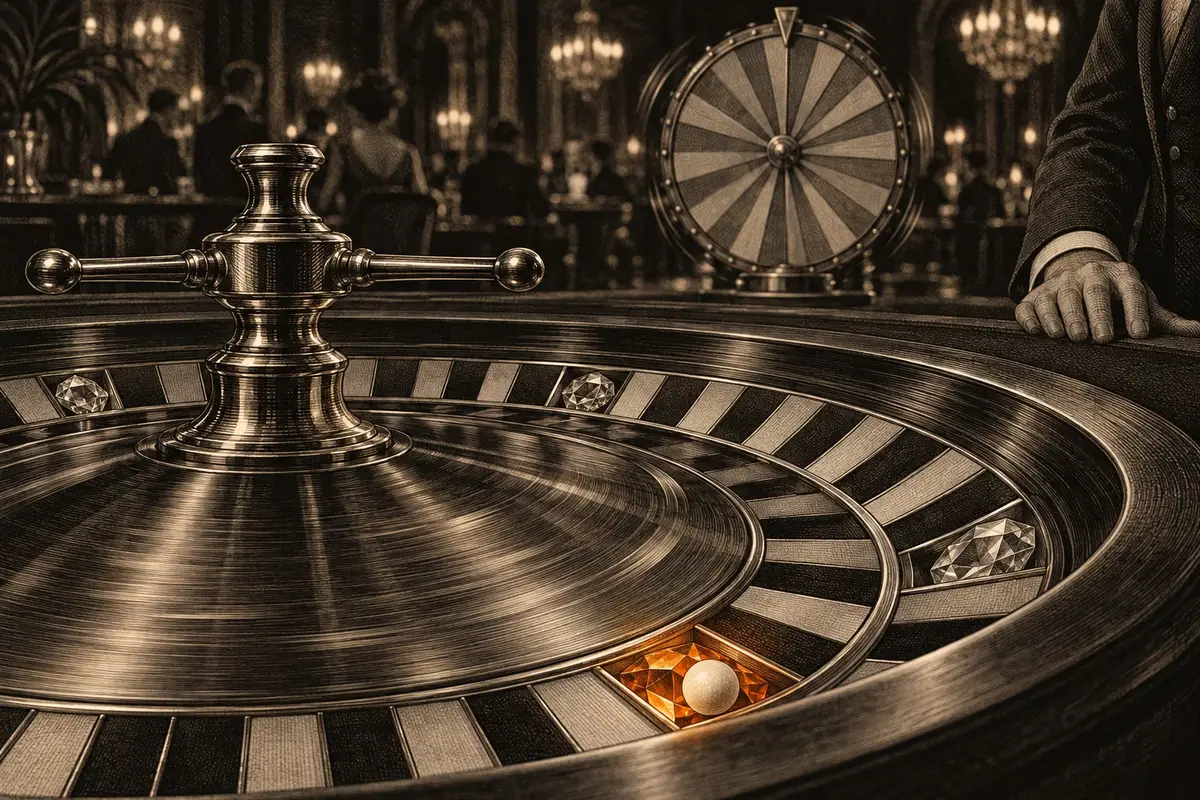
Deal or No Deal Roulette: missing trigger frequencies
The version described by Wizard of Odds adds two bonus symbols to single-zero roulette. One starts a box-selection game; the other starts a prize wheel. The cited analysis gives conditional returns of 46.68 times the bet for keeping a box to the end and 40.42 for its stated prize-wheel strategy. Those figures describe bonuses once reached, not the return of the initial bet.
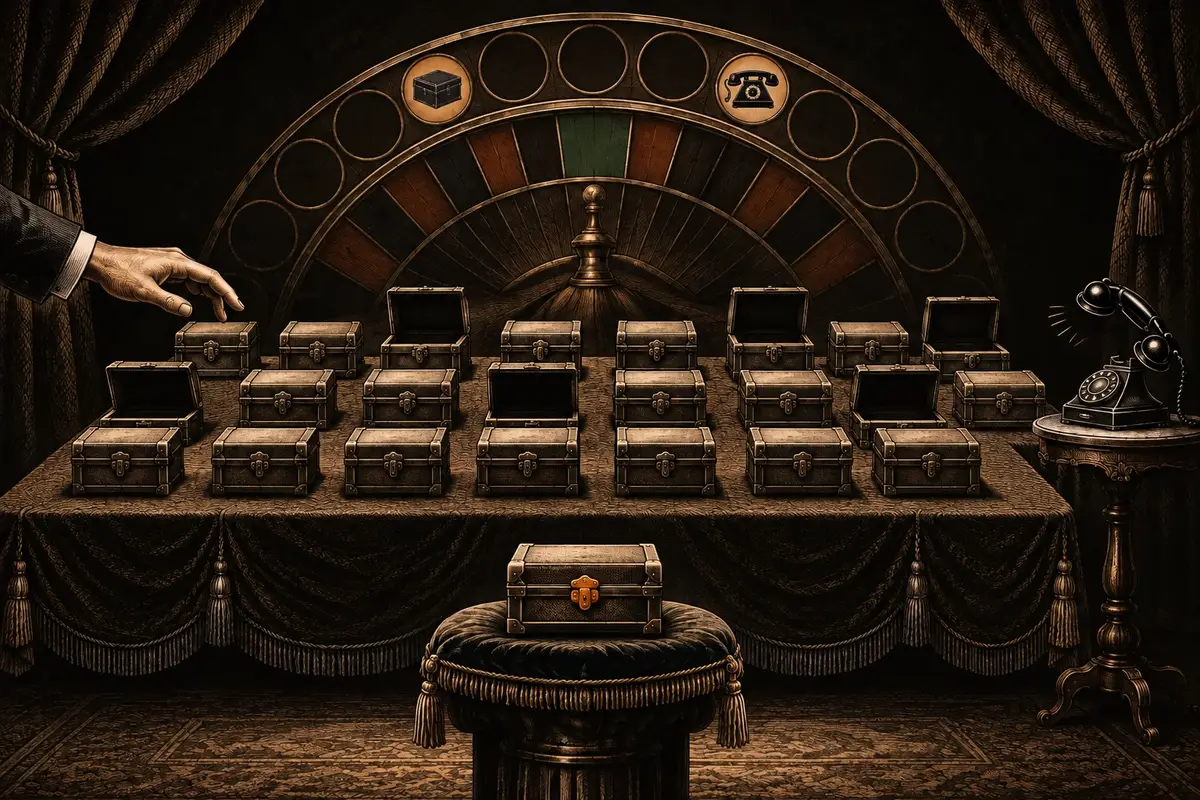
What the game leaves out
The published help-screen analysis cited here gives prizes but not symbol-trigger frequencies. If it were 1 spin in 37 for each, the bonus bet would return 46.68/37 + 40.42/37, about 235% of what is staked: a hypothetical player advantage of about 135%. A published estimate puts the symbol frequency far below that, and without verified frequencies this example cannot be priced reliably. Both payouts and outcome probabilities are needed to calculate expected return.
What to take from it
A bonus does not make a wheel cheaper unless the casino gives back more than the bonus costs it, and only one of the three priced here does.
- Count the house pockets first. Four of them start at 10%, whatever lights up.
- The bets on the bonus itself are the dearest on the layout: 13% to 25% here.
- Double Bonus Spin’s non-basket standard bets are under 3% on this model; the five-number bet is 4.72%.
- Read the help screen: “for 1” or “to 1”, and what a bonus multiplies.
Questions
Its straight up, at 6.65%, costs more than an American wheel and much more than a European one. Its three bonus bets cost 13% to 25%.
Because the two free spins are worth more than the extra pocket and a half costs, for every standard bet. That is our calculation from the rules as Bollman describes them; check the game’s own pay table.
For standard bets on numbers 1 to 36, yes: the four gem pockets lose, giving a 10% house edgemathHouse edgeThe casino’s expected net gain expressed as a fraction of the stake, under specified probabilities and payouts.Read full definition → with standard payouts and equally likely pockets. Gem bets are separate wagers with their own bonus payouts.
Fun with Math
Try these yourself first. Each solution is folded; open it when you are ready.
Suppose ten distinct spaces are chosen uniformly from a 40-space layoutequipmentLayoutThe marked betting surface, whether printed on a table or displayed on a screen.Read full definition → arranged in ten rows of four. What are the probabilities that exactly one whole row is selected and that exactly two whole rows are selected?
Show the solution
Answer One whole row: about 2.3% of spins, 1 in 44. Two whole rows: about 1 spin in 38,000.
There are 847,660,528 ways to pick 10 spaces out of 40, all equally likely.
Two whole rows: choose the two rows (45 ways), then the last 2 Bonus spaces from the other 32 (496 ways). Two spaces cannot complete a third row, so that is 22,320 ways: 1 in about 37,978.
Exactly one whole row: choose the row (10 ways) and the other 6 spaces from the remaining 36 (1,947,792 ways), then remove the choices that complete a second row (9 rows × 496 = 4,464). That leaves 10 × 1,943,328 = 19,433,280 ways, 2.29%. A particular row is fully selected with probabilitymathProbabilityA measure of how likely an event is, from zero to one. Percentages express the same scale from 0% to 100%.Read full definition → C(36,6)/C(40,10), about 0.2298%. That is different from the probability that exactly one of all ten rows is complete.
Consider this weighted bonus-wheel model. Thirty-eight ordinary pocketsequipmentPocketA compartment on the rotor in which the ball can settle. The number of pockets depends on the wheel.Read full definition → have weight 1 each; a bonus outcome has weight 1.5. A five-number bet pays 6:1 on an ordinary hit. A bonus triggers two independent draws from the same weights: each hit wins 6 unitsmoneyUnitA base amount used to express stakes or results.Read full definition →, and the original unit is lost only if both draws miss. What is the edge?
Show the solution
Answer About 4.72%, against 7.89% for the same bet on a plain American wheel.
The assumed probability weights total 39.5. The calculation uses those weights; physical pocket width alone would not establish an actual probability distribution. On a normal spin the basketbetBasketA name used for bets covering zero and nearby layout numbers. The covered numbers and payout depend on the game.Read full definition → wins with chance 5/39.5 and pays 6, and loses with chance 33/39.5.
In the bonus round each free spin hits one of your five numbers with chance 5/39.5. You lose your chipmoneyChipA token used to place a wager, with a printed or assigned value. Also called a check in some casino terminology.Read full definition → only if both miss, (34.5/39.5)² = 76.3% of the time; one hit pays 6, two hits pay 12. On average the round is worth +0.756 units.
Put together, per spin: (5 × 6 − 33 + 1.5 × 0.756)/39.5 = −0.0472. The free spins save the basket from about two fifths of its usual cost. This result applies to the stated model, including no retrigger on a bonus-round bonus outcome.
Comic relief
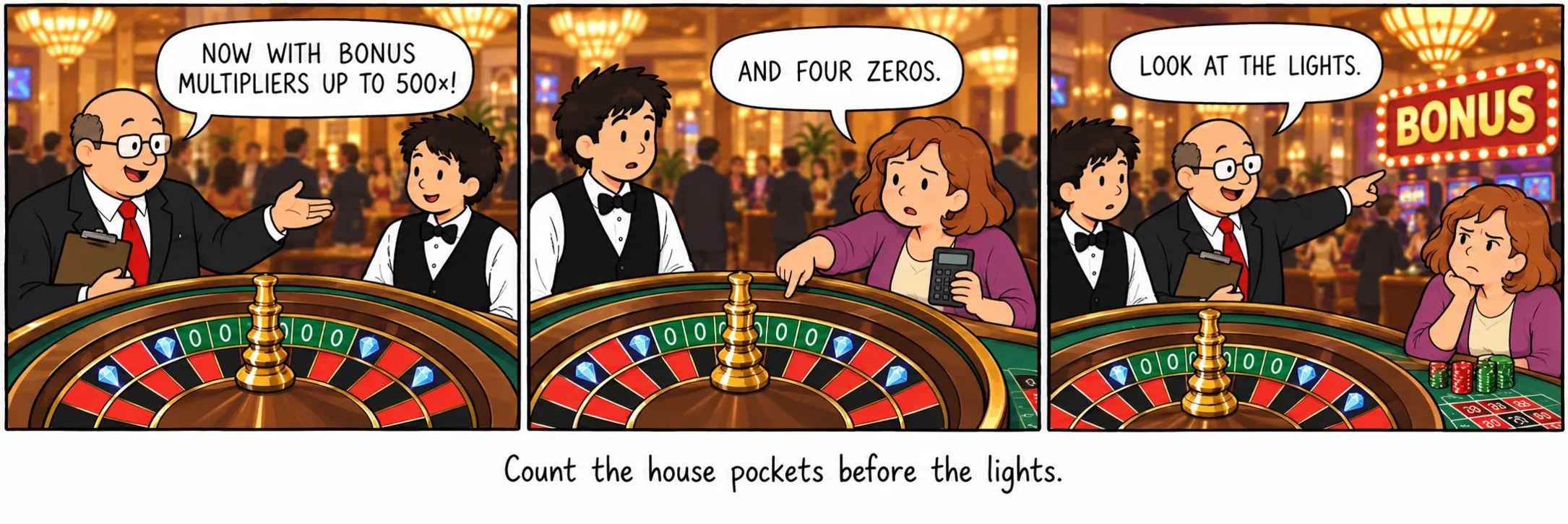
Calculate ordinary and bonus returns together.
Sources
- Bollman, M. Mathematics of the Big Four Casino Table Games: Blackjack, Baccarat, Craps, & Roulette.
- Singapore GRA, Sands Fast Action Roulette version 3 — effective March 2022
- John Mehaffey, Vegas Advantage, “Quadruple Zero Roulette Debuts on the Las Vegas Strip” — August 18, 2025; updated September 23, 2025
- Wizard of Odds. “Deal or No Deal Roulette.”