Roulette in Film
The wheel is cinema’s favorite way to show a character gambling with more than money.
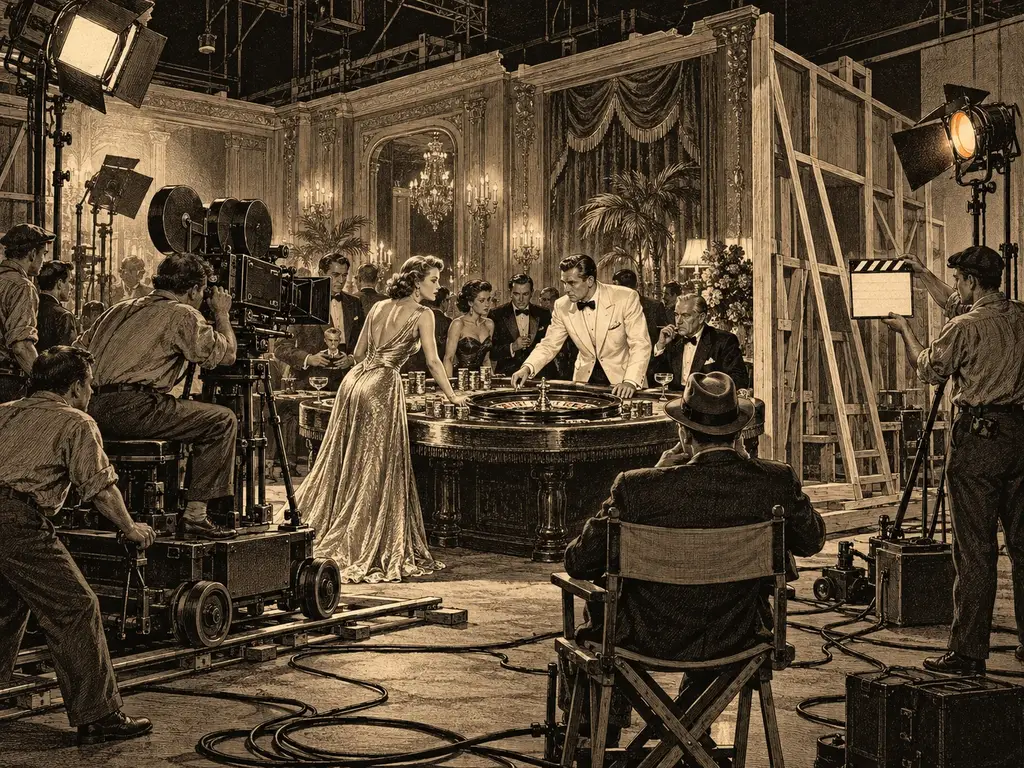
Roulette appears in films as a shorthand for fate, recklessness or cool. The bets are usually wrong, the odds are never mentioned, and the ball always lands in the last second. A few films get the table right.
What films show
A character places everything on one number (redbetRedEven-money bet on the 18 red numbers. French: rouge.Read full →, in a pinch), the wheel spins in slow motion, the ballequipmentBallThe small ball launched along the track against the rotor. Modern balls are ivorine or Teflon, 18–21 mm.Read full → bounces twice and lands. If the character is the hero, it hits; if the film is about ruin, it does not. The straight-up bet is chosen because it is legible: one chipmoneyChipA token representing a fixed amount, placed on the layout to make a bet. Also: check.Read full →, one number, one outcome. Nobody in a film has ever placed voisins du zéroFR · sectorVoisins du zéro“Neighbors of zero”: the seventeen numbers from 22 to 25 on the wheel, bet with nine chips.Read full →.
What films get wrong
The ball is launched after bets are shown being placed, which is right, but it lands within three seconds, which is not: a real spin lasts eight to twenty. Characters bet after the ball is slowing, which no dealer would allow. PayoutsmoneyPayoutWhat a winning bet returns, quoted as “X to 1” on top of the returned stake.Read full → are described loosely (“you just won a fortune” on a $100 chip at 35:1 is $3,500). And the wheel is almost always American on American sets and European in Europe, which is accurate, and the edge is never spoken aloud, which is also accurate to how people talk.
Casablanca, 1942
The one scene everyone remembers: the café owner tells a young husband to put his last chips on 22, and the croupierpeopleCroupierThe dealer at a roulette table.Read full → makes sure it hits, twice. It is the only famous film roulette scene in which the wheel is explicitly rigged, and it is rigged in the player’s favor. Audiences love it because it dramatizes what every player half-believes: that the result is a decision someone made. On a real wheel it is not.
Other scenes worth knowing
The Honeymoon Machine (1961) has two sailors borrow a Navy computer to beat a Venice casino’s wheel, the same year Thorp and Shannon tested a real one in Las Vegas. Thorp later pointed out that no computer can name the exact pocketequipmentPocketOne of the 37 numbered compartments on the rotor. Also: slot, cup.Read full →, because the bounce on the fretsequipmentFretThe metal divider between two pockets on the wheel.Read full → scatters the ball; physics can only favor a sectorwheelSectorA contiguous arc of pockets on the wheel, as distinct from a group on the layout.Read full →. Run Lola Run (1998) stakes 100 marks on 20, twice, and the film treats the outcome as willpower. Croupier (1998) is the rare film from the dealer’s side and gets the procedure right. Diamonds Are Forever and the Bond novels supply the 14-5-1 spread covered in the Strategy section. The Gambler (1974 and 2014) understands compulsion rather than roulette. Indecent Proposal (1993) uses the table as the moment a marriage is priced.
Casablanca: 22, rigged for the hero.
The Honeymoon Machine: a Navy computer picks the number.
Casino Royale (novel): Bond backs two dozens at the table maximum.
Diamonds Are Forever: Bond at the tables in Las Vegas.
The Gambler: James Caan; the game as compulsion.
Indecent Proposal: a million-dollar night at the tables.
Run Lola Run: 20, twice. Croupier: the dealer’s view, done properly.
Live-casino streams make real roulette a genre on video platforms.
Why it works on screen
A roulette spin is a complete story in fifteen seconds: stake, suspense, resolution. It needs no explanation and no opponent. The filmmaker controls the outcome, which is the one thing a real player cannot do, and the audience, who know the odds no better than the characters, accept the 2.70% shot landing as drama rather than fraud.
Questions
Croupier (1998) for procedure; The Gambler for the player’s state of mind.
Only as a rigged wheel. On a fair wheel 22 twice running is 1 in 1,369.
Some do, after hours. Most film tables are sets with real dealers hired as consultants.
Comic relief
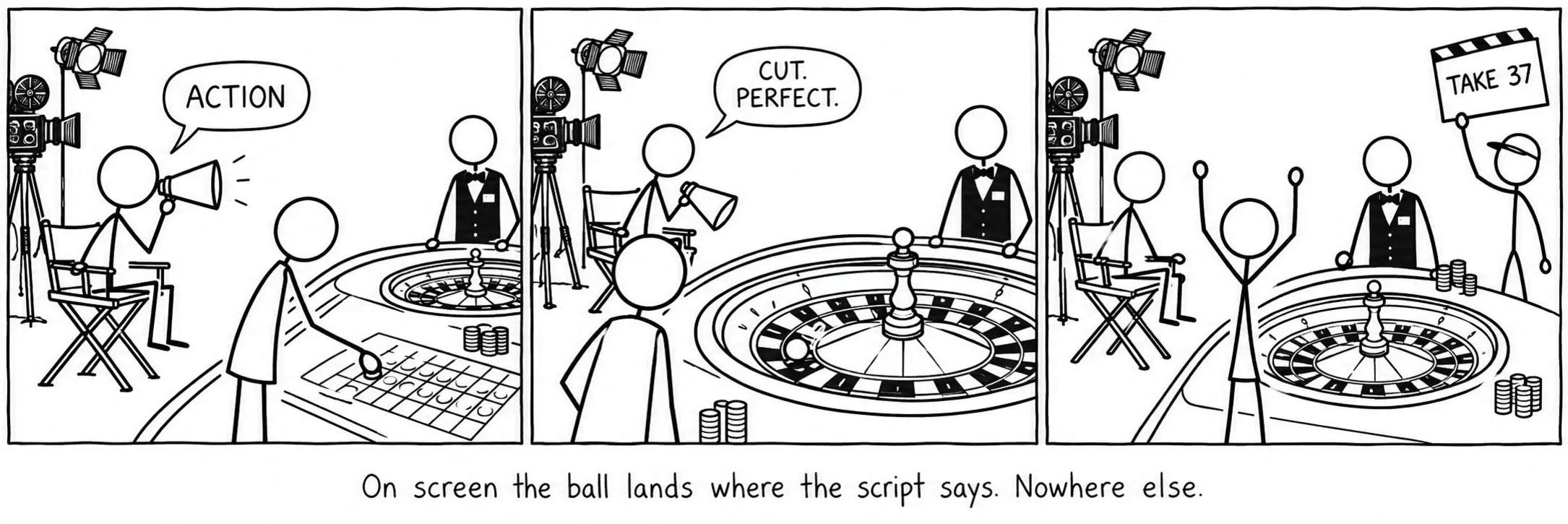
On screen the ball lands where the script says. Nowhere else.
Sources
- Schwartz, D. G. Roll the Bones: The History of Gambling.
- Kavanagh, T. M. Dice, Cards, Wheels: A Different History of French Culture.
- Thorp, E. O. The Mathematics of Gambling.