Problem: The Table Limit
A $10 Martingale at a $500 table. How often does it break, how much does it lose when it does, and does raising the limit help?
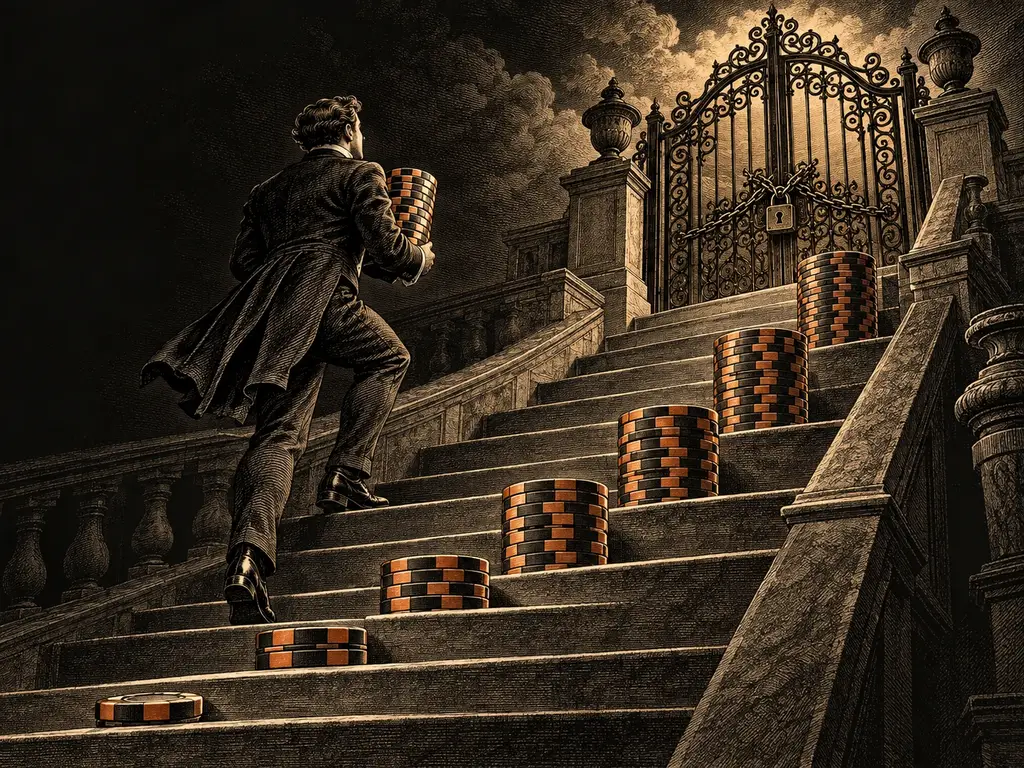
Six losses in a row break it: 1.8% per cycle, about 60% of 100-spin sessions. The break costs $630. Raising the limit to $5,000 makes the break rarer (0.25% per cycle) and bigger ($5,110). The expected loss per dollar wagered is 2.70% at any limit.
The problem
A player bets $10 on redbetRedEven-money bet on the 18 red numbers. French: rouge.Read full → and doubles after each loss, resetting after a win. The table maximum is $500. (a) How many consecutive losses break the progressionstrategyProgressionAny rule that changes the stake based on previous results. Negative progressions raise it after losses, positive after wins.Read full →? (b) What is the probabilitymathProbabilityChance of an outcome, from 0 to 1 or 0% to 100%. One number: 1/37 = 2.70%.Read full → per cycle? (c) What is lost at the break? (d) How does a $5,000 limit change the answers? (e) Does any limit make the system profitable?
Solutions (a)–(c)
Stakes: 10, 20, 40, 80, 160, 320. The seventh would be 640 > 500, so six losses break it. (b) p(loss) = 19/37 on red; (19/37)⁶ = 0.0183, about 1.8% per cycle. A cycle lasts about two spins on average, so a 100-spin session has roughly 50 cycles and p(at least one break) ≈ 1 − 0.9817⁵⁰ ≈ 60%. (c) 10 + 20 + 40 + 80 + 160 + 320 = $630, which is 63 base unitsmoneyUnitThe base stake a system or a player works in. Progressions are described in units so they apply at any table.Read full →, against the $10 the cycle was trying to win.
Solution (d)
At $5,000: stakes to 2,560 are allowed; the tenth stake, 5,120, is refused. Nine losses break it: (19/37)⁹ ≈ 0.25% per cycle, about 11% of 100-spin sessions. Loss at the break: 10 + 20 + … + 2,560 = $5,110. The player has bought a rarer catastrophe at the price of a larger one. Over many sessions the expected cost of breaks is p × loss ≈ 0.0183 × 630 = $11.5 per cycle at the $500 limit and 0.0025 × 5,110 = $12.8 at $5,000; it is, within rounding, the same number, and it is the expected lossmathExpected lossExpected value times total amount wagered; the average amount lost over a session or a period.Read full → of the cycle minus the $10 the winning cycles earn.
Solution (e)
No. Expected loss per cycle = (expected total stake in the cycle) / 37, at any limit, because each bet is −1/37 of itself. The limit only decides how the loss is distributed between many small wins and few large losses. With no limit and infinite bankrollmoneyBankrollThe total amount set aside for play. Bankroll management is deciding how much of it to risk per bet and per session.Read full → the progression would “work”, in the sense that it would never break, and it would also wager an unbounded amount with expected loss 2.70% of that unbounded amount. The table limittableTable limitMinimum and maximum bet allowed. The maximum is what stops doubling progressions.Read full → is not what stops MartingalestrategyMartingaleProgression that doubles the bet after each loss. See the Strategy section for what it does and does not do.Read full → from working. Arithmetic is.
Two real tables
Thorp’s example is a $1 table with a $1,000 maximum, where a player hopes to win $30 for dinner a dollar at a time. The stakes 1, 2, 4 … 512 allow ten bets, so ten losses in a row break the progression: once in 785 cycles on a European wheel (once in 613 on an American one), at a cost of $1,023. Thirty cycles all succeed 96.2% of the time. The other 3.8% lose about $1,000, and the average result of the evening is −$9.17, which is exactly 1/37 of the $339 the thirty cycles stake on average. A $5 table with a $2,000 maximum is no different: stakes up to $1,280 allow nine bets, and the break comes once in 403 cycles on a European wheel (once in 323 on an American one) and costs $2,555.
A rich player
Give the progression a deep bankroll instead of a low limit: 1,000 units, a one-unit base and 1,000 spins on red, starting again at one unit whenever the next double is more than what is left. We simulated a million such evenings. On a European wheel 52% finish ahead, 21% lose everything, and the average result is −124 units. Even in a game with no zerowheelZeroThe single green pocket that no even-money, dozen or column bet covers; the source of the house edge. Also: single zero, 0.Read full →, where every bet is fair, only about 60% would finish ahead. The usual evening is a small win; the average is paid for by the evenings that end at zero.
The lesson
Casinos set limits to cap their own variancemathVarianceA measure of how widely results spread around the expected value. High for straight up, low for even-money bets.Read full →, not to defeat systems. Defeating Martingale is a side effect they are happy to have, and the arithmetic would defeat it anyway. A player who thinks the limit is the problem has located the cliff and mistaken it for the slope.
Formula
Questions
It lets you survive to a higher limit, where the break is rarer and larger. The expected loss per dollar is unchanged.
Stakes 10, 30, 70, 150, 310: the $500 limit is hit after five losses, and the break costs $570. Same 2.70%.
So that one player cannot bet more than the casino’s reserve can comfortably pay. Variance management.
Fun with Math
Try these yourself first. Each solution is folded; open it when you are ready.
A MartingalestrategyMartingaleProgression that doubles the bet after each loss. See the Strategy section for what it does and does not do.Read full → starts at $100 on redbetRedEven-money bet on the 18 red numbers. French: rouge.Read full → and allows itself at most n bets a cycle: after n losses in a row it gives up and starts again. Write the average result of one cycle as a formula in n, and work it out for 5, 6 and 7 bets on a European wheel.
Show the solution
Answer The average is 100 × (1 − (38/37)ⁿ): −$14.26 for 5 bets, −$17.35 for 6 and −$20.52 for 7. Allowing more bets makes the average cycle worse, not better.
A cycle wins $100 unless all n bets lose, which happens with chance qⁿ, where q = 19/37. When they all lose, the stakes 100, 200 … 100 × 2ⁿ⁻¹ add up to 100 × (2ⁿ − 1). So the average is 100 × (1 − qⁿ) − 100 × (2ⁿ − 1) × qⁿ = 100 × (1 − (2q)ⁿ).
Here 2q = 38/37, a little more than 1, so (2q)ⁿ grows with n and the average falls: n = 5 gives 1.1426 and −$14.26; n = 6 gives 1.1735 and −$17.35; n = 7 gives 1.2052 and −$20.52. A longer ladder loses less often, in 3.6%, 1.8% and 0.9% of cycles, but each loss is twice as large, and more money crosses the table each cycle, at 2.70% of every bet.
On an American wheel 2q = 40/38 and the figures are −$29.24, −$36.04 and −$43.20 (Taylor, 2021). In a game with no zerowheelZeroThe single green pocket that no even-money, dozen or column bet covers; the source of the house edge. Also: single zero, 0.Read full → 2q = 1, and every cycle averages exactly zero however long the ladder.
The “grand Martingale” doubles the stake after a loss and adds one unitmoneyUnitThe base stake a system or a player works in. Progressions are described in units so they apply at any table.Read full →, so the stakes run 1, 3, 7, 15, 31 … How much are you up when the first win comes on the 1st, 2nd, 3rd or kth bet? At a $10 unit and a $500 maximum, how often does a cycle break, and what does a cycle cost on average?
Show the solution
Answer A win on the kth bet leaves you k units up: +1, +2, +3 and so on. At $10 and $500 the cycle breaks after five losses, 3.57% of cycles, for −$570. On average a cycle loses $2.32 out of $85.73 staked: 2.70%.
The kth stake is 2ᵏ − 1 units: 1, 3, 7, 15, 31. The first k − 1 stakes add up to 2ᵏ − 2 − (k − 1) = 2ᵏ − k − 1. A win on the kth bet pays 2ᵏ − 1, so the cycle ends (2ᵏ − 1) − (2ᵏ − k − 1) = k units up: one extra unit for every loss before the win.
At $10 a unit the stakes are $10, $30, $70, $150 and $310; the next, $630, is over the $500 maximum. Five losses in a row, (19/37)⁵ = 3.57%, cost 10 + 30 + 70 + 150 + 310 = $570.
Average: the wins bring in $10 × k with chance (19/37)ᵏ⁻¹ × 18/37 for k = 1 to 5, and the break takes $570 with chance 3.57%; together −$2.32. The money staked averages $85.73 a cycle, and 2.32/85.73 = 2.70%. The ordinary Martingale at the same table breaks after six losses, 1.83% of cycles, for −$630, and loses $1.74 out of $64.20 staked: 2.70% again.
A player plans a Martingale on red with a $1 first bet at a table whose limit is $1,000, so ten bets are possible: $1, $2, $4 and so on up to $512. How often does a cycle lose all ten, how long does that take on average, and how often does an evening of 200 bets end that way?
Show the solution
Answer A cycle loses all ten about once in 784, which costs $1,023. That is about 1,600 bets on average, and an evening of 200 bets hits the wall about 11% of the time. A cycle still loses $0.31 on average out of $11.31 staked: 2.70%.
A bet on red loses with chance 19/37, the zero included. Ten in a row: (19/37)¹⁰ ≈ 0.00128, about 1 in 784. The stakes 1 + 2 + 4 + … + 512 add up to $1,023.
A cycle takes 2.05 bets on average, so 784 cycles take about 1,600 bets. Counted spin by spin, a run of ten losses turns up somewhere in 200 bets 11.3% of the time.
Between disasters the player wins $1 a cycle: about $783 before the bad one, then −$1,023, about −$240 over the whole stretch. Per cycle: 1 × (1 − 0.00128) − 1,023 × 0.00128 ≈ −$0.31. Money staked per cycle: 1 + 2 × (19/37) + 4 × (19/37)² + … + 512 × (19/37)⁹ ≈ $11.31. And −0.31/11.31 = −2.70%.
Compare a $10 first bet at a $500 limit, six bets: the wall comes once in 55 cycles, and an evening of 200 bets meets it 84% of the time. A higher limit makes the crash rarer and larger, not cheaper.
Comic relief
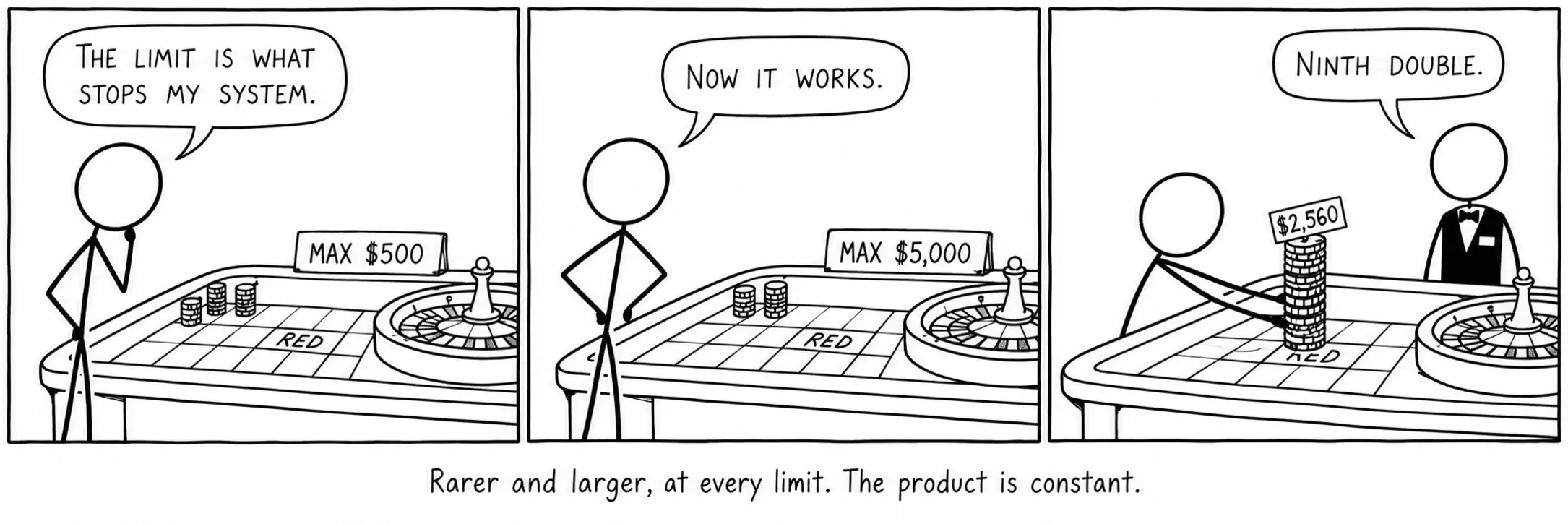
Rarer and larger, at every limit. The product is constant.
Sources
- Ethier, S. N. The Doctrine of Chances: Probabilistic Aspects of Gambling.
- Thorp, E. O. “Optimal gambling systems for favorable games.”
- Thorp, E. O. The Mathematics of Gambling.
- Epstein, R. A. The Theory of Gambling and Statistical Logic, 2nd ed.