Independent Roulette Spins
What it means to model roulette spins as independent events.

In the standard model, knowing earlier outcomes does not change the next spin’s probabilities. Independence and equal pocket probabilities are assumptions to check when studying a real wheel or software game.
What independence means
For independent spinsmathIndependent spinsSpins for which learning an earlier outcome does not change the probabilities assigned to a later one.Read full definition → on a fair single-zerowheelZeroThe 0 outcome, conventionally shown in green. Ordinary color, parity, high/low, dozen and column bets do not include it.Read full definition → wheel, p(redbetRedAn even-money wager on the 18 red numbers. French: rouge.Read full definition → on spin 2 | red on spin 1) = p(red) = 18/37. Knowing the earlier result leaves the probabilitymathProbabilityA measure of how likely an event is, from zero to one. Percentages express the same scale from 0% to 100%.Read full definition → unchanged. Hot and cold numbersmythCold numberA number that has appeared infrequently, or not at all, in a chosen record. Its history does not change the next outcome on independent fair spins.Read full definition → describe a recorded sample; those labels alone do not forecast the next spin. Under independence, the probability of a specified sequence is the product of its single-spin probabilities.
What a physical wheel can tell us
A physical wheel is governed by motion, not by a rule that compensates for recent results. That does not prove exact statistical independence. Research by Small and Tse (2012) shows that measurements of a ballequipmentBallThe small ball that settles in a numbered pocket to determine a physical roulette result.Read full definition → and wheel during a spin can contain predictive information. Such measurements differ from simply observing that red has appeared several times.
| claim | true? | why |
|---|---|---|
| earlier outcomes change the next probability | not in the independent model | this is the defining assumption |
| a number becomes “due” after an absence | no, under this model | its next-spin probability stays the same |
| a pocket could be more likely than 1/37 | possible on a biased wheel | unequal probabilities do not necessarily imply dependence |
| a past streak proves a physical prediction method | no | the method needs separate evidence |
What follows from it
For standard single-zero bets under this model, every unitmoneyUnitA base amount used to express stakes or results.Read full definition → staked has an expected lossmathExpected lossThe probability-weighted average net loss under a stated model. With a constant edge, it equals edge times expected total stakes.Read full definition → of 1/37. Choosing a bet or stake from past results does not alter that conditional expected loss per unit. A progressionstrategyProgressionA rule that changes stakes over a sequence of bets, often using previous wins or losses.Read full definition → can change the total amount wagered and the distribution of session results; it cannot turn those bets into positive-expectation bets.
When it would fail
Independence fails if knowing earlier outcomes changes the conditional distribution of a later one. Bias is a separate issue: spins can be independent even if some pocketsequipmentPocketA compartment on the rotor in which the ball can settle. The number of pockets depends on the wheel.Read full definition → are more likely than others. Changing conditions, serial dependence and unequal pocket probabilities require different tests. Earlier results can provide evidence about an unknown wheel without making an absent number due.
Independence is an assumption
The general multiplication rule is p(A and B) = p(A) × p(B | A). Only with independence can p(B | A) be replaced by p(B). The Royal Statistical Society’s 2001 statement on the Sally Clark case illustrates why that distinction matters. It criticized a calculation that squared the chance of one sudden infant death to estimate two deaths within a family. Shared genetic or environmental factors could invalidate the independence assumption. The statistical lesson is to justify independence before multiplying marginal probabilities.
Independence and RNG tables
For games subject to Great Britain’s remote technical standards, the Gambling Commission requires acceptably random outcomes, appropriate outcome distributions and unpredictability, and prohibits compensated behavior that adjusts probabilities to past results. Testing requirements depend on the jurisdiction and product. A wheel animation does not establish that a game has been tested; check the applicable rules and testing information.
Questions
A results streak does not demonstrate that a dealer can aim at a pocket or sectorwheelSectorA continuous arc of neighboring pockets around the wheel, rather than a group defined by the betting layout.Read full definition →. Claims about controlled releases need evidence from the specific wheel and conditions; see the Lab discussion of dealer signatures.
A short results board does not make a number due. A sufficiently large, reliable record from an identified wheel can help test a specific bias hypothesis, but the required sample depends on the effect size and test.
Fun with Math
Try these yourself first. Each solution is folded; open it when you are ready.
A bet placed before two spins pays even money if the second number is higher than the first. A tie loses, and 0 counts as the lowest number. What does it cost on a European wheel?
Show the solution
Answer Exactly 2.70%, the same as redbetRedAn even-money wager on the 18 red numbers. French: rouge.Read full definition →.
The two spins are independent and have the same uniform distribution, so exchanging their order shows that the second is as likely to be higher as lower. The only other case is a tie, the same number twice, with probabilitymathProbabilityA measure of how likely an event is, from zero to one. Percentages express the same scale from 0% to 100%.Read full definition → 1/37.
So the bet wins with probability (1 − 1/37)/2 = 18/37, exactly the chance of red, and costs the same 2.70%.
If the same even-money betbetEven-money betA bet paying a profit equal to the stake, such as red/black, odd/even or high/low.Read full definition → were offered after the first number was known, its expected valuemathExpected valueThe sum of each possible net result multiplied by its probability. It can be positive, zero or negative.Read full definition → would depend on that number. After 0 it would win with probability 36/37, giving a positive player expectation. That is a different bet from the one placed before both spins.
Comic relief
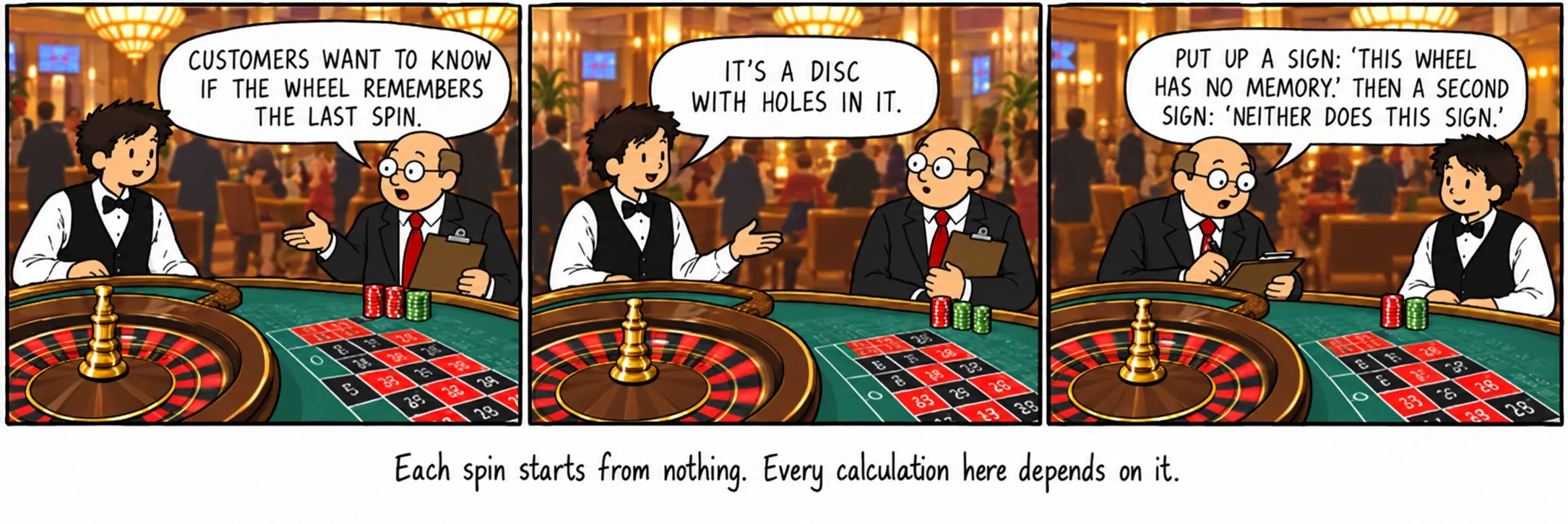
In the independent-spin model, earlier results do not change the next spin’s probabilities.
Sources
- Feller, W. An Introduction to Probability Theory and Its Applications, Vol. 1.
- Small, M. & Tse, C. K. “Predicting the outcome of roulette.”
- Royal Statistical Society. “Statement regarding statistical issues in the Sally Clark case.”
- Gambling Commission. RTS 7 — Generation of random outcomes.