Roulette Dozen Bet
A roulette dozen bet covers twelve consecutive numbers: 1–12, 13–24 or 25–36.
Twelve numbers, pays 2:1. ProbabilitymathProbabilityA measure of how likely an event is, from zero to one. Percentages express the same scale from 0% to 100%.Read full definition → 32.43%. Zero loses.
Where are the dozens on a roulette table?
The three boxes along the long side of the layoutequipmentLayoutThe marked betting surface, whether printed on a table or displayed on a screen.Read full definition →, marked 1st 12, 2nd 12, 3rd 12 or, on French tables, P12 (première), M12 (moyenne), D12 (dernière). Check how the table applies its minimum to outside betsbetOutside betA bet in the areas surrounding the numbered grid, including dozens, columns and the six even-money options.Read full definition →. ZerowheelZeroThe 0 outcome, conventionally shown in green. Ordinary color, parity, high/low, dozen and column bets do not include it.Read full definition → is in no dozenbetDozenA bet on 1–12, 13–24 or 25–36, ordinarily paying 2 to 1.Read full definition →.
Roulette dozen payout and expectation
Fair odds against twelve numbers in 37 are 2.083 to 1; the table pays 2. A $10 dozen that hits wins $20, plus the return of the $10 stake. Expected counts over 37 spins: 12 hits (+$240), 25 misses (−$250), net −$10.
| $10 × 100 spins | dozen |
|---|---|
| probability per spin | 32.43% |
| expected wins in 100 spins | 32.4 |
| expected result | −$27.03 |
| standard deviation | $140 |
| p(no win in 100 spins) | 0.000000% |
Two dozens at once
Covering two dozens with equal chipsmoneyChipA token used to place a wager, with a printed or assigned value. Also called a check in some casino terminology.Read full definition → wins 24 of 37 spins (64.9%) but nets only one unitmoneyUnitA base amount used to express stakes or results.Read full definition →: you win 2 on one and lose 1 on the other. The 13 losing spins cost two units each. (24 × 1 − 13 × 2)/37 = −2/37 per two units, the usual 2.70%. The shape is attractive, a win nearly two spins in three, and the edge is unchanged.
| $10 on each of two dozens | outcome | probability | result |
|---|---|---|---|
| ball in a covered dozen | win one, lose one | 64.86% | +$10 |
| ball in the third dozen | lose both | 32.43% | −$20 |
| zero | lose both | 2.70% | −$20 |
| expected per spin | −$0.54 |
Roulette dozens and progressions
For a single dozen paying 2:1, doubling after losses would more than recover previous losses if a win arrives before funds or limits run out. For two dozens backed equally, a winning spin nets one chip while a losing spin costs two; tripling each chip after a loss would recover the sequence, subject to those same constraints. Neither progressionstrategyProgressionA rule that changes stakes over a sequence of bets, often using previous wins or losses.Read full definition → changes the house edgemathHouse edgeThe casino’s expected net gain expressed as a fraction of the stake, under specified probabilities and payouts.Read full definition →. Rotating which dozen to leave out does not predict the next independent spin.
On the wheel
The twelve numbers of a dozen are scattered around the rim; the first dozen occupies pocketsequipmentPocketA compartment on the rotor in which the ball can settle. The number of pockets depends on the wheel.Read full definition → at 1, 2, 3, 4, 5, 6, 7, 8, 9, 10, 11, 12 which sit at positions spread across the whole wheel. A dozen is a layout bet with no physical sectorwheelSectorA continuous arc of neighboring pockets around the wheel, rather than a group defined by the betting layout.Read full definition →, so it should not be confused with a contiguous group of wheel pockets.
Questions
No. On a fair single-zero wheel, each dozen has the same 12/37 chance on every spin. Previous results and popular choices do not change it.
Yes, and you will win one and lose two on 36 of 37 spins, and lose all three on zero.
Both cover twelve numbers. The payoutmoneyPayoutThe amount paid on a winning wager. Check whether the quoted figure is net profit or total return including the stake.Read full definition → rule only counts coverage.
Comic relief
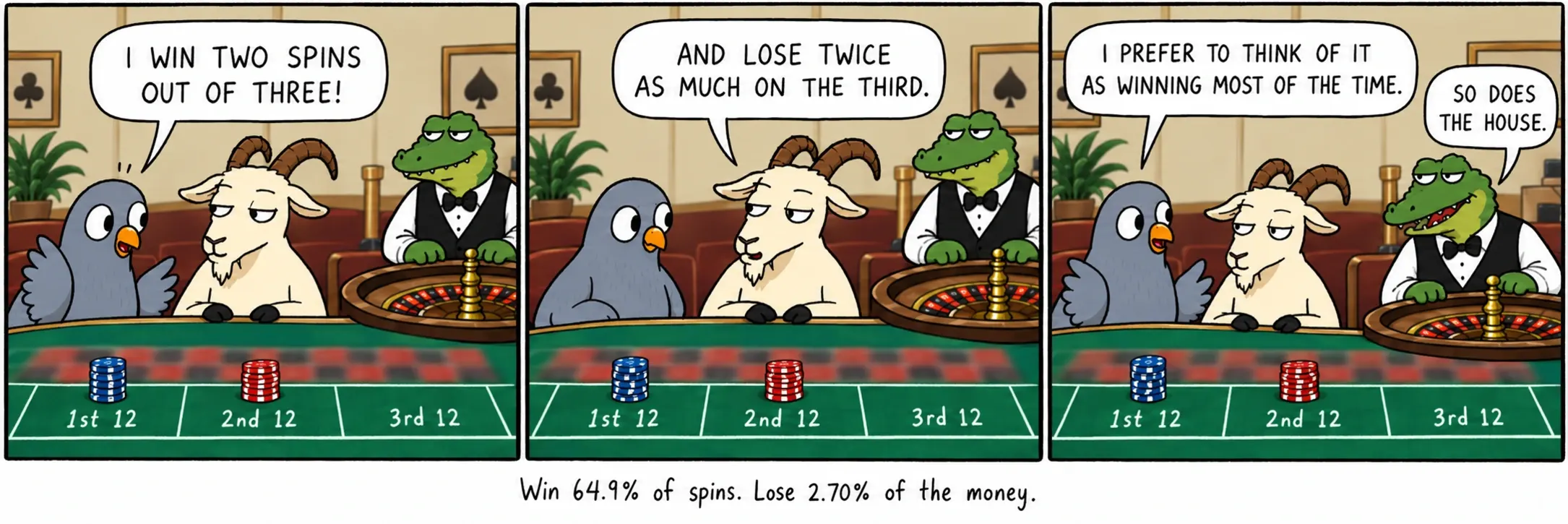
Two dozens win on 24 of 37 outcomes. The expected loss is 2.70% of the amount wagered.
Sources
- Ethier, S. N. The Doctrine of Chances: Probabilistic Aspects of Gambling.