Problem: How Long Until Zero
Zero hits one spin in 37 on average. How long do you actually wait, and what does that do to an even-money bettor?
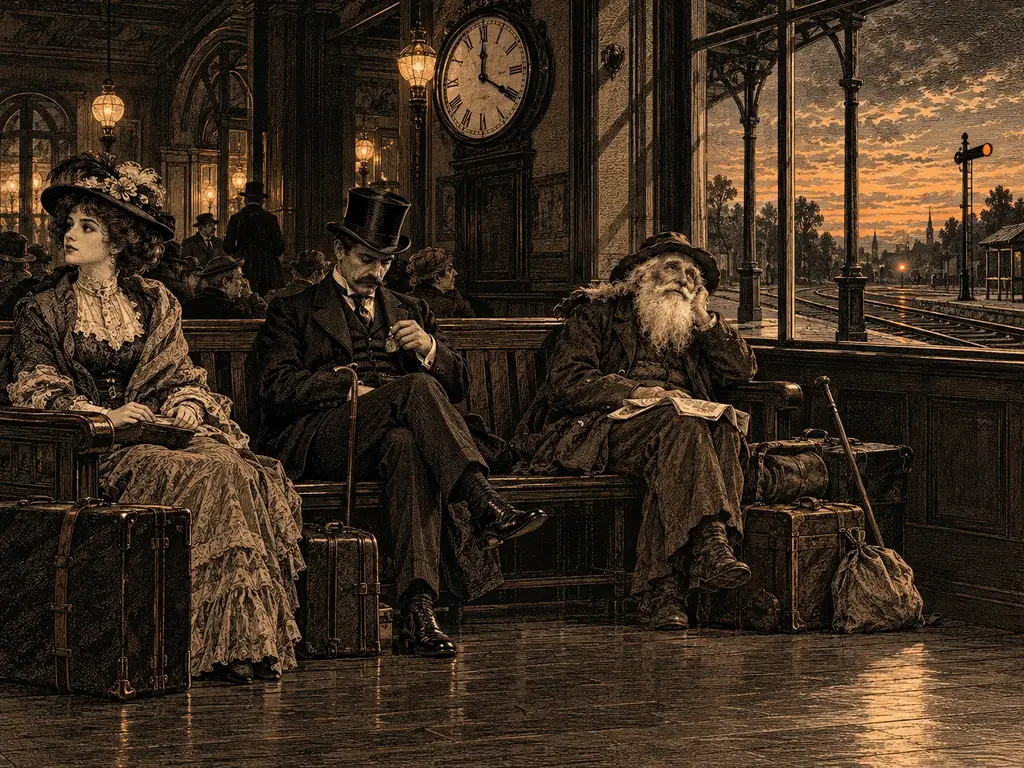
The wait for zero is geometric: mean 37 spins, median 25, and one wait in twenty exceeds 110 spins. Over a 200-spin session an even-money bettor expects 5.4 zeros and will see anywhere from 1 to 10.
The problem
ZerowheelZeroThe single green pocket that no even-money, dozen or column bet covers; the source of the house edge. Also: single zero, 0.Read full → has probabilitymathProbabilityChance of an outcome, from 0 to 1 or 0% to 100%. One number: 1/37 = 2.70%.Read full → 1/37 per spin. (a) What is the probability of no zero in the next 37 spins? (b) What is the median wait? (c) Over a 200-spin even-money session, how many zeros should a player expect, and what is the range?
Solutions
(a) (36/37)³⁷ = 36.3%. More than a third of the time, 37 spins pass with no zero at all, which is the same arithmetic as “at least one hit on a straight upbetStraight upA single number, pays 35:1.Read full → in 37 spins” being only 63.7%. (b) The wait W is geometric; p(W > k) = (36/37)ᵏ; the median is the k where this crosses 0.5, which is k ≈ 25. Half the waits are 25 spins or shorter and half longer; the mean of 37 is pulled up by the long tail. (c) Zeros in 200 spins are binomial with mean 200/37 = 5.4 and standard deviationmathStandard deviationSquare root of variance; the typical distance of a result from the expected value.Read full → √(200 × (1/37) × (36/37)) ≈ 2.3. A 95% range is roughly 1 to 10.
What zero costs an even-money bettor
Each zero costs one stake, and zeros are the whole edge on redbetRedEven-money bet on the 18 red numbers. French: rouge.Read full →: over 37 average spins the 18 wins and 18 losses cancel, and the one zero is the −1/37. In a 200-spin session at $10, the expected 5.4 zeros cost $54, which is exactly 200 × $10 / 37. A session with 2 zeros has had $34 of good luck; a session with 9 zeros has had $36 of bad luck, and will feel rigged. On a la partageruleLa partageFrench rule: when zero hits, half of an even-money stake is returned. Halves the house edge on those bets to 1.35%.Read full → table each zero costs half a stake and the figures halve.
The follow-up
What is the probability of two zeros in a row? (1/37)² = 1/1,369. In a casino running 20 tables at 50 spins an hour, that is about one double zerovariantDouble zeroThe 00 pocket of the American wheel. Its presence raises the house edge from 2.70% to 5.26%.Read full → somewhere every 1.4 hours. Players who see it conclude the wheel is broken; the arithmetic says it is Tuesday.
Try it
The Session Simulator counts zeros per session. Run 100 spins a few hundred times and plot the count: the histogram above will appear, with its long right tail. The tail is where the stories come from.
Formula
Questions
Not on a fair one. On a biased wheellabBiased wheelA wheel whose physical defects make some pockets more likely than 1/37. Rare, detectable only with thousands of recorded spins.Read full → any pocketequipmentPocketOne of the 37 numbered compartments on the rotor. Also: slot, cup.Read full → could be, and it would take thousands of spins to tell.
It is a 2.70% bet like every other. It changes the shape of the session (a zero becomes a win) and not the cost.
Because the distribution of waits is skewed: many short waits, a few very long ones.
Comic relief
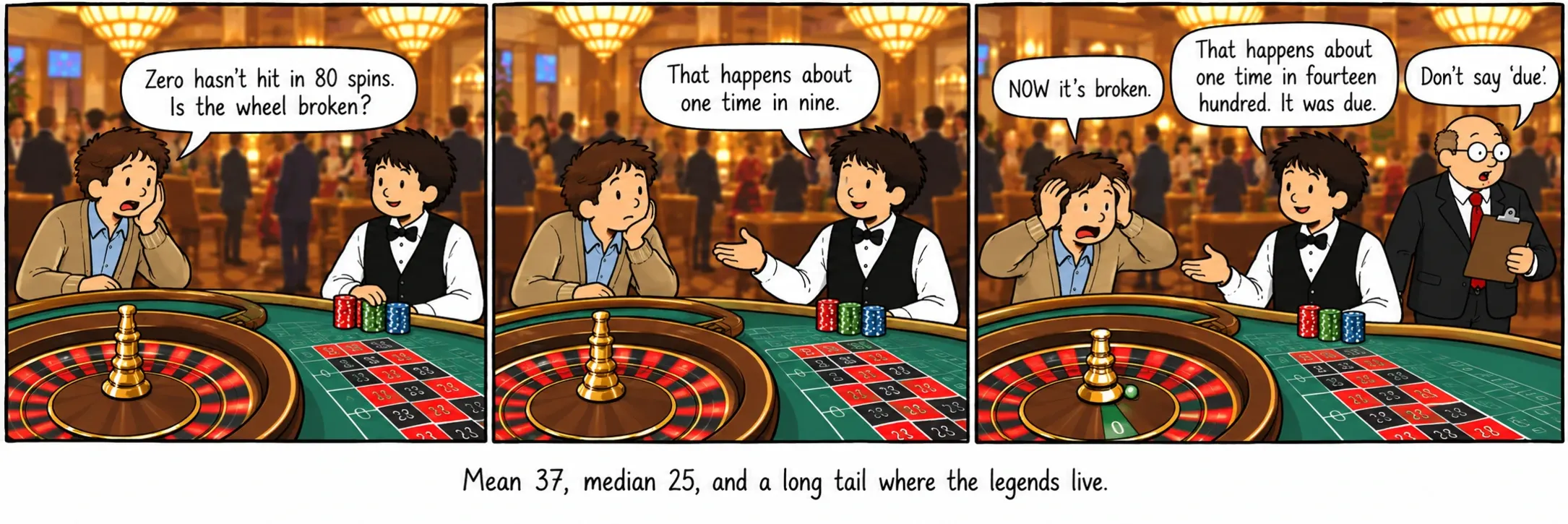
Mean 37, median 25, and a long tail where the legends live.
Sources
- Feller, W. An Introduction to Probability Theory and Its Applications, Vol. 1.
- Ethier, S. N. The Doctrine of Chances: Probabilistic Aspects of Gambling.