A Dealer’s Shift
Eight hours, several hundred spins, three or four tables, and a lot of standing. What a roulette dealer’s day actually consists of.
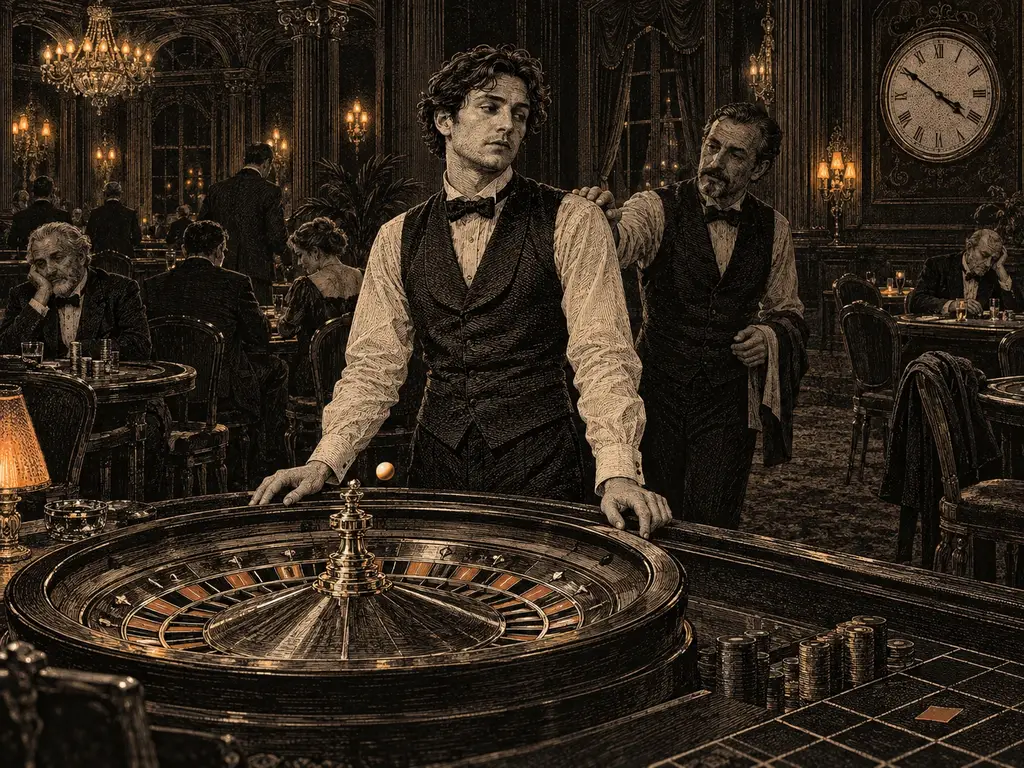
A composite account of a dealer’s shift on a European casino floor or in a live studio: the briefing, the rotations, the procedure repeated several hundred times, the disputes, the regulars, and what dealers think about while the ball is in the air.
Before the floor
A dealer arrives, signs in, and is assigned a string of tables for the shift. On a casino floor the pit boss briefs on minimums, any players to watch and any wheel that has been serviced. In a studio the briefing covers which markets the table serves tonight, the language of the stream, and the betting-window timings the server will enforce. Uniform, hands checked (no rings that could flick a chipmoneyChipA token representing a fixed amount, placed on the layout to make a bet. Also: check.Read full →, no long sleeves), and onto the first table.
The rotation
Twenty to forty minutes at a table, then a “tap out” as a colleague arrives, a break or a move to the next table. Rotation exists for the dealer’s concentration and for the house’s protection against dealer signatures, collusion and fatigue. A dealer may work three or four tables in a shift and never see the end of any player’s session.
Sign in, briefing, assignment: three roulette tables and a break pattern.
Table 1. Quiet start. Buy-ins, color chips, a regular who bets voisins every spin.
Tap out, table 2. Busy. Twelve players, chips flying, “no more bets” said with intent.
Break. Water, sit down, nothing to do with chips for twenty minutes.
Table 3. A dispute: a late chip. Pit boss reviews camera; chip returned.
Table 1 again. The voisins player is up $400 and tells the dealer his system.
Studio shift (alternative): camera 3 to the left, chat in three languages, the server closes bets at the launch.
Last table. The voisins player is down $600 and has stopped explaining.
Count, sign out. Several hundred spins. Legs ache. Same again tomorrow.
The procedure, several hundred times
Lift the dollyequipmentDollyThe marker placed on the winning number on the layout while bets are settled.Read full →, open bets, push the rotorequipmentRotorThe spinning part of the wheel that carries the pockets.Read full →, launch, watch, wave, call, announce, dolly, sweep, pay outside, pay inside, lift. Dealers are trained to the sequence until it is automatic, because the automaticity is what makes mistakes rare and audits clean. PayoutsmoneyPayoutWhat a winning bet returns, quoted as “X to 1” on top of the returned stake.Read full → are counted in stacks by sight; a 35:1 win on a $5 chip is paid as a cut stack of 175 without arithmetic. Good dealers are fast, accurate and dull, in that order.
Disputes and the pit
Most disputes are a chip placed after the call or a chip read as a splitbetSplitTwo adjacent numbers, pays 17:1.Read full → that the player meant as a straight upbetStraight upA single number, pays 35:1.Read full →. The dealer’s reading stands unless the pit boss, who can see the camera, overrules it. Dealers are trained not to argue and not to apologize; the camera decides. In a studio the chat moderator takes the equivalent role, and the recorded round is the evidence.
What dealers think about
The ballequipmentBallThe small ball launched along the track against the rotor. Modern balls are ivorine or Teflon, 18–21 mm.Read full →, mostly. Then the layoutequipmentLayoutThe printed betting grid on the table. Also: table, felt, cloth.Read full →, because the next payout is being read while the ball is still in the air. Then the players, in the way a bartender reads a bar: who is new, who is losing more than they planned, who will tip and who will blame the dealer. Dealers do not think about where the ball will land because they cannot affect it and because, after the first few thousand spins, they have stopped expecting it to mean anything.
The regulars
Every table has them: the voisins player, the system player with a notebook, the couple who bet their anniversary, the man who tips on every win and only on wins. Dealers like regulars who are pleasant and worry about regulars who are chasing. The house wants turnovermoneyTurnoverThe total amount wagered over a session or period, counting re-bet winnings. Also: handle, action.Read full →; the dealer wants a quiet shift; the two interests mostly coincide. Dealers see more roulette than any player ever will, and almost none of them play it.
Questions
Varies by country: a modest base plus tips (pooled in most of Europe, individual in the US). Studio dealers are salaried.
They stop hearing it. The phrase is a reflex by the second week.
Rarely. The ones who did usually stopped.
Comic relief
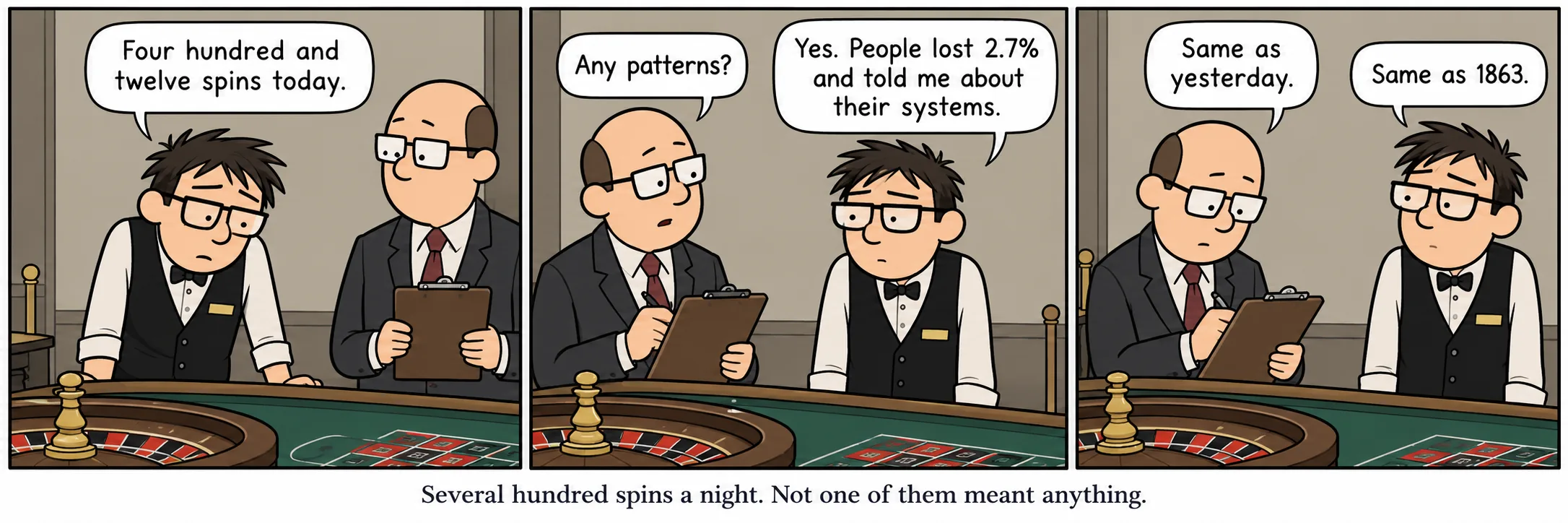
Several hundred spins a night. Not one of them meant anything.
Sources
- UK Gambling Commission. Remote gambling and software technical standards.
- Wykes, A. The Complete Illustrated Guide to Gambling.